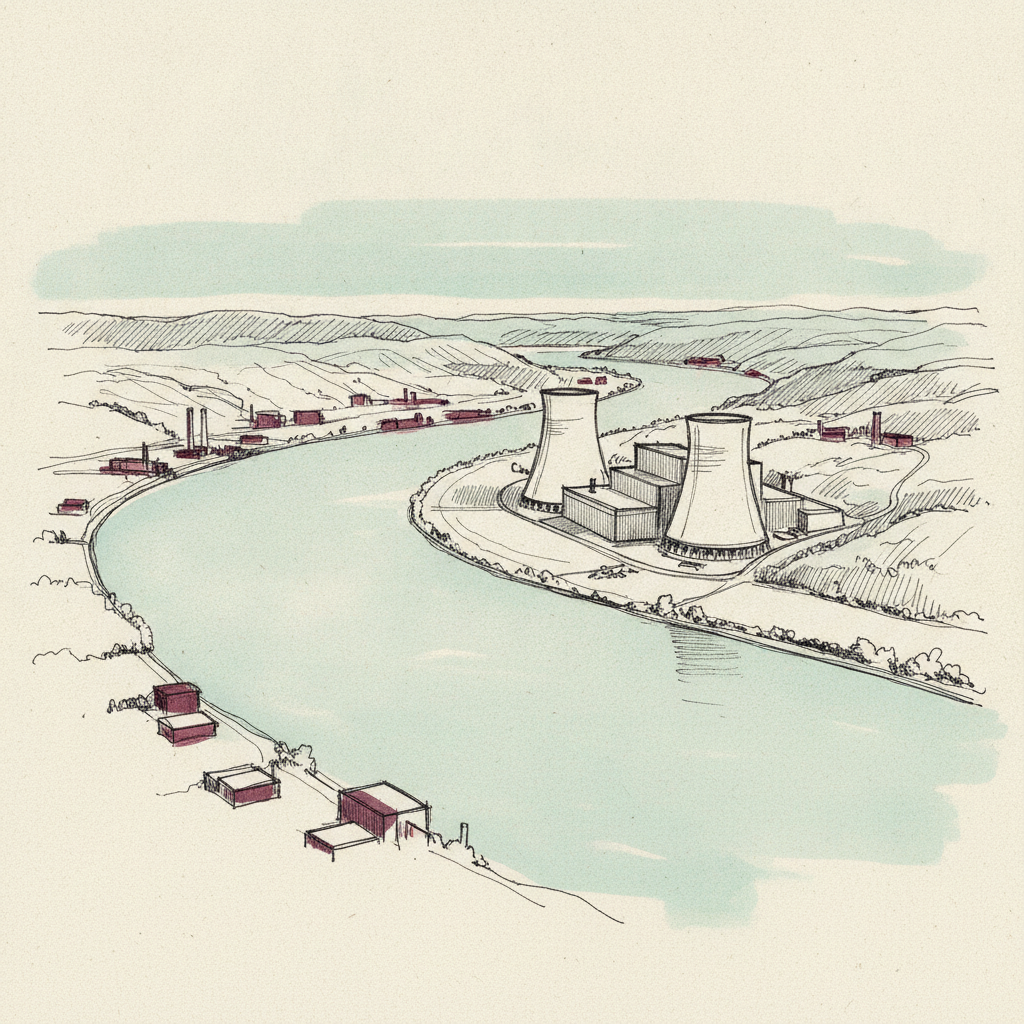
Why did a river force three French nuclear plants offline in July 2026?
Timeline for Meuse
Mentioned in: French heat flips the FR-DE spread
European Energy MarketsMentioned in: EDF adds Chooz to the curtailment list
European Energy MarketsBackground
The Meuse is a major western European river that rises on the Langres plateau in north-eastern France, flows through the Ardennes and Wallonia in Belgium, and continues into the Netherlands, where it is known as the Maas, before reaching the North Sea. Along its French stretch it supplies cooling water to EDF's Chooz nuclear power station, whose two 1,500 MW reactors depend on the river staying below regulatory temperature limits.
On 12 July 2026, French day-ahead power cleared roughly €7/MWh above German prices after EDF took Chooz fully offline, alongside Golfech and Bugey, citing cooling-water discharge limits during a heatwave. The spread had run €18-26/MWh in France's FAVOUR just a week earlier, on 5 July, before settling back to around €3/MWh by 13 July as river conditions eased.
The episode illustrates a structural vulnerability in French nuclear generation: reactors sited on smaller rivers such as the Meuse, rather than the SEA or a major waterway, are the first to face discharge-temperature curtailment in a heatwave. As European summers grow hotter, the Meuse's flow and temperature look set to recur as a swing factor in French power availability and, by extension, in cross-border electricity and gas pricing.
