Skip to content
Briefings are running a touch slower this week while we rebuild the foundations.See roadmap
European Energy Markets
4JUN

EDF March output highest since 2019

2 min read
10:45UTC

French nuclear is on track for 350-370 TWh this year and ran EUR 45 under Germany in Wednesday's day-ahead.

EconomicDeveloping
Key takeaway

French nuclear is the regional buffer until September, then one reactor less for a year.

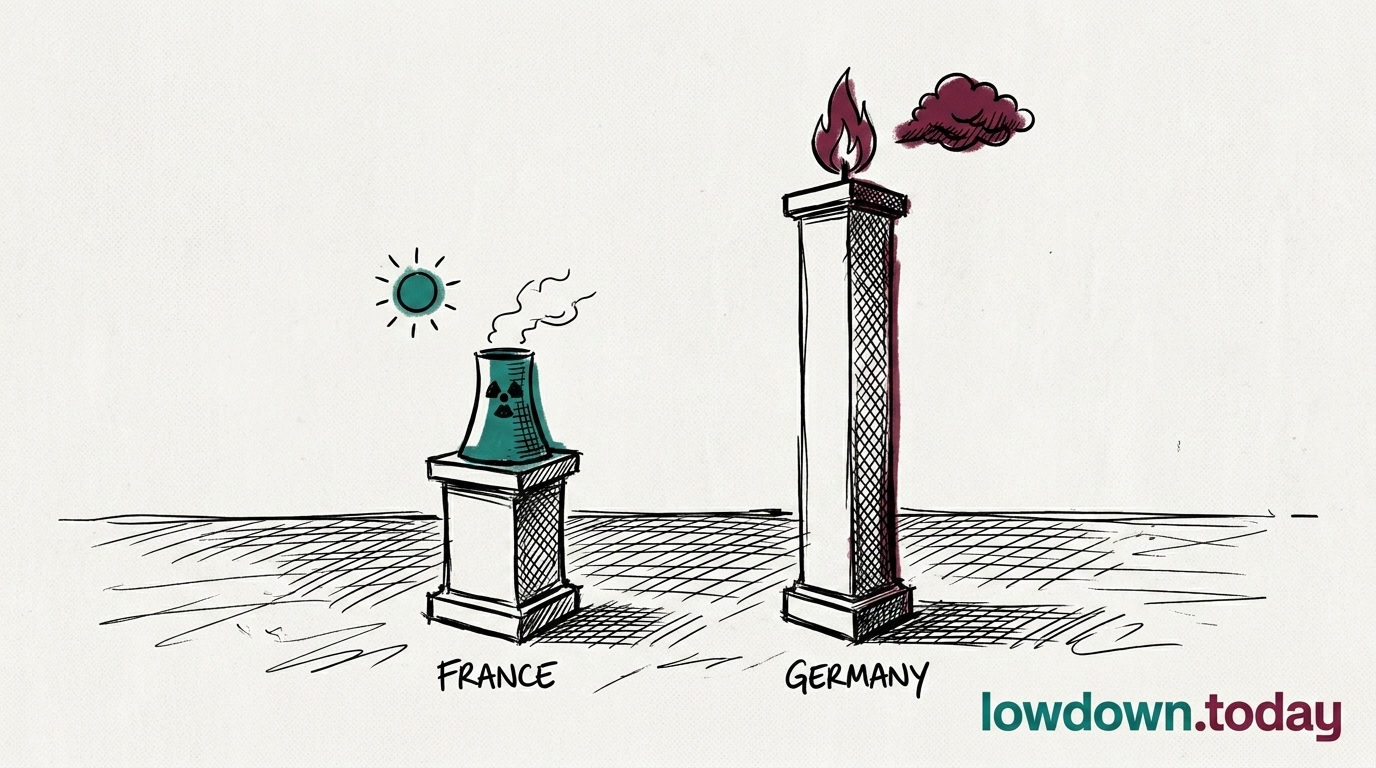
EDF's French nuclear fleet posted its highest monthly output since 2019 in March 2026 and is on track for 350-370 TWh full-year against a CRE-estimated average sale price of EUR 65.90/MWh under the new VNU mechanism 1. The fleet's output translated directly into wholesale prices on 15 April : France landed well beneath the German print and close to Spanish levels on the same session.

The operational effect is that French nuclear surplus is behaving like a southern-European supply asset rather than a domestic baseload. On a low-wind Iberian print the Franco-Iberian interconnector is the arbitrage; on a gas-set German print the north-south flow absorbs the German power premium. Both directions depend on the fleet holding availability through the heavy-maintenance window that typically begins in autumn.

Flamanville-3, France's newest reactor at roughly 1.6 GW, enters a one-year major overhaul from September 2026. That is one unit off the fleet through winter and into the next spring. The shortfall is material relative to the roughly 350-370 TWh target, and it is timed against the autumn-winter window when European storage is either high or exposed. If Germany's April injection fails to recover , the Flamanville-3 overhaul compounds a thin supply stack in the quarter when the stack matters most.

For utilities and industrial offtakers the picture through Q2 is a Franco-Iberian arbitrage while the fleet runs, followed by a material reduction in the regional buffer from September. Positions that lean on French surplus persisting through Q4 2026 need to price the Flamanville-3 calendar, not the March headline.


Deep Analysis

In plain English

France generates about 70% of its electricity from nuclear power stations, more than any other major economy. After several years of problems when safety inspectors found cracks in reactor components and forced many plants offline for repairs, French nuclear output has recovered strongly in early 2026. In March 2026, EDF (the French state utility that owns the nuclear fleet) achieved its highest monthly output since 2019. This matters beyond France because French power stations export surplus electricity to neighbouring countries, helping to keep prices lower in Germany, Spain, and Italy. However, there is a catch: Flamanville-3, France's newest and most powerful reactor, is scheduled for a major one-year overhaul starting September 2026. During that overhaul, France will lose a significant amount of generating capacity, which could raise power prices across the region heading into the following winter.

Deep Analysis
Root Causes

French nuclear's 2019-2022 output collapse had a specific engineering cause: stress corrosion cracking (SCC) found in the primary circuit elbows of PWR reactors, which required simultaneous inspections and repairs across the fleet.

EDF and the French nuclear safety authority ASN eventually developed a standardised repair protocol, allowing the fleet to restart systematically from 2023. The 2026 recovery to seven-year-high output is therefore not a permanent new normal but the completion of a multi-year repair cycle.

Flamanville-3's September 2026 overhaul is the European Pressurised Reactor (EPR), France's first new nuclear unit since 1999 and the first EPR to enter commercial operation anywhere in the world after extensive delays. Major overhauls on first-of-class reactors carry higher schedule risk than fleet maintenance because the repair tooling and procedures have not been standardised.

What could happen next?
  • Risk

    Flamanville-3's one-year overhaul from September 2026 removes the newest and highest-capacity reactor from the fleet precisely as winter 2026-27 demand rises, reducing France's export surplus and increasing Germany and Italy's gas-fired generation hours.

First Reported In

Update #2 · TTF EUR 42 as Russian LNG ban enters range

euenergy.live (ENTSO-E feed)· 15 Apr 2026
Read original
Different Perspectives
TTF traders / Amsterdam hub desks
TTF broke its 38-session EUR 46-47 band on 2 June to EUR 48.9 on stalled Iran diplomacy and an unconfirmed Troll A restart; Dutch EBN mandates carry storage trajectory while commercial injection books nothing. The 17 June pipeline expiry is the next binary level: Central European hub premium above EUR 2/MWh widens sharply on any physical step-down.
Red Electrica / Spanish grid operators
Spain logged 397 negative-price hours in Q1 2026, eight times the 48 hours of Q1 2025, documenting midday solar surplus now embedding structurally into Continental pricing. Spain is four to six quarters ahead of France and Germany on the solar-penetration curve, making it the clearest forward indicator of where Continental midday clearing is heading.
Equinor
Equinor
Equinor issued no Troll A restart notice through 4 June despite extending the combined outage to 31 May, keeping up to 51 mcm/day of Norwegian supply offline alongside Hammerfest LNG dark since 22 April. The company's silence follows its 2025 Hammerfest pattern, which ran 24 days past target, and each day without a notice sustains the TTF supply premium.
European Commission / GMTF
SWD(2026)147 found EU gas spot and derivatives markets functioning well on 2 June, recommending MiFID-REMIT legislative alignment rather than emergency intervention. The GMTF verdict addressed derivatives-market integrity, not the physical injection mechanism FNB Gas declared broken five days earlier: the Commission's immediate next step is a legislative proposal, not an emergency storage order.
FNB Gas / Bundesnetzagentur
FNB Gas declared the storage-refill mechanism broken on 27 May after zero bookings in January 2026 auctions, and German day-ahead cleared EUR 102.64 on 3 June on a CCGT stack set by TTF near EUR 49 plus EUA near EUR 78. Winter storage fill now depends on state mandates with no commercial self-correction.
EDF / French government
EDF held full-year nuclear guidance at 350-370 TWh after April output of 29.3 TWh, anchoring the surplus that collapsed French day-ahead to EUR 8.96 on 3 June and passed that price to VNU industrials. Flamanville-3's September overhaul removes 1.6 GW at heating-season onset, reversing the nuclear surplus that made VNU pricing competitive.
