Skip to content
You can now search across every topic, entity and event.What's new
European Energy Markets
26MAY

OIES base case becomes its stress case

3 min read
12:01UTC

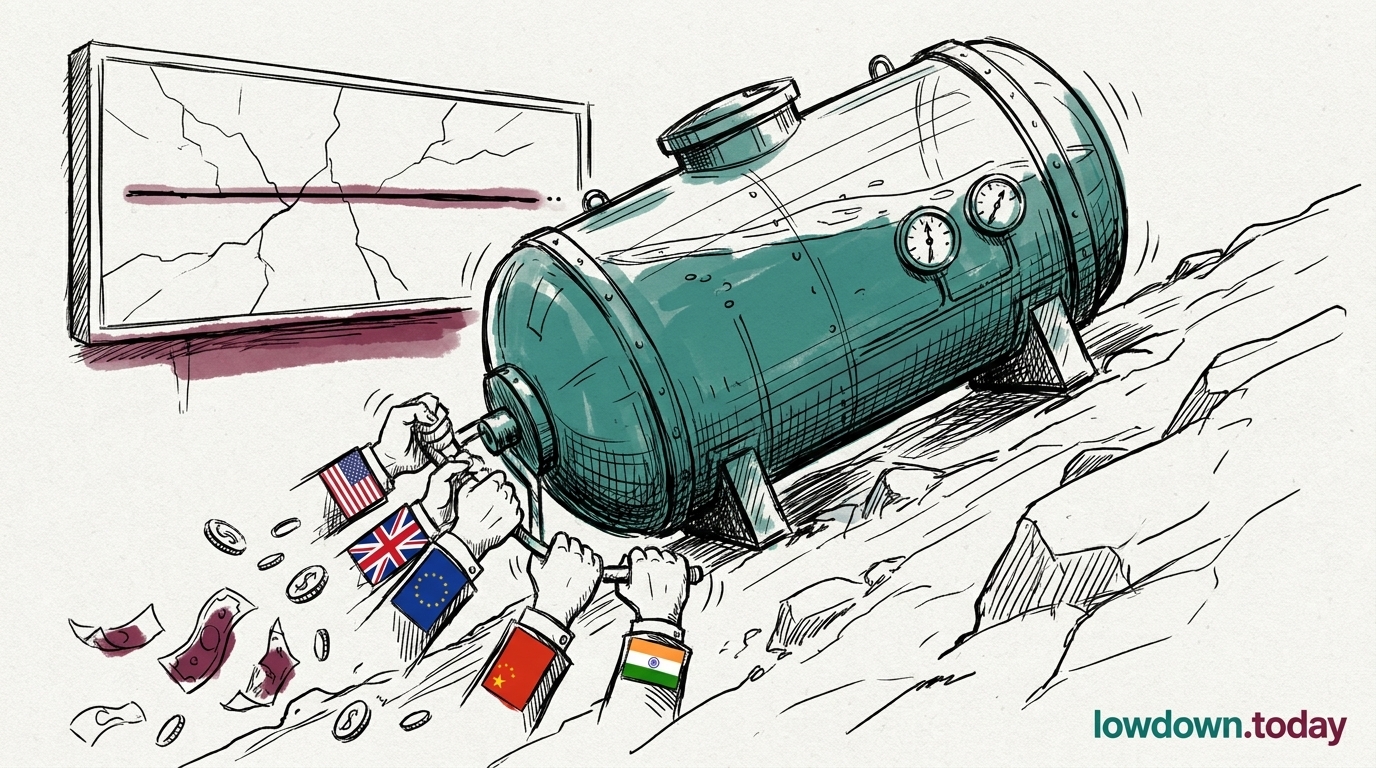
OIES charted EU storage to 74.3 bcm by 1 November on a mid-year Hormuz reopening; the 26-29 June Gulf round-trip knocked that base case out, leaving its stress case as the live path.

EconomicAssessed
Key takeaway

OIES's base case is dead; its closed-through-October stress case now sets Europe's autumn storage path.

The Oxford Institute for Energy Studies (OIES) built the base case of its June Comment on a mid-year reopening of the Strait of Hormuz, charting EU storage to 74.3 bcm by 1 November, or 69.6% fill 1. The 26 to 29 June escalation in The Gulf, followed by a verbal US-Iran stand-down, knocked that assumption out from under the model.

OIES is the energy research arm at Oxford whose storage notes set the reference path desks plan against. Its base case assumed the corridor would reopen mid-year, and the 17 June ceasefire that underpinned it collapsed within nine days . What the institute labelled its base case now reads as the optimistic leg, while the closed-through-October scenario it had sketched as a stress test becomes the line the autumn is measured against.

The 80% floor still needs 354.8 TWh more gas, from 549.62 TWh in store on 28 June 2. At the current net pace that gap closes around late September, comfortably before winter. The catch sits in the back half of the season: demand compresses the net rate through the autumn, and the cargoes meant to cover the September-October top-up are the very molecules Hormuz keeps throwing into doubt. OIES's own 2.1 bcm/month shortfall figure and Goldman Sachs's end-July normalisation window both now read as optimistic legs .

Deep Analysis

In plain English

The Oxford Institute for Energy Studies (OIES) is a research organisation that tracks global energy markets. In June 2026 they published a forecast saying Europe should have 69.6% of its gas storage full by 1 November, but that assumed the Strait of Hormuz, a narrow shipping lane in the Persian Gulf, would reopen to normal traffic by mid-year so that liquefied gas tankers from Qatar could resume deliveries. Between 26 and 29 June, tensions in the Hormuz area escalated again and then partially eased via a verbal agreement, but the lane did not fully reopen. OIES's own worst-case scenario, which assumed the strait stayed closed through October, is now the most realistic trajectory. Two Qatar production facilities were also physically destroyed by missiles and cannot restart for years regardless of diplomacy. Europe needs to find about 355 terawatt-hours of gas before November, and getting there depends on whether gas tanker routes stay clear long enough for deliveries to arrive in September and October.

Deep Analysis
Root Causes

The OIES June Comment base case embedded two assumptions that the 26-29 June round-trip broke simultaneously. First, it assumed that the 17 June US-Iran memorandum would hold long enough to allow Hormuz commercial traffic to normalise before July and trigger QatarEnergy's 50%-capacity restart clock.

The nine-day ceasefire that preceded the 26-29 June re-escalation ran for less than a fortnight before traffic was again disrupted, confirming the corridor was not on a stable reopening trajectory.

Second, the OIES base case did not price the two-train structural destruction at Ras Laffan: even full Hormuz transit normalisation cannot restore more than 80% of Qatar's pre-conflict LNG capacity until physical train reconstruction completes, a timeline running to years not months.

Goldman Sachs had flagged this constraint when pushing its own LNG normalisation timeline from end-June to end-July . The October top-up window is therefore bounded above by a physical supply ceiling that persists regardless of diplomatic outcomes.

What could happen next?
  • Risk

    If OIES's closed-through-October stress scenario is the live trajectory, EU aggregate fill may reach only 70-72% by 1 November, 8-10 percentage points below the statutory 80% floor, triggering EU emergency gas coordination under Regulation 2022/1369.

    Medium term · Assessed
  • Consequence

    Goldman Sachs's end-July LNG normalisation window (ID:4302) and OIES's 2.1 bcm monthly shortfall figure now both read as optimistic rather than central projections, as the 26-29 June round-trip consumed the last window in which a base-case supply recovery was physically possible before August.

    Short term · Reported
  • Precedent

    The invalidation of the OIES June base case within days of publication establishes a forecast-invalidation pattern: supply-contingent storage forecasts published during active Hormuz volatility carry structural uncertainty that cannot be hedged with scenario analysis alone.

    Long term · Assessed
First Reported In

Update #22 · Germany refills as the autumn cliff nears

Oxford Institute for Energy Studies· 30 Jun 2026
Read original
Different Perspectives
EU carbon and storage regulators
EUA carbon broke EUR 81/tonne on 13 July as the ETS Market Stability Reserve's scheduled withdrawals met fresh fuel-switching demand from France's nuclear curtailment. Brussels' mandatory storage-fill rule kept German and French injection running regardless of the TTF swings, the mechanism working as designed four years after the 2022 shock.
Equinor
Equinor
Equinor returned its Asgard field from maintenance on 11 July, lifting Gassco's exit nominations to 319.8 mcm/day just as TTF round-tripped on Hormuz risk. The restart gave Norway spare pipeline capacity to help Europe absorb the gas rally without drawing down storage, reinforcing its role as the post-2022 swing supplier.
Germany
Germany
Germany briefly became the cheaper leg of the FR-DE spread on 12 July as French reactors went offline, while its own storage injection tripled to 723 GWh on 11 July under the EU's mandatory fill rule. Berlin's CCGT fleet absorbed the extra load at a time when EUA's climb past EUR 81 is raising its own marginal cost too.
EDF
EDF
EDF took Chooz, Golfech and Bugey fully offline on 12 July under river-cooling discharge limits, then secured a temperature exemption for Bugey to 20 July rather than wait for the rivers to cool. The government's willingness to relax the environmental ceiling shows French grid security now outweighs the permit breach when reactor hardware itself is undamaged.
Storage and injection-pace desk
EU storage sat at 51.1% on 8 July, still running below the pace needed for an 80% November target, and the JKM-TTF Asia premium of roughly USD 1.4-2.4/MMBtu was already pulling marginal cargoes east before Qatar's withdrawal compounded the gap. October's top-up remains the binding constraint, not this week's price level.
EDF / France
EDF / France
EDF added Chooz to its heat-curtailment watch list as a precaution against the second heat dome peaking 9-14 July, alongside standing warnings at Blayais, Bugey, Golfech and Saint-Alban. No output cut has been confirmed at any site as of 10 July.

