Skip to content
Welcome, thoughtbot's Giant Robots listeners!Start here
Drones: Industry & Defence
13APR

Fury completes AMRAAM captive carry test

3 min read
13:26UTC

Anduril's autonomous wingman completed captive carry testing with an AIM-120 AMRAAM, moving from flight-test platform toward weapons-capable combat system as the Air Force prepares to choose from three competitors.

TechnologyDeveloping
Key takeaway

Fury's early manufacturing readiness is a source-selection argument, not merely a development milestone.

Anduril's YFQ-44A Fury completed captive carry testing with an inert AIM-120 AMRAAM air-to-air missile⁠1. Captive carry — mounting a live-geometry weapon and flying with it without release — is a standard weapons integration step that validates aerodynamic compatibility, pylon loading, and avionics interface. Live-fire demonstrations are planned for later in 2026.

The Fury competes against General Atomics' YFQ-42A Dark Merlin and Northrop Grumman's YFQ-48A Talon Blue for the Air Force's initial CCA production contract. Congress allocated $680 million for the programme, with a selection expected this fiscal year.

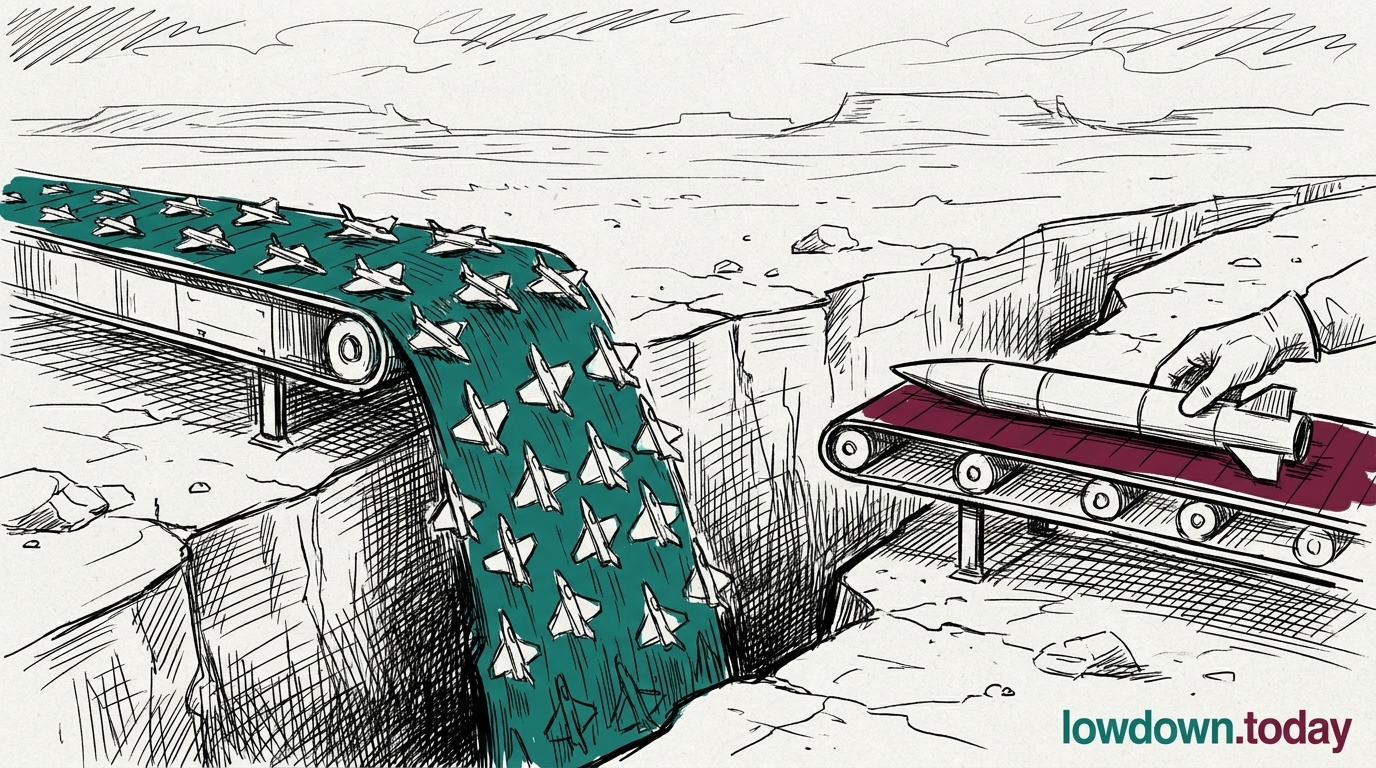
The CCA programme requires an autonomous wingman cheap enough to be attritable — acceptable to lose in combat — yet capable enough to carry and employ real weapons alongside crewed fighters. General Atomics built the MQ-9 Reaper line that defined military drone operations for two decades. Northrop Grumman developed the X-47B, the first autonomous aircraft to complete an arrested landing on an aircraft carrier. Both bring extensive weapons integration pedigree on unmanned platforms. Anduril has neither heritage — but it has Arsenal-1, already producing Fury airframes.

The $680 million initial allocation is modest by combat aircraft standards. The programme's long-term value, if CCA scales to equip fighter squadrons across the Air Force as intended, runs to tens of billions. The selection will determine whether the Pentagon weighs combat aviation heritage or manufacturing velocity more heavily when the two compete directly for the same contract.

Deep Analysis

In plain English

The US Air Force wants autonomous drone wingmen — aircraft that fly alongside manned fighter jets and take on the most dangerous tasks in combat. Three designs are competing for a production contract: Anduril's Fury, General Atomics' Dark Merlin, and Northrop Grumman's Talon Blue. Anduril's Fury has just passed an important safety gate: it flew near a manned aircraft while carrying a real but inactive missile. The next step is actually firing that missile. Congress has set aside $680 million for the winning design — but the real prize is the follow-on production contract, which could be worth billions more over the programme's lifetime.

Deep Analysis
Synthesis

The Fury's AIM-120 AMRAAM integration is strategically significant beyond the CCA competition itself. AMRAAM compatibility makes the Fury a beyond-visual-range air-to-air missile delivery platform with a potential unit cost one-fiftieth that of a manned fighter. If Fury wins and reaches operational scale, adversaries face saturation engagements from attritable platforms whose loss is economically sustainable in a way that losing F-35s structurally is not — fundamentally altering the cost calculus of contested airspace operations.

Root Causes

The $680M allocation is structurally underfunded relative to precedent — the X-45 UCAV demonstrator alone cost approximately $1B, and F-35 development exceeded $55B. The figure covers initial production rather than development, revealing that the Air Force has compressed the traditional development-to-production boundary. This accepts elevated technical risk in exchange for faster fielding, a doctrinal shift driven by the pace of Chinese autonomous aircraft development rather than by programme maturity.

Escalation

The competition is entering its decisive phase with asymmetric public visibility: Anduril has announced both a captive-carry milestone and an operational factory, while General Atomics and Northrop have not disclosed equivalent progress markers. This narrative asymmetry may influence source selection evaluators and congressional oversight before formal evaluation data becomes available.

What could happen next?
1 meaning1 opportunity1 risk1 precedent1 consequence
  • Meaning

    AMRAAM-armed autonomous wingmen are transitioning from demonstrator to production competition, marking the formal entry of attritable platforms into US air-to-air combat doctrine.

    Immediate · Assessed
  • Opportunity

    The CCA winner gains incumbency in a programme likely to exceed $10B over its lifecycle and becomes the reference platform for allied air forces pursuing compatible autonomous teaming capabilities.

    Medium term · Assessed
  • Risk

    Compressed development timelines and the attritable cost constraint may produce survivability shortfalls that only emerge in operational testing against peer-level air defences, requiring costly redesign after initial production.

    Short term · Suggested
  • Precedent

    A defence tech startup founded in 2017 is competing as a peer prime contractor against Northrop Grumman for a major manned-unmanned teaming production contract — the first such instance in modern US combat aircraft competition.

    Immediate · Reported
  • Consequence

    A Fury win would validate Anduril's vertically integrated manufacturing model for next-generation combat aircraft, setting a template that challenges the subcontractor-dependent production architectures of traditional primes across future programmes.

    Long term · Suggested
First Reported In

Update #2 · UK startup tops Pentagon's drone gauntlet

Breaking Defense· 19 Mar 2026
Read original →
Causes and effects
This Event
Fury completes AMRAAM captive carry test
The captive carry test is the first public weapons integration milestone for Anduril's CCA entry. With $680 million allocated and a contract decision expected this fiscal year, the test puts a nine-year-old startup on comparable footing with General Atomics and Northrop Grumman — companies with decades of unmanned combat aircraft experience.
Different Perspectives
Israel Defense Forces (Chief of Staff Lt. Gen. Eyal Zamir)
The IDF finalised a new Unmanned Systems and Artificial Intelligence Branch on 10 September, with full inauguration expected by early December. Israel is reorganising its forces around drones while Israeli suppliers pass into foreign hands: US-listed Ondas bought the fuze maker GATE on 14 September.
EHang (chairman and chief executive Huazhi Hu)
EHang withdrew its 600 million yuan revenue guidance on 25 August, blaming a more cautious Chinese regulator after industry air incidents. China's leading pilotless-aircraft maker now seeks first approvals in Sri Lanka and Thailand while US tariffs and FCC rules shut Chinese parts out of allied supply chains.
DroneShield
DroneShield
The Australian firm won one of ten Domestic Shield ceilings, $500m, on 29 September, while its FY2027-and-beyond committed revenue stood at A$46m. Its own filing warns investors that the US award may never turn into orders.
Pete Hegseth, US Secretary of War
In a speech at Quantico on 30 September Hegseth announced AUTOWARCOM, a four-star drone command targeted for 1 October 2027 if Congress agrees, and called Drone Dominance and JIATF-401 a good start. He wants one command with its own budget to buy at the scale those two efforts have not reached.
Defense Acquisition Program Administration (DAPA)
A DAPA-chaired committee approved a 2.16 trillion won domestic programme on 15 September for an army vertical take-off reconnaissance drone, running from 2027 to 2036. Seoul is choosing slow domestic development over urgent imports for its divisional surveillance.
Taiwan's Executive Yuan (Cabinet)
After the Legislative Yuan voted 60 to 50 on 27 August for a baseline of NT$40bn a year, in principle, for domestic drones and rejected its special budget, the Cabinet said on 30 August it would expedite funding and indicated it would co-sign the act. Taipei gets a statutory domestic market but loses a ring-fenced multi-year fund.
