Skip to content
You can now search across every topic, entity and event.What's new
Drones: Industry & Defence
19MAR

Arsenal-1 opens months early in Columbus

3 min read
08:30UTC

The 5-million-square-foot Arsenal-1 facility, backed by Ohio's largest-ever single employer incentive, will begin producing Fury autonomous combat aircraft before the Pentagon selects a CCA winner.

TechnologyDeveloping
Key takeaway

Arsenal-1 repositions Anduril as a tier-1 prime contractor — scale manufacturing is the new competitive moat.

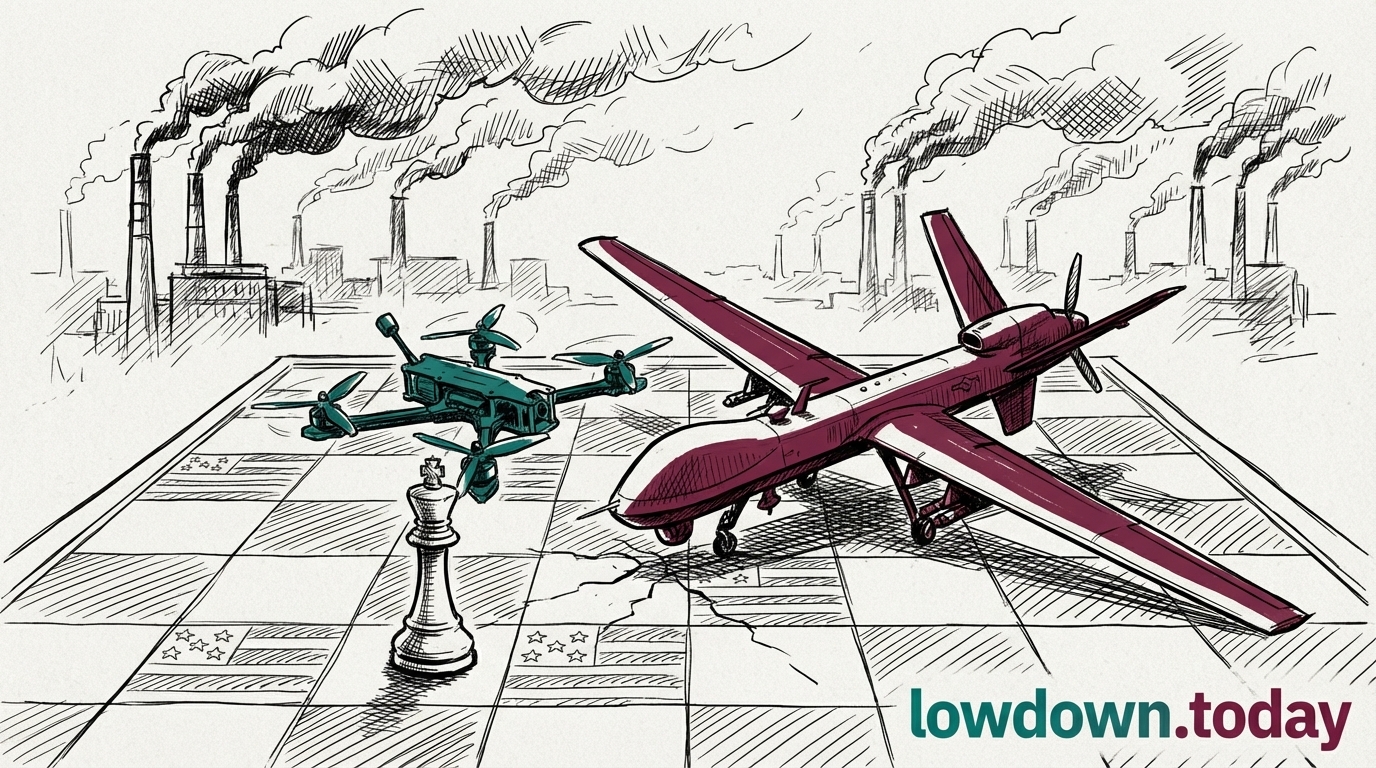
Anduril's Arsenal-1 manufacturing facility in Columbus, Ohio will begin production "in a matter of days" — months ahead of its announced July 2026 opening 1. The 5-million-square-foot plant sits on a 500-acre site near Rickenbacker International Airport. A $310 million JobsOhio grant backs the project — the state's largest single incentive package — with 4,000 jobs promised 2.

The first product off the line: the YFQ-44A Fury, Anduril's entry in the Air Force's Collaborative Combat Aircraft competition. Jason Levin, Anduril's SVP of Engineering, said the facility will produce "YFQ-44s at rate, but also many other Anduril products" 3.

Anduril was founded in 2017. Nine years later, it is building out manufacturing floor space that exceeds most legacy defence contractors' individual plants. The acceleration from announced timeline to production suggests a company that has structured its build-out around speed — a contrast with the multi-year facility programmes typical of established primes. Ohio's $310 million incentive, its largest ever for a single employer, is one measure of how aggressively US states are competing for defence manufacturing capacity as Pentagon procurement shifts toward newer entrants.

The timing carries competitive weight. Anduril faces General Atomics and Northrop Grumman for the initial CCA production contract, with a decision expected this fiscal year. Having a factory producing Fury airframes before that decision is a manufacturing readiness demonstration that planned future capacity, however credible, cannot fully replicate.

Deep Analysis

In plain English

Anduril has built a factory the size of 87 football pitches in Ohio, and it is opening ahead of schedule. The state of Ohio contributed over $300 million to support its construction because it will employ 4,000 people. The first products will be autonomous military aircraft, but the facility is designed to manufacture many different Anduril weapons systems. This matters because it signals a fundamental shift in who makes America's weapons. Traditionally, a handful of giant defence companies — Lockheed, Northrop, Raytheon — dominated military manufacturing. Anduril, founded only in 2017, now operates a facility that rivals theirs in scale, and it got there faster than any of them have expanded in decades.

Deep Analysis
Synthesis

Arsenal-1's 5-million-square-foot scale exceeds any single product's foreseeable demand, and the confirmation that it will produce many other Anduril products reveals the factory as a platform for industrial diversification rather than a programme-specific asset. This mirrors SpaceX's Starbase strategy: proprietary scale manufacturing creates a cost structure that incumbent prime contractors, operating through fragmented subcontractor networks, structurally cannot replicate at equivalent per-unit economics.

Root Causes

The $310M JobsOhio grant reflects a structural shift in US industrial policy not addressed in the body: states are now competing aggressively for defence manufacturing through direct subsidy, mirroring the semiconductor incentive architecture of the CHIPS Act. This pattern — federal acquisition increasingly shaped by state-level industrial competition — is accelerating the geographic consolidation of defence manufacturing capacity in subsidy-competitive states.

Escalation

The months-early opening implies Anduril received sufficient advance commitment — either confirmed orders or high-confidence forecast demand — to justify accelerating capital deployment ahead of the announced schedule. The CCA source selection expected this fiscal year creates a hard deadline: production readiness demonstrated before the award is a material competitive argument in source selection evaluation.

What could happen next?
  • Precedent

    A defence tech firm founded in 2017 now operates America's largest single job-creation manufacturing investment, demonstrating that the traditional prime contractor model can be bypassed through integrated capital and manufacturing strategy.

    Immediate · Reported
  • Opportunity

    Arsenal-1 positions Anduril to bid the lowest per-unit cost in follow-on CCA and counter-UAS production contracts, where manufacturing scale rather than development heritage determines competitive position.

    Short term · Assessed
  • Risk

    Single-site concentration of critical autonomous weapons production creates a supply chain vulnerability — a natural disaster, labour action, or facility incident would disrupt the entire production line simultaneously.

    Medium term · Assessed
  • Consequence

    Traditional primes face structural margin compression as Arsenal-1 reaches capacity utilisation and Anduril's per-unit economics fall below those achievable through subcontractor-dependent production models.

    Medium term · Assessed
First Reported In

Update #2 · UK startup tops Pentagon's drone gauntlet

Defense One· 19 Mar 2026
Read original
Causes and effects
This Event
Arsenal-1 opens months early in Columbus
A defence startup founded in 2017 is opening one of the largest new weapons manufacturing facilities in the US months ahead of schedule, backed by $310 million in state funding. The early production start gives Anduril a manufacturing readiness argument in the CCA competition that its legacy competitors have not publicly matched.
Different Perspectives
Procurement sceptics
Two identically sized IDIQs to different primes within seven weeks, and a five-nation pact where one partner moves weeks ahead of the rest, could just as easily read as an industrial base still improvising vendor mix as a deliberate hedging doctrine. Neither ceiling appears sized against a validated requirement yet.
Chinese component suppliers
FCC and Pentagon-level restrictions on Chinese-origin airframes and motors have progressively excluded DJI-linked suppliers from federal counter-drone catalogues, narrowing the field JIATF-401 and Gauntlet II can buy from to a short list of certified domestic bidders. Beijing reads the exclusions as protectionism dressed as security policy.
Quantum Systems
Quantum Systems
Blackstone, Airbus, Advent and Noteus reportedly priced the Munich drone maker at $8 billion, more than double its prior mark, on the strength of 19,000 Ukraine missions rather than confirmed revenue. It is betting production capacity, not current sales, is what buyout capital is now paying for.
United Kingdom
United Kingdom
Britain released the first LEAP effector money three weeks after its defence secretary quit over the size of the drone budget, splitting £3.16 million across three small firms rather than one contractor. It expects the other four LEAP partners to follow its pace, not set their own.
JIATF-401
JIATF-401
The task force handed AeroVironment a $500 million counter-drone ceiling identical to Perennial Autonomy's from seven weeks earlier, while its own Gauntlet II red team prepares to attack the drones the winners of that sprint will build. It expects to keep several qualified suppliers warm rather than certify one.
DroneShield
DroneShield
DroneShield appointed retired Rear Admiral Lee Goddard as an independent director from 1 July, its second board move since founder Oleg Vornik's April exit. The ASIC probe into November's disclosures and share sales stays open, so the admiral steadies the story without closing the file.
