Skip to content
You can now search across every topic, entity and event.What's new
Drones: Industry & Defence
20AUG

Washington lends $820m for drone parts

2 min read
16:38UTC

The Office of Strategic Capital signed a conditional loan commitment of up to $820 million with Performance Drone Works on 31 July to build high-volume American component manufacturing.

TechnologyDeveloping
Key takeaway

Federal lending is building the component capacity that the new tariff makes commercially viable.

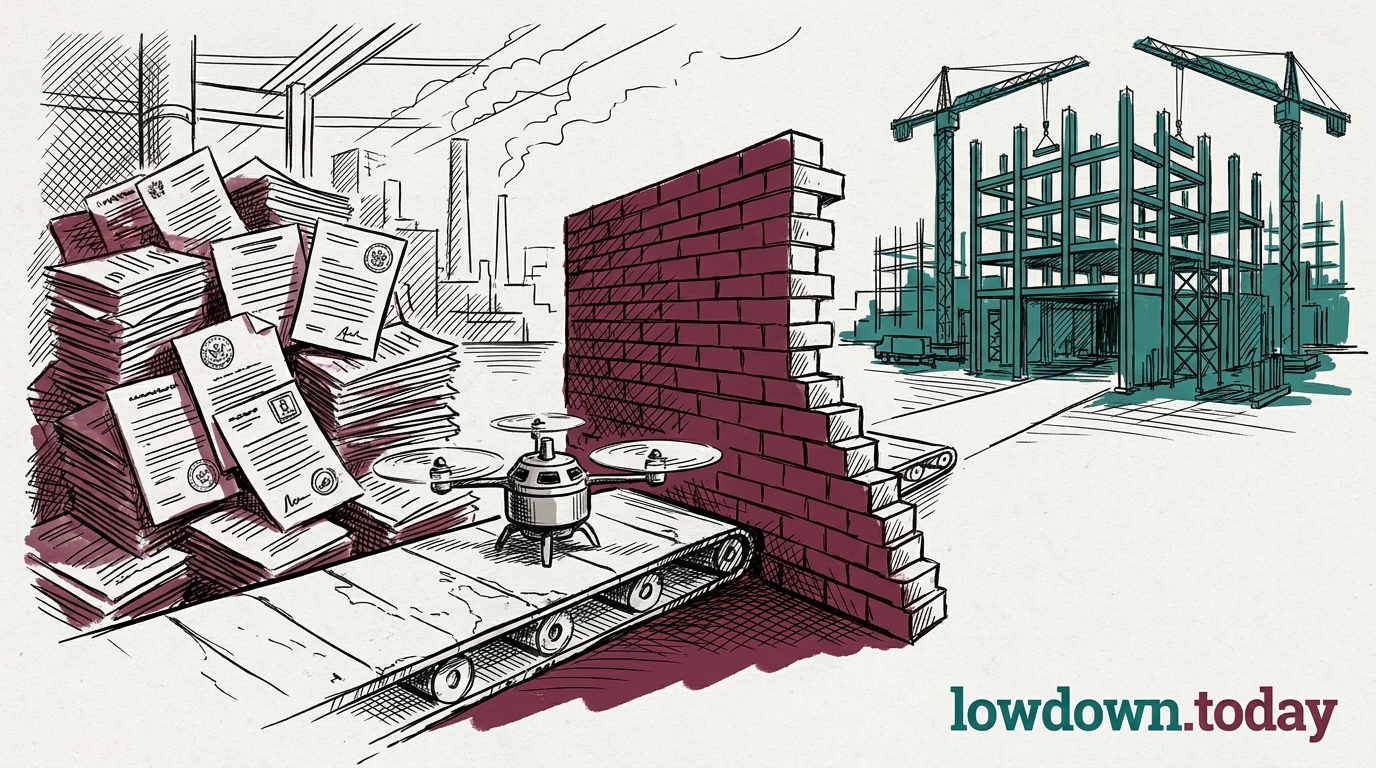
The Office of Strategic Capital (OSC), the War Department's lending arm, signed a conditional loan commitment of up to $820 million with Performance Drone Works on 31 July to build high-volume US manufacturing of drone components 1. Not a research grant and not a services contract. A loan, repayable, aimed squarely at the component layer that the Section 232 proclamation now taxes most heavily on import.

Sequencing matters here. The commitment predates the proclamation by a fortnight, so the lending decision was not made against a published tariff schedule; both instruments nonetheless point at the same shortage. Public money is going into the parts nobody in America currently makes at volume, at the moment importing those parts becomes expensive and, for a firm that commits to a factory, temporarily free.

The purchasing side moved days later. Joint Interagency Task Force 401 upgraded its counter-UAS marketplace on 3 August so that military units, domestic law enforcement and allied governments can identify and buy validated systems through one vetted channel 2. Nine nations signed a letter of intent behind that marketplace at Eurosatory in June . A vetted catalogue converts a one-off award into a standing route to market for whoever is already listed on it, which is a quieter form of industrial policy than a tariff and a longer-lasting one.

Deep Analysis

In plain English

The Office of Strategic Capital's $820 million is a loan commitment, which the borrower repays, unlike the grant it is often mistaken for. The Pentagon office has agreed to lend Performance Drone Works, a US drone-parts maker, up to that amount to expand factory capacity. Performance Drone Works has to pay the money back. The government is betting the company can build enough production volume to sell its way out of the debt.

Deep Analysis
Root Causes

US drone-component manufacturing has lagged demand because private capital has treated the sector as too capital-intensive and too dependent on a single customer, the Pentagon, to underwrite commercial-scale factories on venture terms alone.

The Office of Strategic Capital was given lending authority, not grant authority, so a repayable loan is currently the largest single federal instrument available for this purpose short of a direct appropriation.

What could happen next?
  • Opportunity

    Performance Drone Works gains access to capital scaled well beyond typical defence-startup venture rounds, without giving up equity.

  • Risk

    As a loan rather than a grant, the commitment concentrates repayment risk on Performance Drone Works if Pentagon demand or export orders fall short of the volume needed to service the debt.

First Reported In

Update #17 · Two walls close on the drone supply chain

US Department of War· 20 Aug 2026
Read original
Causes and effects
This Event
Washington lends $820m for drone parts
The War Department is lending a manufacturer the money to build capacity that Washington's own tariff is about to make profitable.
Different Perspectives
South Korea's Defense Acquisition Program Administration
DAPA folded drone and roadside-bomb jammers into an 18-year, KRW 3.448 trillion K2 tank upgrade approved 11 August, rather than fund counter-drone kit as its own programme. Seoul is treating the threat as permanent enough to write into a platform's lifecycle, not urgent enough to buy ahead of it.
NATO Support and Procurement Agency
NSPA named five pre-qualified counter-drone suppliers under new framework contracts on 27 July, giving allies a purchasing route with no published budget attached. A framework without committed money is an instrument waiting for a spending decision, not a guarantee one is coming.
Ukraine's Ministry of Defence
Ukraine's forces strike with more than 70 AI and computer-vision systems drawn from over 200 domestic producers, the ministry said on 18 August, a supplier base neither Washington's tariff fight nor Beijing's export licence touches. Kyiv is scaling capability faster than either government is writing rules for it.
A European drone-component manufacturer
A European manufacturer selling components into the United States faces the same 100 per cent tariff and 3 September deadline as any other foreign supplier, with the duty-free onshoring carve-out available only to firms building on American soil. That leaves it to absorb the cost, relocate assembly, or cede the US market rather than shop around a rival supply chain.
Chinese drone component exporters
Exporters now need a case-by-case licence for each US-bound dual-use shipment after MOFCOM's 5 August order, with no published review clock. The same week Shenzhen logged nearly 200,000 domestic logistics-drone sorties and Hunan reported record spraying coverage, a home market large enough to absorb what the licence regime slows from leaving the country.
US drone manufacturers
The onshoring carve-out protects Performance Drone Works' $820 million War Department loan, but the same 3 September deadline hits Red Cat Holdings and Unusual Machines, both filing over 500 per cent revenue growth on 6 August, on Chinese-sourced components with no qualified domestic substitute yet.
