Skip to content
You can now search across every topic, entity and event.What's new
Drones: Industry & Defence
20AUG

US Army buys the robot resupply job

3 min read
16:38UTC

American Rheinmetall took an 18-month US Army award on 31 July for hybrid-powered autonomous resupply vehicles, with Harbinger, Forterra and Primordial Labs behind it. No value was disclosed.

TechnologyDeveloping
Key takeaway

The Army has bought a prototype programme, not a fleet, and it has not said what it paid.

American Rheinmetall was named prime contractor on Project Sustainment, an 18-month US Army award announced on 31 July and executed through the National Advanced Mobility Consortium 1. The contract covers hybrid-powered autonomous UGVs (uncrewed ground vehicles) for what the release calls "company-sized element sustainment missions". Rheinmetall disclosed no contract value.

Three suppliers sit under the prime. Harbinger provides the vehicle, Forterra the autonomy stack, and Primordial Labs the Anura natural-language interface, which lets a soldier speak instructions to the vehicle rather than drive it. American Rheinmetall is the US arm of the German group Rheinmetall; its last appearance on this beat was the MV-8 Komodo mine-breaching robot shown at Eurosatory . Breaching wins the show floor. Sustainment recurs every day of a deployment, and it is sustainment that carries the follow-on orders.

Strip the programme name off and the mission is the one Ukrainian units have been running for two years: haul ammunition and water forward, carry wounded soldiers back. Trinity Robotics doubled 2026 output of its Konyk One logistics and casualty-evacuation robot to roughly 2,200 units , and the national procurement target for the year stands at 50,000 vehicles . The Army is not inventing a category here; it is buying into one that has already been proven under fire by somebody else.

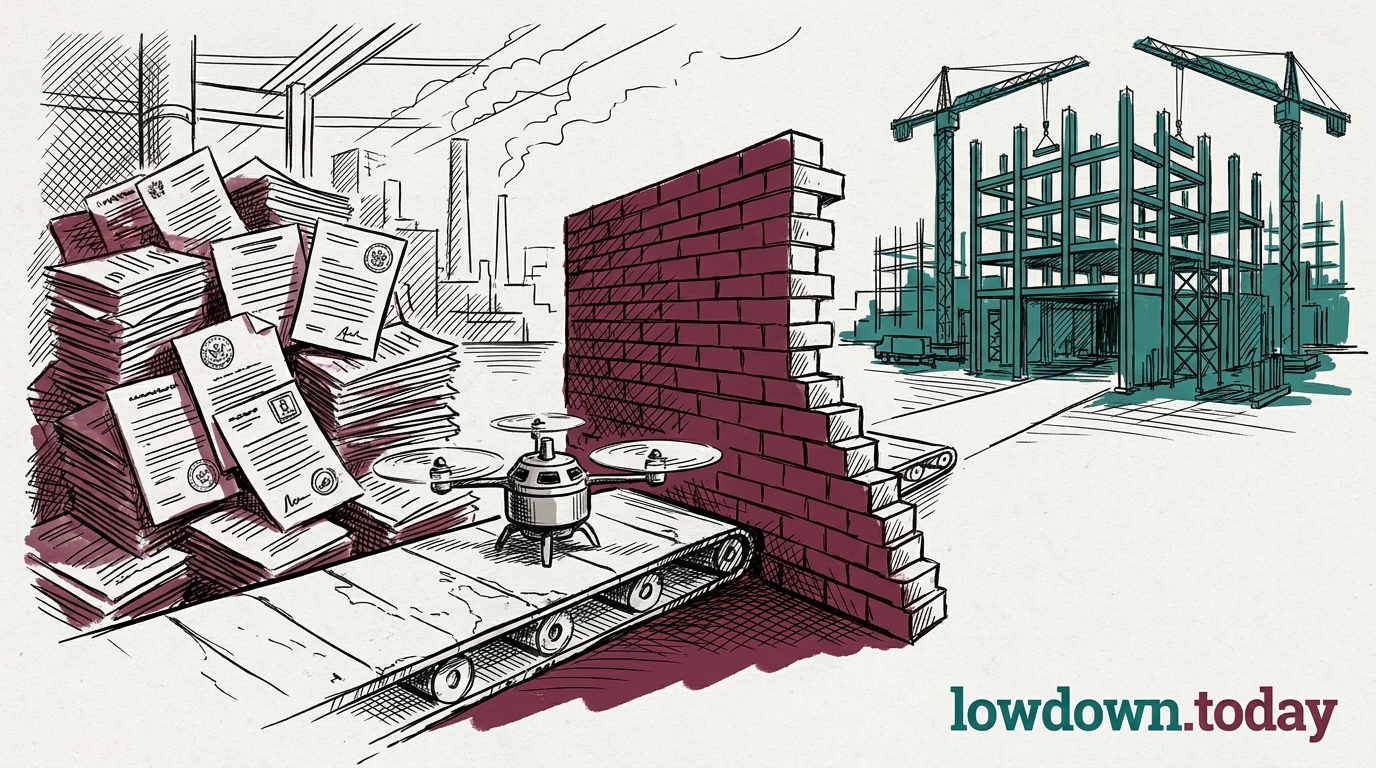
Project Sustainment's silences carry as much weight as its disclosures. Eighteen months with no published value reads as a prototyping vehicle rather than a production buy, so the commercial signal arrives at the follow-on decision rather than now. The three-supplier split matters for the same reason: Forterra's autonomy and Primordial Labs' voice layer are separable from Harbinger's hull, which means a follow-on could recompete the vehicle while keeping the software. The US Army also judges sustainment autonomy on a different curve from combat autonomy. The acceptance test is uptime across a supply run, not lethality, which rewards whoever can show fleet hours and penalises whoever can only show a demonstration.

Deep Analysis

In plain English

A UGV is an uncrewed ground vehicle, essentially a robot truck that can drive itself over rough terrain. The US Army has hired American Rheinmetall to build one that resupplies frontline troops without a driver, for company-sized element sustainment missions, meaning it carries food, ammunition and equipment to a unit of roughly 60 to 200 soldiers. Three companies split the job: Harbinger builds the vehicle itself, Forterra writes the software that lets it navigate on its own, and Primordial Labs built Anura, a voice system so a soldier can talk to the vehicle rather than type commands. Nobody has said what the contract is worth, which is normal for defence deals at this early stage.

Deep Analysis
Root Causes

No single US firm currently builds a UGV hull, an autonomy stack and a natural-language control layer together at production scale, which is why Project Sustainment stacks three specialist suppliers under the National Advanced Mobility Consortium's contracting vehicle instead of a single prime.

Routing the award through NAMC, an industry consortium contracting vehicle, lets the Army award a multi-supplier team without running three separate competitive tenders, trading a longer procurement cycle for a mechanism that has already cleared its own government vetting.

What could happen next?
  • Precedent

    A three-supplier, one-consortium contracting model for a UGV logistics award gives US Army planners a template to buy further autonomy stacks without vetting a single prime contractor for every function.

  • Risk

    Integration failures between Harbinger's hull, Forterra's autonomy stack and Primordial Labs' interface have no single contracted owner, which could surface as delivery delays inside the 18-month window.

First Reported In

Update #10 · Belgium's twelve robots are not autonomous

Rheinmetall· 3 Aug 2026
Read original
Causes and effects
This Event
US Army buys the robot resupply job
A US Army programme office has put an 18-month clock on buying the ground-robot logistics capability Ukrainian units already run at industrial scale.
Different Perspectives
South Korea's Defense Acquisition Program Administration
DAPA folded drone and roadside-bomb jammers into an 18-year, KRW 3.448 trillion K2 tank upgrade approved 11 August, rather than fund counter-drone kit as its own programme. Seoul is treating the threat as permanent enough to write into a platform's lifecycle, not urgent enough to buy ahead of it.
NATO Support and Procurement Agency
NSPA named five pre-qualified counter-drone suppliers under new framework contracts on 27 July, giving allies a purchasing route with no published budget attached. A framework without committed money is an instrument waiting for a spending decision, not a guarantee one is coming.
Ukraine's Ministry of Defence
Ukraine's forces strike with more than 70 AI and computer-vision systems drawn from over 200 domestic producers, the ministry said on 18 August, a supplier base neither Washington's tariff fight nor Beijing's export licence touches. Kyiv is scaling capability faster than either government is writing rules for it.
A European drone-component manufacturer
A European manufacturer selling components into the United States faces the same 100 per cent tariff and 3 September deadline as any other foreign supplier, with the duty-free onshoring carve-out available only to firms building on American soil. That leaves it to absorb the cost, relocate assembly, or cede the US market rather than shop around a rival supply chain.
Chinese drone component exporters
Exporters now need a case-by-case licence for each US-bound dual-use shipment after MOFCOM's 5 August order, with no published review clock. The same week Shenzhen logged nearly 200,000 domestic logistics-drone sorties and Hunan reported record spraying coverage, a home market large enough to absorb what the licence regime slows from leaving the country.
US drone manufacturers
The onshoring carve-out protects Performance Drone Works' $820 million War Department loan, but the same 3 September deadline hits Red Cat Holdings and Unusual Machines, both filing over 500 per cent revenue growth on 6 August, on Chinese-sourced components with no qualified domestic substitute yet.
