Skip to content
You can now search across every topic, entity and event.What's new
Data Centres: Boom and Backlash
28JUN

Irish regulators split over data centres

4 min read
12:23UTC

Ireland's CRU reopened data-centre grid connections in early 2026, while its grid operator EirGrid warns of peak supply shortfalls through 2028. Labour has tabled a Dail moratorium motion for 18 June.

IndustryDeveloping
Key takeaway

Ireland reopened data-centre connections as its grid operator projected peak shortfalls through 2028, with no shared adequacy gate.

Ireland's Commission for Regulation of Utilities (CRU, the national energy and water regulator) reopened large-load grid connections in early 2026, ending a multi-year de-facto freeze, on condition that new data centres reach 80% renewable supply within six years and carry 100% on-site backup. Yet EirGrid, the state grid operator, published its All-Island Resource Adequacy Assessment in February 2026 warning that demand will exceed supply at peak across 2026 to 2028 1. By EirGrid's projection, data centres now take about 32% of national electricity, up from 22% in 2024, with Dublin's campuses at roughly half of regional demand.

The figure the connection policy sets aside sits in the adequacy report. New data-centre applications could need an additional 5.8 GW, close to Ireland's all-time peak demand of 6.024 GW, according to EirGrid. The CRU governs who connects; EirGrid governs whether the system can supply them. With no shared adequacy gate between the two, a regulator can reopen the door at the exact moment the grid operator warns the room behind it is full. The 32% share is a 2026 projection from EirGrid and the CRU, not a settled meter reading.

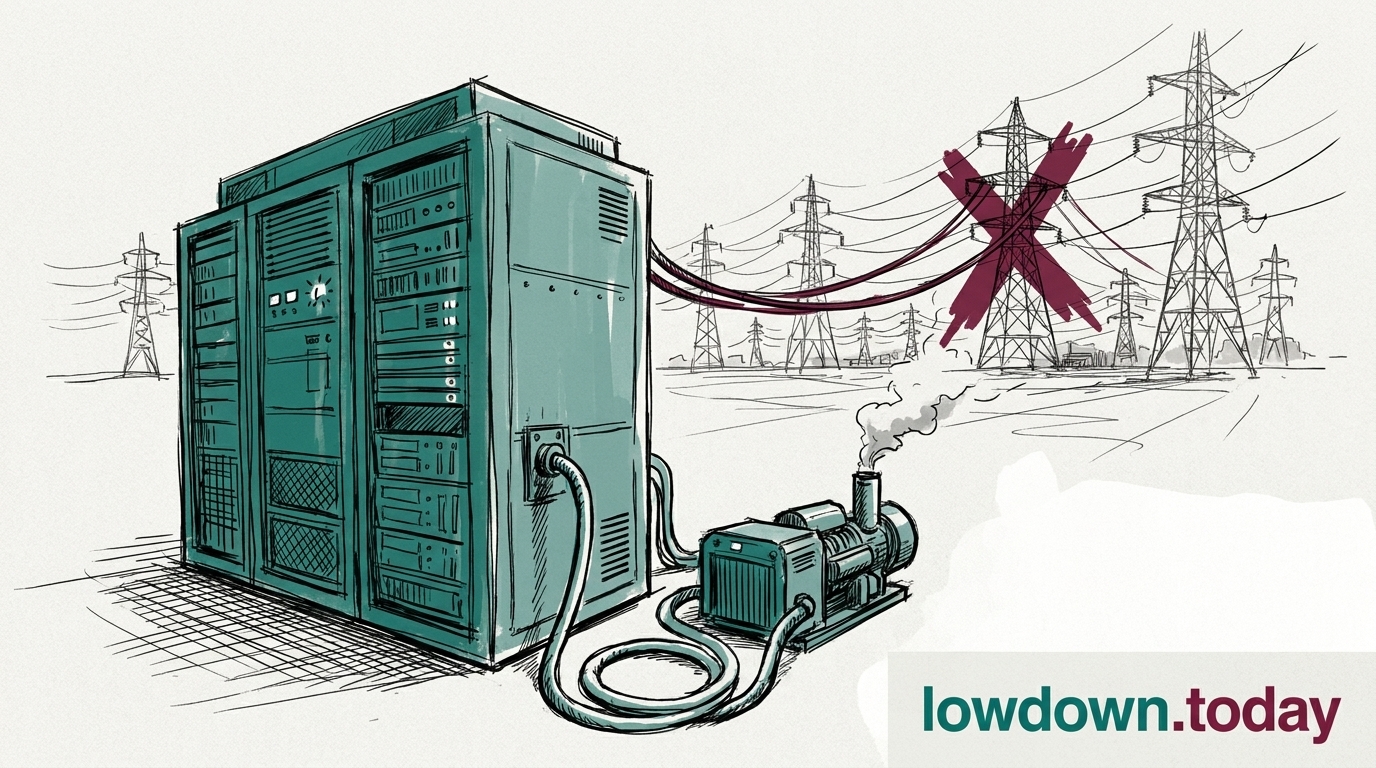
The CRU's 100%-backup rule also replicates the exact set-up that triggered the US curtailment orders: on-site generation beside the load. Ireland's first such behind-the-meter (BTM, where a campus runs its own power plant beside the load instead of importing from the grid) microgrid surfaced in Dublin in April , the CRU-compliant generation template that the adequacy gap now puts under pressure. Labour and the Social Democrats each tabled Dail moratorium motions for debate on 18 June, with Labour's climate spokesperson Ciaran Ahern calling for a data-centre levy to offset costs falling on the 500,000 households already in energy-bill arrears 2.

Deep Analysis

In plain English

Ireland has two bodies that deal with electricity for data centres. The CRU (Commission for Regulation of Utilities) is the regulator: it decides which companies can connect to the grid. EirGrid is the operator: it runs the actual power network day to day and publishes forecasts of whether supply will be sufficient. In early 2026, the CRU said new data centres can start connecting to the grid again, after a long pause. The conditions are tough: new centres must get 80% of their power from renewable sources within six years of connecting, and must have full backup power on site. But EirGrid's own February 2026 report warns that demand, heavily driven by data centres, will exceed supply at peak times in 2026, 2027, and 2028. Data centres now use about 32% of all Irish electricity. In Dublin specifically, they account for about half of all regional power use. If all the data-centre projects currently applying were built, they might need 5.8 GW of extra grid capacity. Ireland's biggest ever electricity demand was 6.024 GW. So the pending applications could require nearly as much power as the whole country has ever used at once. Two political parties have tabled motions in the Dail (Ireland's parliament) asking for a moratorium, a pause on new data centres. One party wants a levy on data centres to help 500,000 Irish households who cannot pay their energy bills.

Deep Analysis
Root Causes

Ireland's CRU-EirGrid contradiction has a structural cause rooted in how Irish energy regulation is organised. The CRU sets connection policy and conditions; EirGrid operates the network and publishes adequacy assessments. Neither body has authority over the other's primary function.

The CRU can open connections with conditions it deems appropriate; EirGrid can publish forecasts showing the network cannot reliably honour those connections at peak. No statutory mechanism requires the two bodies to align their outputs before the CRU issues a connection offer.

Demand growth at a pace EirGrid's adequacy models did not anticipate explains the 2026 gap. EirGrid's own figures show data-centre load rising from 22% to 32% of national consumption in two years. No grid adequacy assessment published in 2022 modelled this rate of increase, meaning the conditions attached to 2022-era connection offers were calibrated to a demand trajectory that has already been exceeded.

First Reported In

Update #7 · Virginia taxes the backup, not the draw

EirGrid· 17 Jun 2026
Read original
Different Perspectives
Global hyperscale operators
Operators are still filing gigawatt-scale campuses and Meta is proceeding with its $10bn Lebanon, Indiana site despite the county-level bans nearby, betting Q2 capex outruns the patchwork of restrictions. Industry framing casts New York's freeze, Oregon's surcharge and Indiana's bans as taxes and levies that push build-out toward faster-permitting jurisdictions such as India and the Gulf.
EirGrid
EirGrid
EirGrid set a 900 MW instantaneous demand-loss ceiling because a single voltage dip can trip many data centres onto backup power at once, risking imbalance above 1,150 MW. It wrote the limit into a standing procedure rather than waiting for an emergency to force one.
US host communities and ratepayers
Prince William residents backed the 8-0 denial of Dulles South over the Occoquan watershed, drinking water for eight million people, while Oregon's approved tariff cuts residential bills 1.3% by charging large loads 29% more. Their position: consent and cost-attribution belong in law, not left to a developer's or a utility's discretion.
Hassan Allam Digital Infrastructure
Hassan Allam Digital Infrastructure, an Egyptian conglomerate rather than a foreign hyperscaler, reportedly secured a domestic hyperscale licence with a $400m first phase, per single-source reporting still to be verified. It reads as home-grown sovereign compute ambition, building national capacity rather than importing a US or Gulf operator's campus.
Damac Digital
Damac Digital
Damac Digital keeps building toward roughly 6,000 megawatts of hyperscale capacity across 13 countries while Virginia taxes power and New York weighs a freeze. Every dollar or month of delay a US state adds is capacity a Gulf developer can site somewhere with faster permitting and no equivalent levy.
Acequia communities, Santa Fe County
Santa Fe County commissioners voted unanimously on 2 July to freeze any data centre over one megawatt, citing the acequia irrigation commons that has shared scarce water since Spanish colonial rule. They expect the low threshold to draw the same Fifth Amendment challenge RCM Hill brought against Hill County, Texas.

