Skip to content
Welcome, thoughtbot's Giant Robots listeners!Start here
Data Centres: Boom and Backlash
24SEP

NSW gives its minister a grid veto

2 min read
13:52UTC

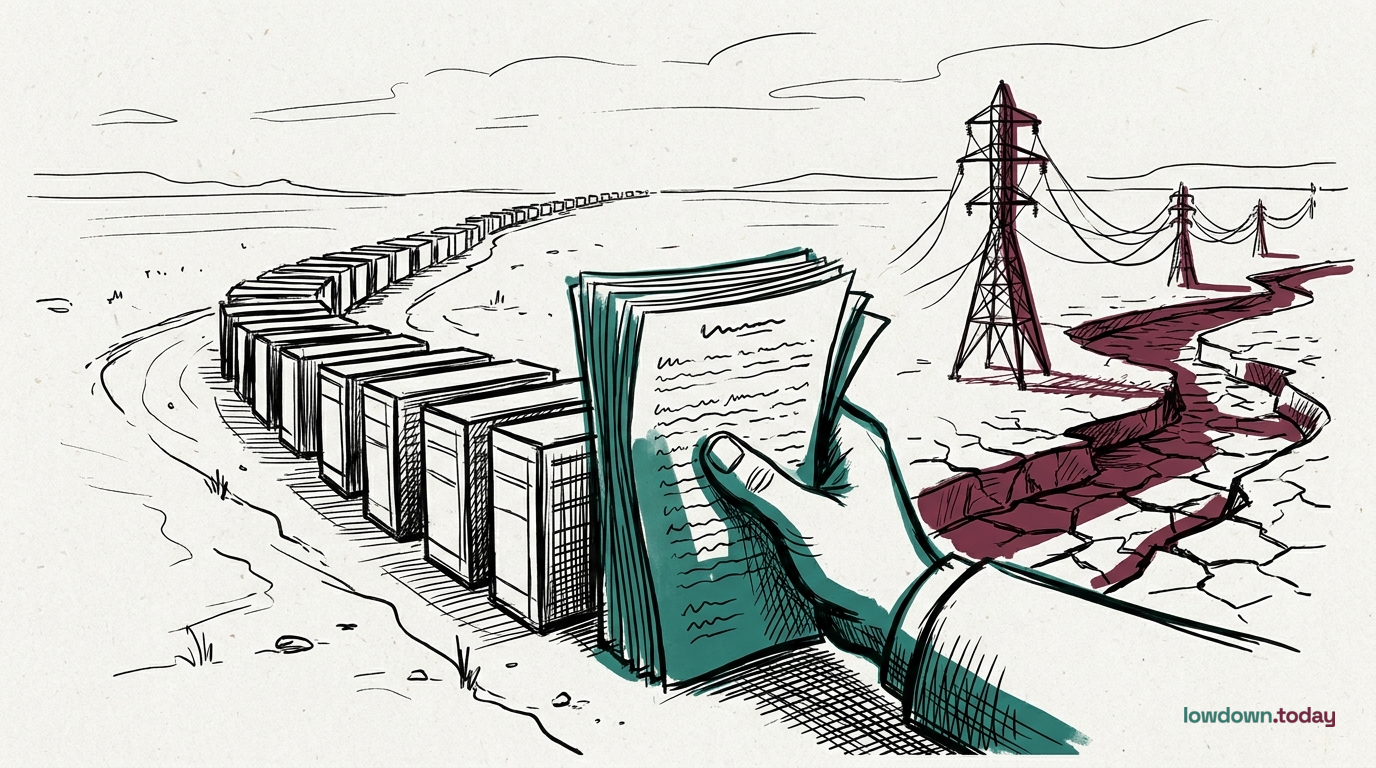
New South Wales introduced a bill on 5 August letting the state energy minister authorise or prohibit grid access for any facility drawing 5 MW or more, and bill the connecting party for network upgrades.

IndustryDeveloping
Key takeaway

New South Wales would let its energy minister prohibit grid access for any load above 5 MW.

New South Wales introduced the Electricity Infrastructure Investment Amendment Bill 2026 in state Parliament on 5 August. It hands the state energy minister power to declare large-load access schemes that can authorise or prohibit grid access for facilities capable of drawing 5 MW or more, and to allocate network-upgrade costs to the connecting party rather than spreading them across consumers⁠1.

At 5 MW the bill reaches far beyond the hyperscale campus. That level catches suburban colocation halls and single large enterprise sites, so the great majority of data-centre development in Australia's largest state economy would fall inside a scheme the minister declares. Cost allocation does the second job: a developer that wants a substation upgrade pays for it, instead of the upgrade landing in everyone's network charges.

Advice and statute landed within hours of each other on the same day, and they point in opposite directions procedurally. One asks ministers to design a test, in a determination still months from completion. The other gives a minister the power to refuse, subject only to the bill's passage. Texas took the third route when its regulator built a classification process rather than a veto, which puts the judgement in a published methodology instead of a ministerial declaration.


Deep Analysis

In plain English

New South Wales, the Australian state that includes Sydney, introduced a bill on 5 August giving its energy minister the power to approve or block a big electricity user's connection to the grid, and to make the developer pay for any network upgrades their project needs. The 5 MW threshold, roughly enough to power a few thousand homes, is low enough that ordinary computer server rooms will now need direct government approval to connect, the same as huge AI campuses.

Deep Analysis
Root Causes

A 5 MW threshold is deliberately low. It catches enterprise server rooms and suburban colocation halls alongside hyperscale campuses, so the New South Wales bill works as a general permitting gate over large electricity users rather than a hyperscaler-specific rule.

Allocating network-upgrade costs to the connecting party addresses a cost-socialisation problem regulators elsewhere have raised. Without it, the cost of reinforcing a substation for one large load spreads across every ratepayer on that network rather than falling on the load that triggered the upgrade.

What could happen next?
  • Consequence

    A 5 MW threshold brings routine colocation and enterprise projects under ministerial approval alongside hyperscale campuses.

First Reported In

Update #13 · GPUs now collateral as Nebius borrows $775m

Parliament of New South Wales· 14 Aug 2026
Read original →
Causes and effects
This Event
NSW gives its minister a grid veto
At 5 MW the threshold reaches ordinary colocation halls, so most data-centre development in the state would need ministerial sign-off.
Different Perspectives
Chilean data-centre developers
Seven projects, one linked to Google, asked SEA this month for rulings that they fall outside full environmental review; four declared diesel-storage volumes just under the review-triggering tonnage, mirroring the mechanism Alto Jahuel used in July. The clustering suggests the threshold is being engineered, not sized to need.
An Coimisiun Pleanala
Ireland's planning appeals body refused the €1.5bn Killala data centre on 17 September, overturning Mayo County Council's 2025 grant for lack of a fixed grid-connection agreement and no corporate renewable power-purchase agreement. The ruling makes matched-power evidence, not planning consent alone, the deciding factor.
Housing Assembly and Foxglove
The two groups' 6 August appeal, filed through the Legal Resources Centre, kept Cape Town's approval of Equinix's data centre suspended through this window over missing water, emissions, noise and diesel-generator data. Deputy Mayor Eddie Andrews confirmed on 20-21 September that the suspension holds.
Brazil (President Lula, signing Redata)
Lula signed Lei 15.504 on 15 September, creating the Redata tax programme and keeping the Senate's water cap with no veto, while Aneel authorised Scala's AI City to join the national grid from January 2028. Brazil is recruiting capacity other markets are now turning away.
Aragon regional government (Eva Valle)
Aragon's economy chief Eva Valle said on 11 September that Spain's draft decree, requiring 80% hourly-matched renewables via a 10-year power-purchase agreement, is unmeetable by any project and threatens Blackstone, Azora and Microsoft builds already under way. Aragon holds 3,600 MW of granted grid access against 108 MW built.
Texas Governor Greg Abbott
Abbott ordered TCEQ on 21 September to halt every pending data-centre permit until projects pay their own way and complete ERCOT and Texas Water Development Board audits. Texas built the country's most permissive data-centre market; freezing it signals even that market has hit its grid limit.