Skip to content
You can now search across every topic, entity and event.What's new
Data Centres: Boom and Backlash
14AUG

NVIDIA networking up 199%, chips up 77%

3 min read
10:48UTC

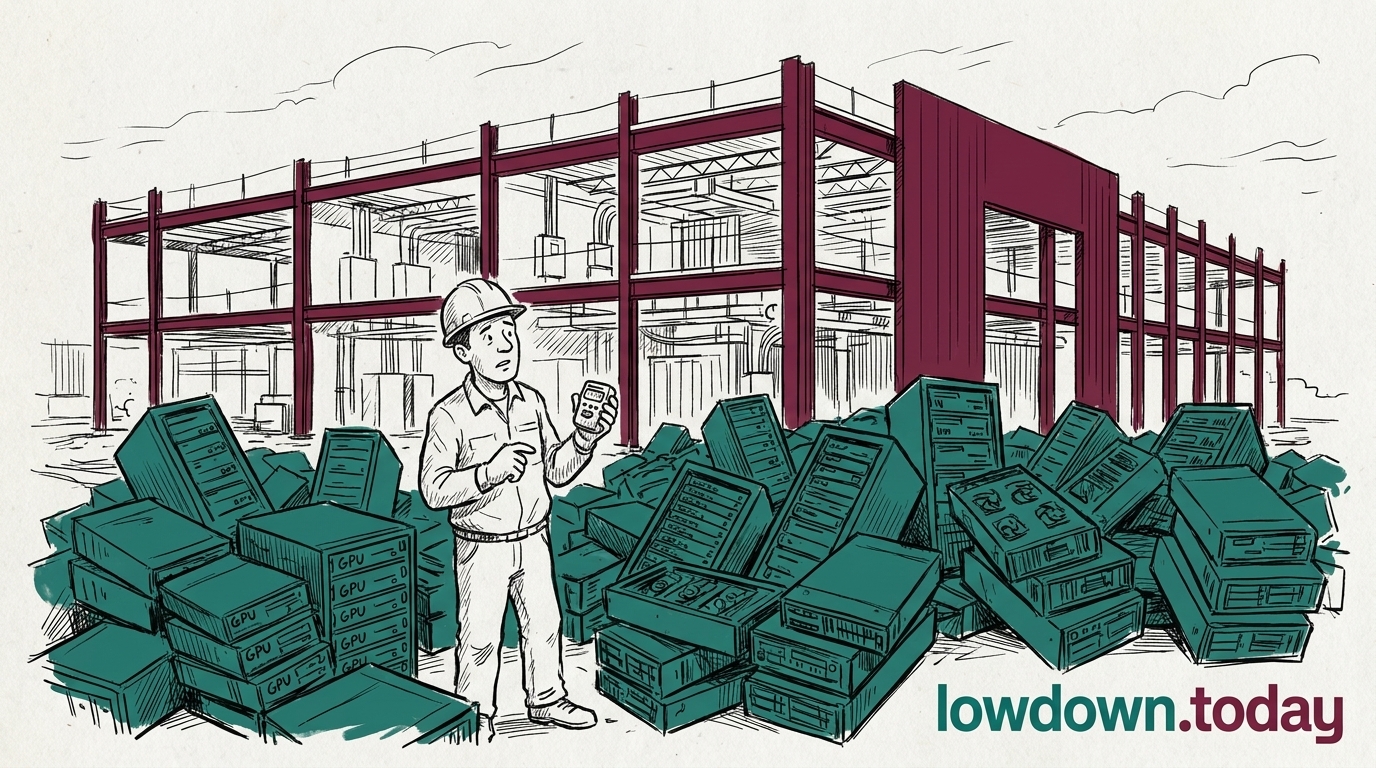
NVIDIA's 20 May results showed data-centre networking revenue at $14.8 billion, up 199 per cent year-on-year, while compute rose 77 per cent, the gap revealing that hyperscalers have shifted spend from buying GPUs to wiring them together.

IndustryDeveloping
Key takeaway

After chips and transformers, the interconnect fabric is the next physical limit on how fast data-centre capacity can come online.

Nvidia reported first-quarter fiscal 2027 results on 20 May, with data-centre networking revenue of $14.8 billion, up 199 per cent year-on-year, against compute revenue of $60.4 billion, up 77 per cent. 1 Networking grew 2.6 times faster than compute; total data-centre revenue reached $75.2 billion for the quarter.

The growth gap traces to how these clusters run. Tens of thousands of graphics processors (GPUs) behave as one machine only if the fabric between them, the InfiniBand and Ethernet switching that carries data chip to chip, keeps pace. Once the processors are ordered, the interconnect becomes the limit on how large a usable cluster gets. Networking at 199 per cent against compute at 77 per cent says hyperscalers have placed their GPU orders and are now spending at triple the rate to link them.

That adds a third item to the supply-chain critical path. GE Vernova booked a $163bn backlog with five-year transformer lead times after buying out Prolec , and Equinix reported 46 active projects, a 3 GW pipeline and capacity it called tight . Switch and interconnect supply now competes with transformers and GPUs for the same finite build timelines. What Nvidia's record quarter says about capital allocation belongs to a separate ledger; for the physical build-out, the fabric rather than the spend now gates when capacity powers on.

Deep Analysis

In plain English

A GPU (graphics processing unit) is the specialist chip that handles the calculations needed to train and run large AI models. NVIDIA makes the most widely used ones. But a single GPU sitting by itself is not very useful for large AI work; you need tens of thousands of them linked together into one giant virtual computer. The cables, switches, and network cards that connect those GPUs are called the interconnect fabric. NVIDIA also makes the leading interconnect system, called InfiniBand, used in the world's largest AI training clusters. When NVIDIA's networking revenue grows nearly 200 per cent while chip revenue grows 77 per cent, it means customers have largely placed their GPU orders and are now spending aggressively on the wiring to link them. The chips are in the warehouse; the interconnect is what turns thousands of boxes into one usable supercomputer.

Deep Analysis
Root Causes

The networking-to-compute revenue ratio shift traces to the GPU cluster architecture NVIDIA popularised with NVLink and InfiniBand: at 72-GPU node scale (DGX H100), each node requires four 400Gb/s InfiniBand ports, and connecting 10,000 such nodes into a single fabric requires roughly 5,500 top-of-rack switches plus two spine layers, each of which must be procured and installed.

The more GPUs ordered in prior quarters, the more interconnect spend follows in subsequent quarters as a near-mechanical consequence.

Lead times on InfiniBand director-class switches stretched to 52-68 weeks in Q4 2025 according to supply-chain reports from Mellanox distributors, meaning the Q1 FY2027 revenue is partly shipping hardware ordered 12-18 months prior, adding a temporal lag between GPU and network procurement that exaggerates the quarterly ratio.

What could happen next?
  • Consequence

    Interconnect fabric joins power transformers and GPUs as the third concurrent supply bottleneck on the critical path for bringing new AI compute capacity online, adding 6-12 months to cluster activation timelines where switch lead times exceed 52 weeks.

  • Risk

    If NVIDIA pricing accounts for 20+ per cent of the 199 per cent networking growth, a normalisation of switch pricing as Ethernet alternatives (Ultra Ethernet Consortium) scale could compress networking revenue materially in FY2028.

First Reported In

Update #4 · Grid wins power to switch off data centres

NVIDIA· 26 May 2026
Read original
Different Perspectives
Antel, Uruguay's state telecom
Antel will build a $70m AI data centre in Canelones, announced after an 11-12 August Council of Ministers meeting, with construction from Q1 2027 and roughly 250 direct jobs. Uruguay is putting a sovereign AI facility on the state balance sheet rather than courting a hyperscaler to build one.
Comtel
Comtel
Comtel is building a Figline Valdarno data centre inside the H2-Era Green Valley complex, powered by an 84 MW solar plant and selling waste heat to on-site farming. Co-location with generation and a heat offtaker is the model regulators elsewhere are now writing into connection terms rather than negotiating case by case.
Greg Abbott, Texas Governor
Abbott directed PUCT and ERCOT on 3 August to audit every queued data centre's ownership, incentives and water use, saying projects that fail the state's survey should lose grid access. QTS's co-chief executives welcomed the review; Agriculture Commissioner Sid Miller called it too vague and wants a special legislative session instead.
Government of Gujarat
Gujarat notified a Data Centre Policy on 7 August offering capital, interest, tax and duty subsidies for projects sourcing at least 51% green power, targeting 7.5 GW against a 74 GW installed base. Where other jurisdictions priced or restricted grid access this month, Gujarat is paying developers to come instead.
Taiwan's Legislative Yuan Economics Committee
The committee gave preliminary approval on 5 August to a self-generation mandate for large power users, including data centres, with fines up to NT$750,000. It agreed the obligation in principle while leaving the megawatt threshold that defines its reach to later implementing regulation.
Australian Energy Market Commission
AEMC advised ministers on 5 August that data centres should surrender renewable certificates against actual consumption, prove new demand with new firm capacity, and register as market participants. The advice would turn passive customers into obligated participants inside the market's dispatch and settlement machinery, ahead of an access-standards determination due in late October.

