Skip to content
You can now search across every topic, entity and event.What's new
Data Centres: Boom and Backlash
14AUG

GE Vernova prices the transformer bottleneck

4 min read
10:48UTC

GE Vernova reported a $163bn backlog at the end of Q1 and closed its $5.3bn Prolec acquisition the same week, locking in the supply-side choke point that decides which 2026 announcements actually commission.

IndustryDeveloping
Key takeaway

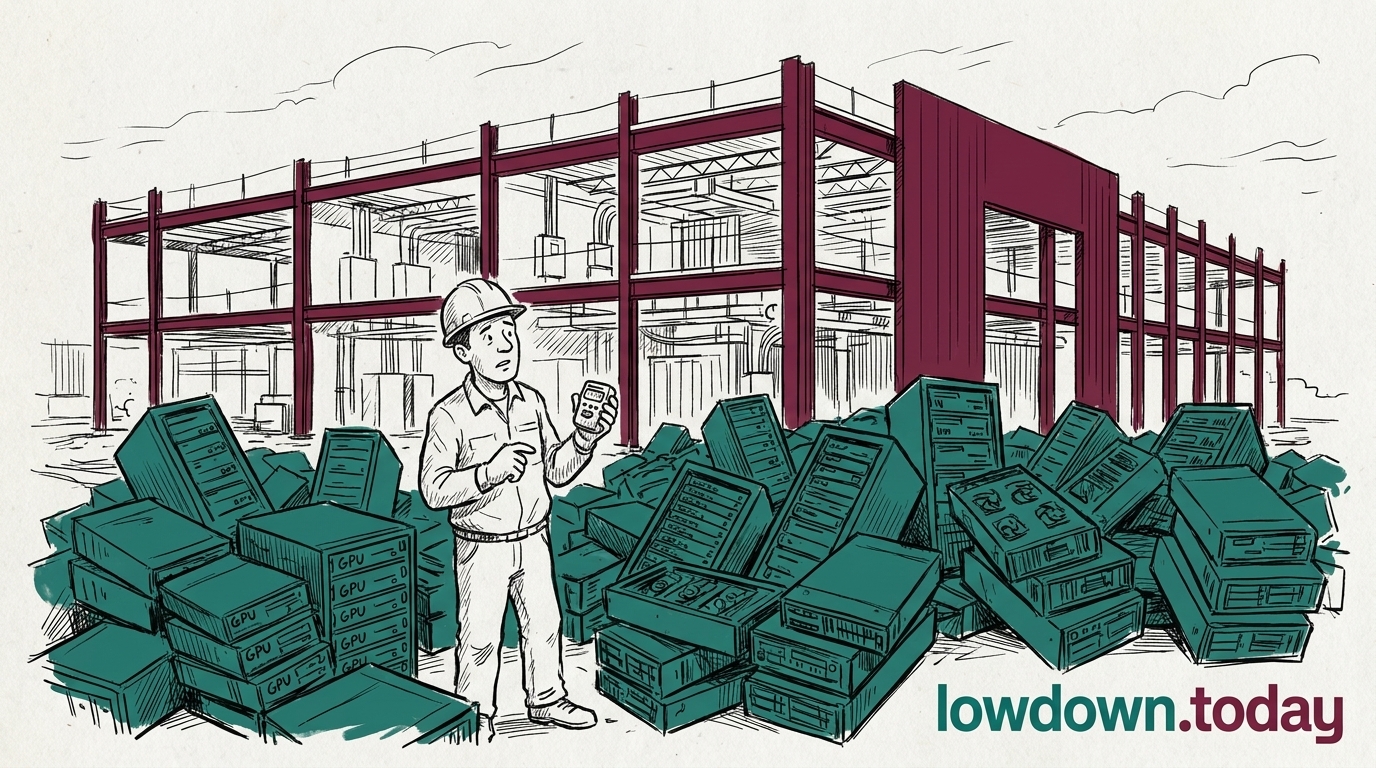
Only a third of 2026's planned data-centre capacity is under construction; transformers will decide which two-thirds slip into 2031.

GE Vernova reported on Wednesday 22 April that its total backlog reached $163bn at the end of the first quarter, an extra $13bn in 90 days, and pulled forward its $200bn backlog target by a year to 2027 1. Data-centre electrification orders alone hit $2.4bn in the quarter, more than the company's full-year 2025 total in that line. The same week, GE Vernova closed its $5.3bn acquisition of the remaining half of Prolec, adding $5bn of transformer backlog to a market where lead times have stretched to five years from 24-30 months pre-2020 2.

The company's gas-turbine book into 2029 had already crossed 80 GW ; the Prolec close extends the same supply-constraint logic to high-voltage transformers, the choke point on every grid-tied campus. Power Magazine puts the read-across in operational terms: only one-third of the 12-16 GW of data-centre capacity planned for 2026 is actually under construction. The rest sits on transformer orders. A unit ordered in May 2026 commissions in 2031 at current lead times, which means Hitachi Energy's $457m South Boston, Virginia plant and Siemens Energy's $150m Charlotte, North Carolina plant, both due in 2027-2028, do not relieve this year's pipeline.

The Prolec deal is the most immediate large-scale capacity addition the market will see in 2026. New build plants take years to commission their own production lines; an acquisition transfers existing capacity inside ninety days. The Q1 electrification line ($2.4bn against a full prior year of $1bn-plus) is the cleanest issuer-confirmed evidence that the demand has moved from talk to order, with cash deposits and slot reservations behind each line. GE Vernova's pricing power on data-centre electrification orders extends through 2028 at minimum on the lead-time arithmetic alone.

For any operator without a 2024 transformer order already on the books, the practical implication of today's hyperscaler aggregate is that announcements above the existing in-flight book are a forward booking against 2031 silicon. The supply side is now visibly the binding constraint on the build rate, and the issuer disclosing the constraint is the same vendor selling its way out of it.

Deep Analysis

In plain English

Before a data centre can receive electricity from the grid, it needs a transformer: a large piece of electrical equipment that converts high-voltage grid power into a form the building can use. GE Vernova, spun out of General Electric in 2024, makes transformers, gas turbines and grid equipment for exactly this purpose. GE Vernova has so many orders it cannot fill them all quickly. If you order a transformer today, you will receive it in five years, not two years as was normal before 2020. This means most of the data centres that have been announced for 2026 cannot actually be built yet, because the equipment is not available. Only one-third of the planned construction for 2026 is actually happening.

Deep Analysis
Root Causes

Transformer manufacturing is capital-intensive and slow to scale for three structural reasons. First, the core laminations require grain-oriented electrical steel, a specialty product with only a handful of global producers including Nippon Steel, AK Steel and Voestalpine; any expansion in transformer output depends on steel supply that is itself constrained.

Second, winding and testing a large power transformer requires skilled labour trained over multiple years; workforce expansion cannot outrun transformer delivery cycles. Third, the pandemic disrupted both supply and workforce simultaneously, creating a deficit that compounded rather than recovered.

GE Vernova's acquisition of Prolec addresses the manufacturing bottleneck more directly than any greenfield plant: Prolec already has trained workers, tested production lines, and steel supply agreements. The $5bn of incremental transformer backlog added by the acquisition is capacity that exists today, not in 2028.

What could happen next?
  • Consequence

    Any data-centre operator without a transformer order placed before 2025 cannot commission new capacity before 2031 at current lead times, regardless of capex or planning consent.

    Medium term · 0.9
  • Opportunity

    GE Vernova's pricing power on data-centre electrification orders extends through 2028 at minimum; its Q1 2026 margin trajectory on this line is materially above the company's blended average.

    Medium term · 0.8
  • Risk

    The two-thirds of 2026 planned capacity waiting on transformer orders will apply for the same 2027-2028 slots simultaneously, creating a secondary congestion event at new-plant commissioning.

    Medium term · 0.7
First Reported In

Update #3 · OpenAI cuts $800bn; rivals double down

GE Vernova· 16 May 2026
Read original
Different Perspectives
Antel, Uruguay's state telecom
Antel will build a $70m AI data centre in Canelones, announced after an 11-12 August Council of Ministers meeting, with construction from Q1 2027 and roughly 250 direct jobs. Uruguay is putting a sovereign AI facility on the state balance sheet rather than courting a hyperscaler to build one.
Comtel
Comtel
Comtel is building a Figline Valdarno data centre inside the H2-Era Green Valley complex, powered by an 84 MW solar plant and selling waste heat to on-site farming. Co-location with generation and a heat offtaker is the model regulators elsewhere are now writing into connection terms rather than negotiating case by case.
Greg Abbott, Texas Governor
Abbott directed PUCT and ERCOT on 3 August to audit every queued data centre's ownership, incentives and water use, saying projects that fail the state's survey should lose grid access. QTS's co-chief executives welcomed the review; Agriculture Commissioner Sid Miller called it too vague and wants a special legislative session instead.
Government of Gujarat
Gujarat notified a Data Centre Policy on 7 August offering capital, interest, tax and duty subsidies for projects sourcing at least 51% green power, targeting 7.5 GW against a 74 GW installed base. Where other jurisdictions priced or restricted grid access this month, Gujarat is paying developers to come instead.
Taiwan's Legislative Yuan Economics Committee
The committee gave preliminary approval on 5 August to a self-generation mandate for large power users, including data centres, with fines up to NT$750,000. It agreed the obligation in principle while leaving the megawatt threshold that defines its reach to later implementing regulation.
Australian Energy Market Commission
AEMC advised ministers on 5 August that data centres should surrender renewable certificates against actual consumption, prove new demand with new firm capacity, and register as market participants. The advice would turn passive customers into obligated participants inside the market's dispatch and settlement machinery, ahead of an access-standards determination due in late October.

