Skip to content
You can now search across every topic, entity and event.What's new
Data Centres: Boom and Backlash
14AUG

IEA: 17% growth, $700B capex run-rate

3 min read
10:48UTC

The IEA's 16 April release put global data centre electricity demand growth at 17% in 2025, six times the overall electricity growth rate, with five hyperscalers' capex topping $400 billion and projected to reach roughly $700 billion in 2026.

IndustryDeveloping
Key takeaway

Capex topped $400B in 2025 and is forecast at $700B in 2026; the binding constraint is no longer capital.

The International Energy Agency (IEA) released its updated data centre electricity report on 16 April 2026, restating the growth curve in maximalist terms. 1 Global data centre electricity demand grew 17% in 2025, six times the 3% overall global electricity growth rate, with AI-focused facilities expanding by roughly 50%. Five major tech companies collectively topped $400 billion in capex in 2025, a figure the IEA expects to rise a further 75% in 2026 to about $700 billion. 2

The IEA is the OECD's energy modelling agency in Paris, the body whose annual World Energy Outlook sets the baseline most utilities and finance ministries use for grid planning. When it puts a number on hyperscaler capex, the figure is sourced directly from company filings and disclosed corporate energy data, not industry analyst projections. The 2025 total absorbed roughly 485 TWh of global electricity at data centres alone.

Conditional agreements for small modular reactor (SMR) power for data centres jumped from 25 GW at end-2024 to 45 GW by April, a near-doubling of paper nuclear in sixteen months. 3 No commercial SMR has yet powered a data centre anywhere in the world; the GW figures are letters of intent, not interconnection agreements. The pipeline reflects what hyperscalers want to procure, not what the supply chain can deliver this decade.

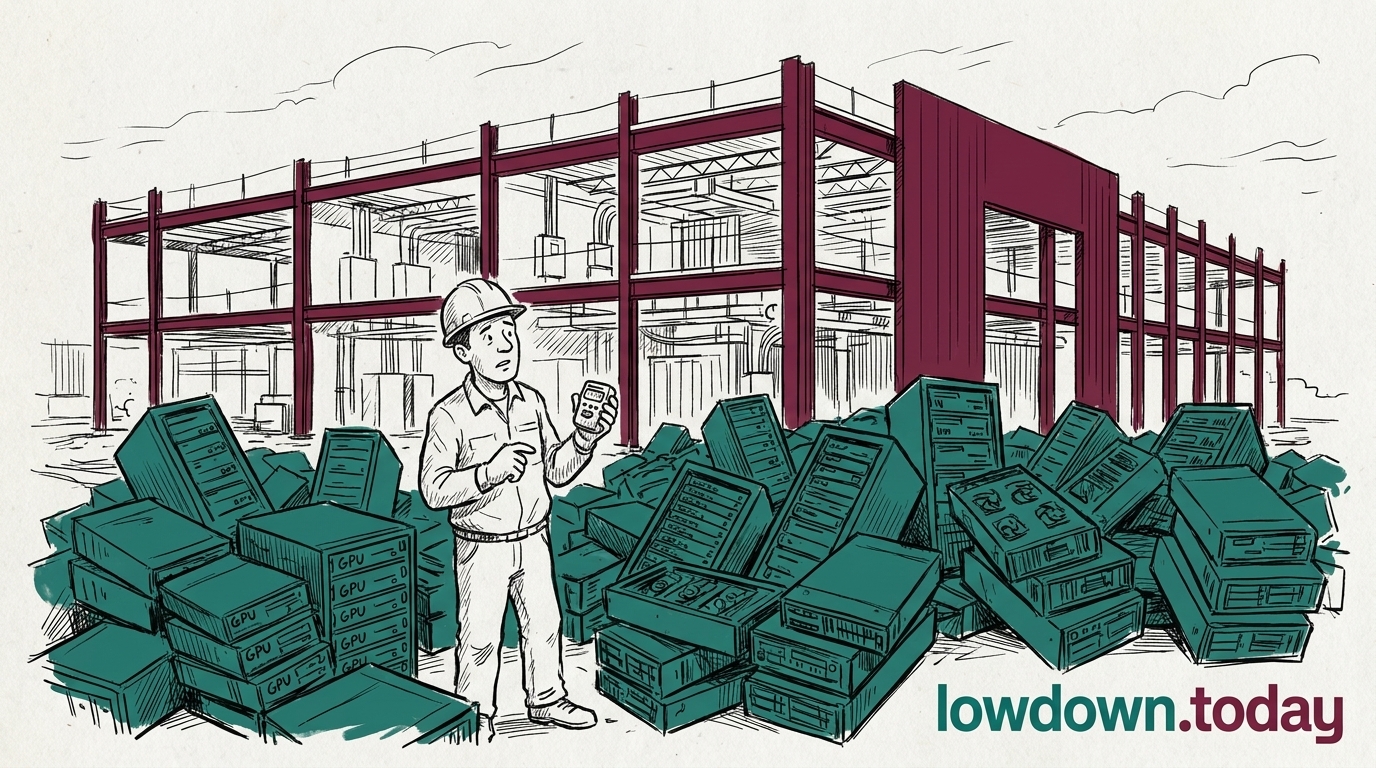
Capex and chips have stopped binding the build-out. Credit lines remain open at unprecedented scale and the silicon supply has caught up enough to absorb the dollars. What stops a project in April 2026 is grid headroom, planning approval, water permits, and increasingly state legislatures, not capital. The five sections that follow trace what happens when a $700 billion spend curve meets jurisdictions that are starting to refuse the load.

Deep Analysis

In plain English

A data centre is a large building full of computers that run cloud storage, streaming, and AI services. Every computation uses electricity and generates heat. As AI models have grown larger and more complex, the computers running them need far more power per square metre of floor space than earlier generations. The IEA is the International Energy Agency, a Paris-based international body that tracks global energy use. Its 16 April figures show that data centres worldwide used 485 TWh of electricity in 2025, about the same as the entire United Kingdom. That is up 17% from the year before, while total global electricity use grew only 3%. SMRs, or small modular reactors, are a type of nuclear power station being developed at smaller scale than traditional plants. Tech companies are signing agreements to buy electricity from SMRs that have not been built yet, because they do not expect the ordinary electricity grid to have enough spare capacity to meet their needs.

Deep Analysis
Root Causes

Data centre electricity demand is growing at a multiple of overall grid growth because AI inference workloads are power-dense in ways general-purpose computing is not. A 2027-era AI server rack draws power equivalent to roughly 65 UK households; a 2020-era rack drew the equivalent of about six. This is not a scheduling or efficiency problem, it is a physics constraint on the rate at which waste heat can be removed and power delivered.

The SMR pipeline jump from 25 to 45 GW in 16 months reflects a secondary cause: grid operators in the UK, US, and EU cannot connect new load at the pace operators require, so operators are contracting alternative generation sources. SMR agreements are conditional and multi-decade; they signal intent, not delivered capacity.

What could happen next?
  • Consequence

    At the IEA's central 2030 projection, data centres would consume approximately 950 TWh globally, equivalent to adding Japan's entire electricity demand to the sector in five years.

    Medium term · Medium
  • Risk

    SMR conditional agreements at 45 GW represent procurement intent, not delivered capacity; if nuclear licensing timelines hold to historical rates, most will not commission before 2035.

    Long term · High
  • Opportunity

    Countries with surplus low-carbon generation capacity and permissive planning frameworks, Iceland, Norway, parts of Canada, stand to attract disproportionate hyperscaler investment as consent constraints tighten elsewhere.

    Medium term · Medium
First Reported In

Update #1 · Boom hits wall: grid says no, states freeze

International Energy Agency· 26 Apr 2026
Read original
Different Perspectives
Antel, Uruguay's state telecom
Antel will build a $70m AI data centre in Canelones, announced after an 11-12 August Council of Ministers meeting, with construction from Q1 2027 and roughly 250 direct jobs. Uruguay is putting a sovereign AI facility on the state balance sheet rather than courting a hyperscaler to build one.
Comtel
Comtel
Comtel is building a Figline Valdarno data centre inside the H2-Era Green Valley complex, powered by an 84 MW solar plant and selling waste heat to on-site farming. Co-location with generation and a heat offtaker is the model regulators elsewhere are now writing into connection terms rather than negotiating case by case.
Greg Abbott, Texas Governor
Abbott directed PUCT and ERCOT on 3 August to audit every queued data centre's ownership, incentives and water use, saying projects that fail the state's survey should lose grid access. QTS's co-chief executives welcomed the review; Agriculture Commissioner Sid Miller called it too vague and wants a special legislative session instead.
Government of Gujarat
Gujarat notified a Data Centre Policy on 7 August offering capital, interest, tax and duty subsidies for projects sourcing at least 51% green power, targeting 7.5 GW against a 74 GW installed base. Where other jurisdictions priced or restricted grid access this month, Gujarat is paying developers to come instead.
Taiwan's Legislative Yuan Economics Committee
The committee gave preliminary approval on 5 August to a self-generation mandate for large power users, including data centres, with fines up to NT$750,000. It agreed the obligation in principle while leaving the megawatt threshold that defines its reach to later implementing regulation.
Australian Energy Market Commission
AEMC advised ministers on 5 August that data centres should surrender renewable certificates against actual consumption, prove new demand with new firm capacity, and register as market participants. The advice would turn passive customers into obligated participants inside the market's dispatch and settlement machinery, ahead of an access-standards determination due in late October.

