Cuba's national grid disconnected completely at 22:43 on Sunday 2 August, cutting power to an island of 11.1 million people. It was the sixth total failure of the Sistema Eléctrico Nacional (SEN), Cuba's unified national grid, in 2026 and the eleventh since late 2024. CNN, drawing on AP, attributed the episode to storm damage to a 220kV (kilovolt) transmission line running from Pinar del Río through Matanzas to Havana. 1
Unión Eléctrica (UNE), the state grid operator, gave a different account through its own bulletins. Félix Estrada Rodríguez, director of UNE's Despacho Nacional de Carga, the national load-dispatch centre, told state television that the total disconnection began with a fault in a 110kV substation in Havana. That fault set off a network oscillation, a rapid swing in the grid's frequency, which travelled the length of the island and tripped the Felton thermal plant in Holguín, some 700km east. 2 Neither UNE account cites weather. A storm can perfectly well cause a substation fault, and whether the two versions reconcile is not established; Lowdown puts both on the record rather than choosing between them.
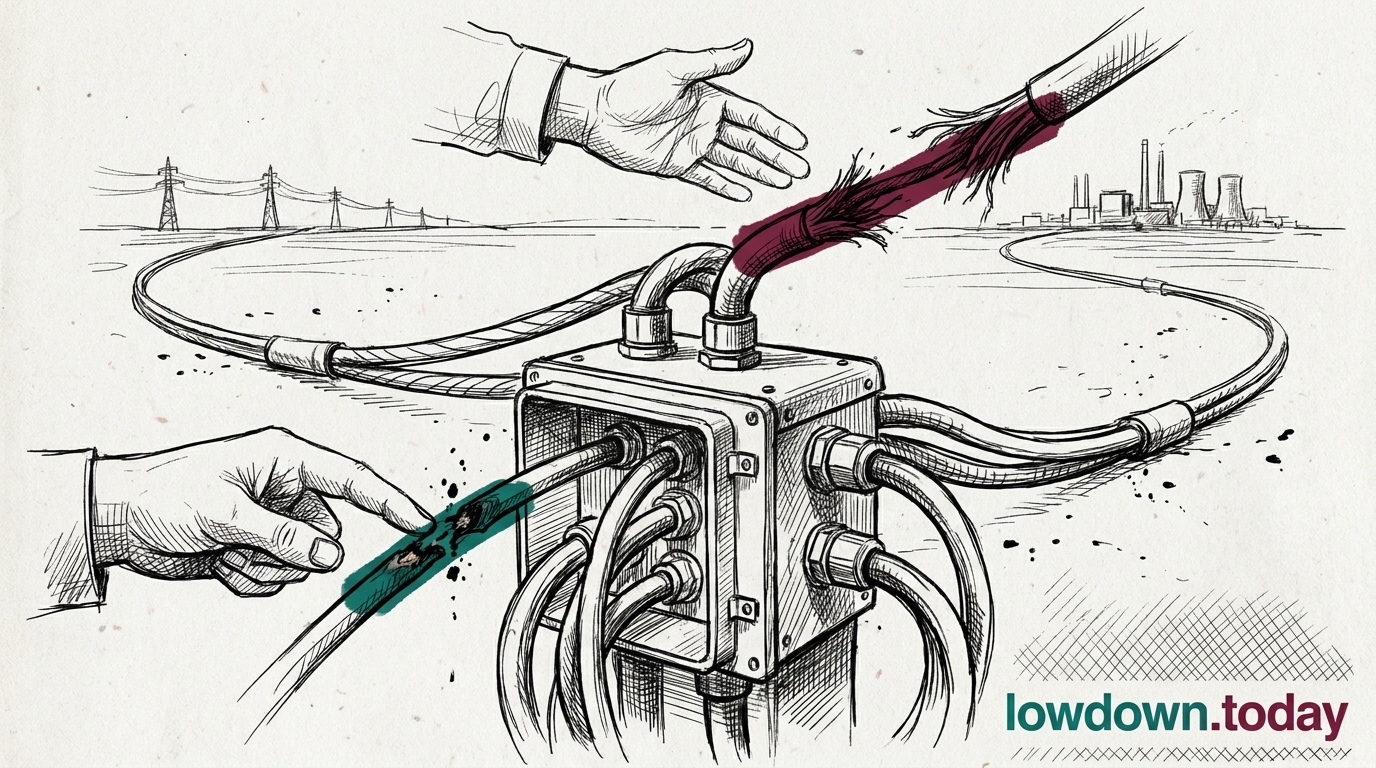
They point at different systems, though. A snapped 220kV line is an external event no operator can prevent. A 110kV distribution fault that cascades into national disconnection describes a fleet with nothing spare behind it, and that is the harsher of the two readings. In practice the difference decides where scarce repair money has to go: transmission steel under the first account, distribution protection and reserve capacity under the second.
The sequence ran for three days. Saturday 1 August brought a partial outage across five of Cuba's fifteen provinces, after the 220kV Matanzas to Cienfuegos and Matanzas to Santa Clara lines tripped simultaneously and split the western zone. A reconnection attempt on Monday 3 August failed when fresh damage struck generating units already brought back online, according to Diario de Cuba. 3 Felton has been here before, at the other end of the causal chain: its unit 1 tripped on 14 July and took the system down itself , four days after a 220kV line between Santa Clara and Sancti Spíritus did the same , and eight days after Unit 6 at Nuevitas opened the sequence on 6 July . Four collapses in four weeks, from a generating unit, a transmission line, a substation and Felton. Mechanically, nothing links the four; what links them is a fleet with no reserve capacity to absorb any single loss.
UNE's restoration reporting is unusually granular, and all of it is first-party. By the bulletins' cut-off Havana had recovered 25 substations and 42 circuits, restoring 126,695 clients and 98 MW (megawatts), 14.7 per cent of the capital, with 31 hospitals and two water-pumping stations back on mains or backup power. 4 AP reported residents sleeping on Havana's Malecón seafront to escape the summer heat, and US Embassy Havana issued an advisory to American citizens. 5