Skip to content
Welcome, thoughtbot's Giant Robots listeners!Start here
Autonomous Systems: Land & Sea
12AUG

Brave1 Market takes 590,000 drone orders

3 min read
14:17UTC

Ukrainian brigades ordered more than 590,000 drones through Brave1 Market in nine months, paying with points earned for confirmed results.

TechnologyAssessed
Key takeaway

Ukrainian brigades ordered over 590,000 drones themselves this year as approvals of new designs accelerated.

Ukrainian units ordered more than 590,000 drones through Brave1 Market in the first nine months of 2026, Ukraine's Ministry of Defence said on 25 September⁠1. Brave1 Market is the ordering platform of Brave1, the state defence-technology cluster. Brigades choose a supplier there and pay with ePoints, credits earned for confirmed results such as hits, reconnaissance and evacuations.

That works out at roughly 65,000 drones a month chosen by the units that fly them rather than by a central buyer. The ministry says the average monthly value of orders has more than doubled since January, and that orders for fixed-wing kamikaze drones peaked at six times their January level. It gave no hryvnia total and no supplier count, so the volume cannot be turned into a price per drone. In August the ministry said Brave1 listed 46 AI products.

The ministry has also codified 650 drone systems since January, among them 238 strike copters and 231 fibre-optic systems⁠2. Codification is the approval a Ukrainian maker needs before the state can buy its product. Fibre-optic drones trail a thin cable instead of using a radio link, so a jammer cannot cut them off, and they now nearly match strike copters among approved designs.

The ministry had reported 413 codified systems by mid-July⁠3. By Lowdown's calculation from those two figures, approvals ran at about 100 a month from mid-July, against about 63 a month before: roughly 1.6 times the earlier pace. A system that pays brigades for results only works if they have a wide catalogue to choose from, and codification is how Kyiv widens it.

Deep Analysis

In plain English

Ukraine's Army uses huge numbers of small drones to scout and to strike Russian forces. Instead of a central office buying all of them, the government runs Brave1 Market, an online shop where frontline units choose drones themselves. Units pay with ePoints, a kind of credit they earn for confirmed results such as destroying enemy equipment. Before a company can sell a drone through the system, the defence ministry must approve, or codify, the design. Some newer drones are steered through a thin cable rather than by radio, so enemy jamming cannot cut them off.

Deep Analysis
Root Causes

electronic warfare drove the design shift. Jammers cut the radio link of most small drones, so fibre-optic control, which trails a cable instead, has become a default requirement, and 231 of the 650 approvals now use it.

The ministry's codification by type also shows where the next demand sits: 42 interceptor drones, 32 middle-strike and nine deep-strike systems were approved alongside the copters. Interceptors answer Russia's Shahed-type attack drones, and the deep-strike types reach targets far behind the front.

What could happen next?
  • Consequence

    Fibre-optic control becomes a standard Ukrainian requirement, pushing radio-only designs to the margins of state buying.

  • Opportunity

    Approved Ukrainian interceptor and deep-strike designs give European partners a catalogue to co-produce if exports open.

First Reported In

Update #18 · Four EU states skip tenders on drone defence

Ministry of Defence of Ukraine (via GlobalSecurity.org)· 1 Oct 2026
Read original →
Causes and effects
This Event
Brave1 Market takes 590,000 drone orders
Ukraine has moved much of its drone buying from a central ministry to the units that fly them, and is approving new designs faster.
Different Perspectives
Conservative opposition
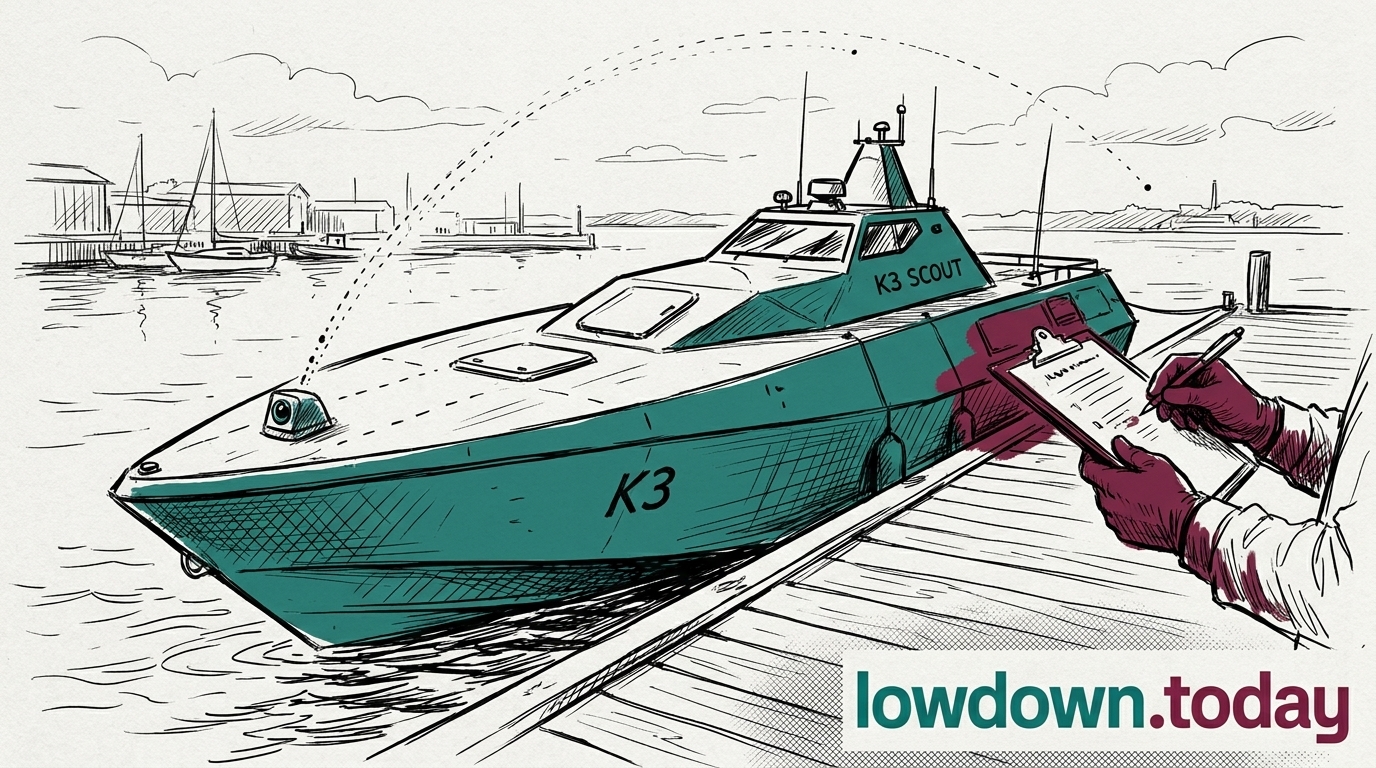
The Conservative opposition called on the Government on 9 August to 'urgently audit' equipment for hidden Chinese components, after the Telegraph's K3 SCOUT report. No named MP has been quoted on the record; the call came at party level, alongside the Ministry of Defence's own 10 August statement that no data had been compromised.
Kraken Technology Group
Kraken Technology Group is a UK maritime-defence company based in Portsmouth that builds the K3 SCOUT, and crossed a $1bn valuation in July on a single-sourced $175m raise. The camera components reached the fleet under a third party's written security assurance, which the Platform Authority, which does not yet exist, was never positioned to check.
Navy Commercial
Navy Commercial
Navy Commercial at Whale Island published two notices on 5 August: 074032-2026, asking industry how to build a Platform Authority to certify uncrewed vessels, and 074351-2026, a GBP10m multi-role USV testbed for the Defence Chief Technology Officer. Responses on the Platform Authority close 19 August, ten days after the cameras were found transmitting to China.
HUMAIN
HUMAIN
HUMAIN and Applied Intuition stated a 2030 target for thousands of autonomous trucks on Saudi logistics corridors. The announcement disclosed no order, fleet baseline or contract value.
Saildrone
Saildrone
Saildrone and Lockheed Martin demonstrated two JAGM launches from a Surveyor-class vessel at RIMPAC. The accepted record identifies no requirement, customer or production configuration behind the demonstration.
Taiwan Legislative Yuan
Taiwan's Legislative Yuan passed the Act at third reading with a small suicide uncrewed boat on the named development list. The NT$240 billion ceiling covers all unmanned domains, and the Act was not promulgated by 4 September.
