Skip to content
You can now search across every topic, entity and event.What's new
AI: Jobs, Power & Money
23APR

Four governments, four AI jobs answers

4 min read
14:51UTC

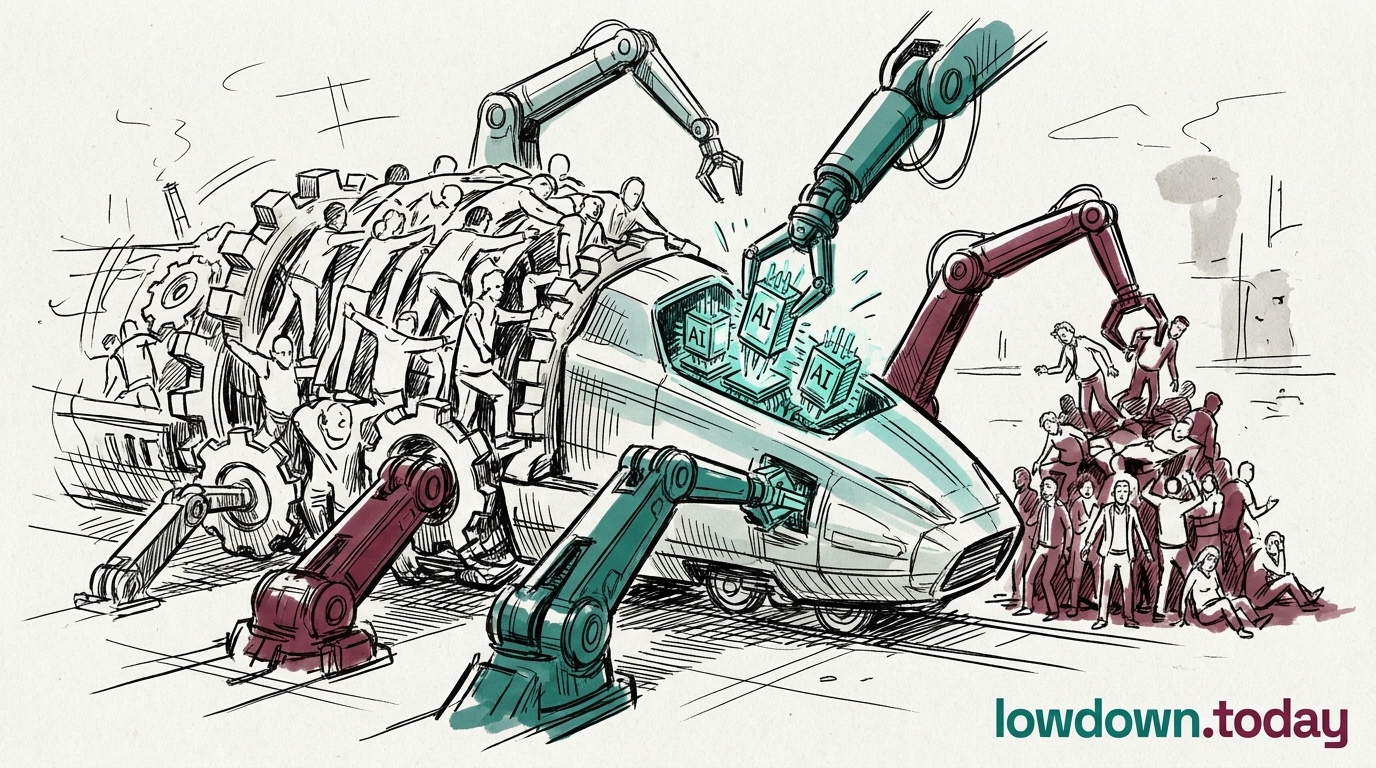
The EU mandates pre-deployment conformity assessments. South Korea bets on innovation-first self-governance. The US has a bipartisan reporting bill and a California notice requirement. Four models, no convergence.

EconomicAssessed
Key takeaway

The global regulatory response to AI displacement is fragmenting into four incompatible models — creating compliance costs for responsible firms and arbitrage opportunities for those willing to operate wherever rules are lightest.

Legislators on three continents are writing rules for AI and employment. None of them agree on what the rules should do.

The EU AI Act's high-risk employment provisions take effect in August 2026 4. Any company deploying AI in recruitment, performance monitoring, promotion, or termination decisions must conduct a conformity assessment before deployment, maintain documented risk management systems, ensure human oversight, and monitor for discriminatory outcomes. Penalties reach €35 million or 7% of global annual turnover. The framework treats employment AI as a regulated product — analogous to medical devices — subject to pre-market authorisation.

South Korea's AI Basic Act, effective since 22 January, takes the opposite bet. It creates an AI Committee under the Prime Minister's office and establishes transparency principles but imposes no conformity assessments, no mandatory risk documentation, and no pre-deployment oversight. Seoul calculated that EU-style compliance costs would disadvantage Samsung, Naver, and Kakao against Chinese competitors. South Korea ranks among the top five countries for AI patent filings. Its youth unemployment hovers around 7–8%.

The United States has no comprehensive federal framework. Senators Mark Warner and Josh Hawley introduced the AI-Related Job Impacts Clarity Act (S.3108), requiring companies and federal agencies to report AI-related layoffs to the Department of Labor 1. The bill addresses the measurement vacuum documented by Challenger — only 8% of early-2026 cuts were formally attributed to AI 2.

California introduced SB 951, the Worker Technological Displacement Act: 90 days' advance notice before AI-driven mass layoffs and a state database to track displacement. Block's single-day workforce elimination is precisely the kind of action SB 951 would require three months' notice for. No US jurisdiction currently tracks AI-related job losses systematically.

A regulatory fault line is forming. The EU demands pre-deployment assessment. South Korea relies on post-deployment self-governance. China regulates by application category. The United States has a patchwork of state bills and one bipartisan federal reporting requirement. For multinationals deploying AI across all four jurisdictions, compliance now requires navigating four philosophical approaches to the same technology.

Deep Analysis

In plain English

Two US senators — one Democrat from Virginia, one Republican from Missouri — have jointly proposed a law requiring large companies and federal agencies to report to the government when they cut jobs because of AI. Right now, companies can lay off thousands of workers and describe it as 'restructuring' without specifying AI as the cause. This bill would create a national record of AI-attributed job losses. It would not directly help displaced workers — no mandatory notice, no retraining, no compensation. But it would make the AI washing problem harder to sustain at scale and could provide the data foundation for stronger legislation in future congressional sessions.

Deep Analysis
Synthesis

The Warner-Hawley alliance is analytically significant beyond the bill's narrow content. Warner's Northern Virginia constituency spans major federal contractors — simultaneously AI-investment beneficiaries and workforces exposed to AI-driven restructuring. Hawley's populist-nationalist brand has converged on opposition to concentrated tech power. Their coalition signals AI labour displacement is developing the cross-ideological salience that is a prerequisite for the stronger, durable legislation that labour advocates and academic researchers argue will ultimately be necessary.

Root Causes

The bill addresses a specific informational asymmetry: the AI washing problem is currently unverifiable at scale because no mandatory causal attribution requirement exists in layoff reporting. The Department of Labor's existing WARN Act filings capture the fact of mass layoffs but not their stated cause. S.3108 targets this data gap — itself a structural cause of policy paralysis, as legislators cannot design targeted interventions without causal data on which jobs are actually displaced by AI versus conventional restructuring.

Escalation

Bipartisan introduction does not guarantee passage — the bill faces Senate HELP Committee dynamics that are genuinely uncertain, and technology-sector lobbying will resist mandatory disclosure requirements. If March payrolls data produces a second consecutive negative print, political urgency for passage rises materially and the window for stronger provisions may open.

What could happen next?
  • Precedent

    Bipartisan sponsorship signals AI labour displacement has achieved cross-ideological political salience sufficient to sustain legislative attention across election cycles.

    Short term · Assessed
  • Opportunity

    The causal attribution data S.3108 would generate could become the evidentiary foundation for stronger AI labour legislation — job guarantees, retraining mandates, or AI taxation — in subsequent sessions.

    Medium term · Suggested
  • Risk

    A reporting mandate without enforcement or remediation provisions may normalise AI-driven displacement by producing official counts without policy response, legitimising rather than limiting the practice.

    Medium term · Suggested
  • Meaning

    The bill's limited scope — reporting only, no notice or remediation — reflects the current political ceiling for AI labour legislation in the United States.

    Immediate · Assessed
First Reported In

Update #1 · Meta cuts 20% while Big Tech spends $650bn

Fortune· 17 Mar 2026
Read original
Causes and effects
This Event
Four governments, four AI jobs answers
For the first time, four major jurisdictions are simultaneously legislating AI employment rules from fundamentally different premises. The EU treats AI as a regulated product. South Korea treats it as an economic growth engine. The US treats it as a reporting problem. China treats it case by case. The divergence shapes where companies locate AI operations and which workers receive protection.
Different Perspectives
Barclays
Barclays
Barclays economist Pooja Sriram flagged a 28,000-a-month bleed in finance and information roles the same week Microsoft disputed that AI drove its own 4,800 cuts. The bank treats Challenger's AI-attribution share as a lagging indicator against faster erosion visible in raw labour-market data.
European Commission
European Commission
Brussels deferred the Digital Omnibus's Annex III employment-compliance deadline from 2 August 2026 to December 2027, even as California advanced three binding AI-hiring bills the same week. The 17-month delay leaves EU workers without the algorithmic-hiring safeguards the regulation already promises.
OpenAI
OpenAI
OpenAI proposed a 5% US government equity stake worth $42.6bn, structured as a public wealth fund modelled on the Alaska Permanent Fund, with Sam Altman pitching it directly to Trump, Bessent and Lutnick. The offer pre-empts Sanders' rival one-time 50% AI-stock tax, which has not yet reached committee.
India's IT and outsourcing sector
BAT's transfer of 3,500 roles to Accenture on 29 June fits a delivery model Indian IT firms increasingly run: consultancies win Western contracts, then execute through offshore centres. The sector expects more Fit2Win-style transfers, not straight redundancies, as employers absorb AI without cutting outsourced headcount.
European Trade Union Confederation
ETUC says the Council's shift from 'ensure' to 'support' in the AI-literacy duty, confirmed in the Digital Omnibus's final adoption on 29 June, is a collapse of the legal threshold, not a drafting tidy-up. It expects EU workers to face AI-driven hiring and monitoring decisions with a statutory right to explanation that exists in name only.
British American Tobacco's Fit2Win workforce
BAT is cutting 9,000 roles under Fit2Win, transferring 3,500 to Accenture rather than making them redundant, to reach roughly £500m in AI-driven savings by 2027. For affected staff, that distinction decides whether they keep a job at all, just not at BAT.
