Skip to content
Briefings are running a touch slower this week while we rebuild the foundations.See roadmap
2026 FIFA World Cup
6JUN

State Dept has no data on visa impact

3 min read
12:17UTC

The government that expanded entry bonds to 50 countries has produced no estimates of how the policy will affect attendance or the $2 billion economic projection.

SportDeveloping
Key takeaway

The US government expanded visa restrictions affecting 9 qualified nations' fans without modelling the attendance impact.

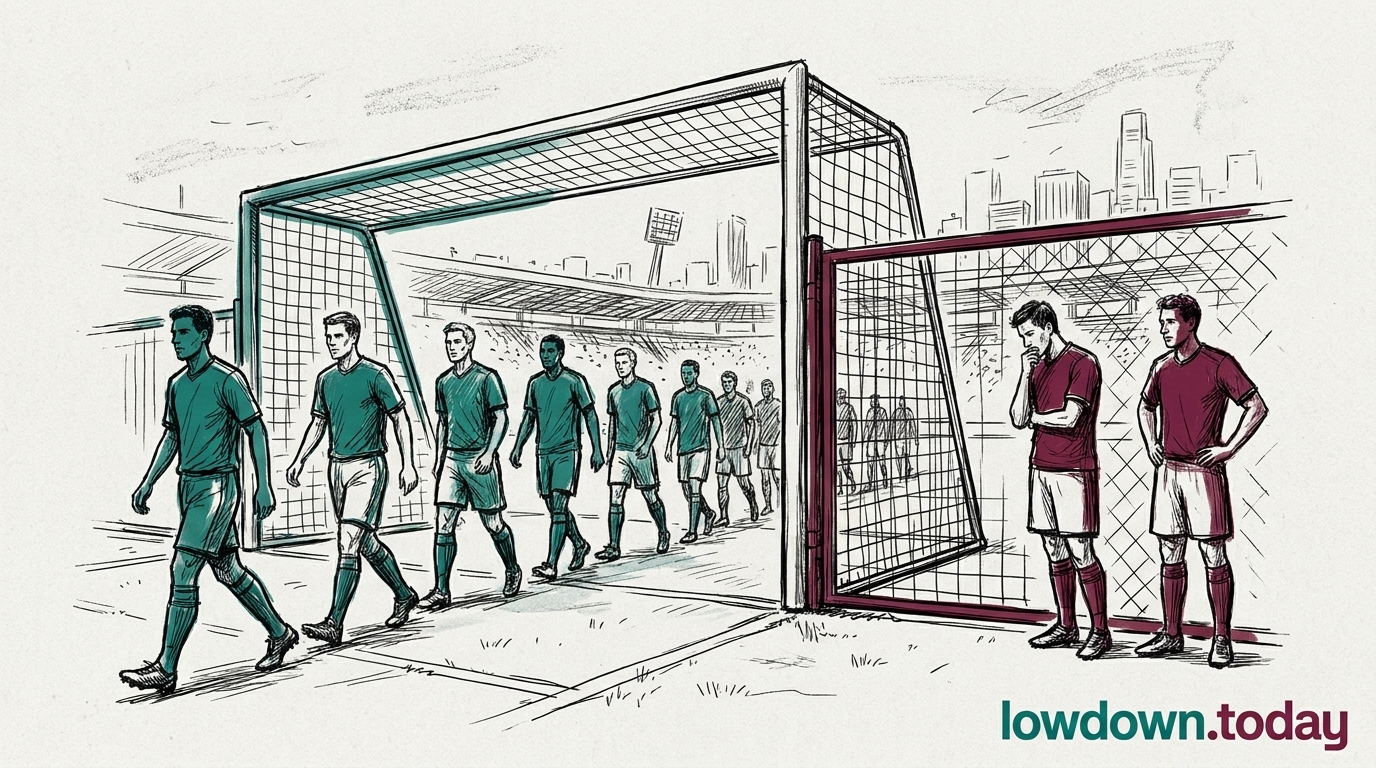
The State Department expanded the bond programme to 50 countries on 2 April and admitted seven days later it had not modelled the impact. The original travel ban bars fans from four qualified nations outright; the bond programme layers financial barriers on top of that.

The Council on Foreign Relations independently identified at least nine qualified World Cup nations whose fans face outright bans or significant barriers, 18.75% of the 48-team field. The admission is a governance gap, not a stated policy position: expanding programme scope without baseline measurement contradicts standard performance metrics guidance. When attendance figures arrive in July, neither the government nor FIFA will have a counterfactual to measure against.

South Africa's 2010 approach (waiving visa requirements for all ticket holders and receiving 300,000 international visitors) represents the policy inverse. The current US trajectory is the opposite on every dimension.

North Texas's $2 billion economic projection now stands as an untested assumption. No government body has modelled how many of the projected 6 million visitors come from the 50 bond-programme countries.


Deep Analysis

In plain English

The US government added 50 countries to a programme requiring fans to post $15,000 bonds to attend matches, then admitted it has no idea how many people this will keep away. It is confidence without data.

Deep Analysis
Root Causes

Originally, the visa bond programme was designed as an immigration enforcement tool, not a tournament access tool. The 2 April expansion to 50 countries was driven by the broader 'enhanced vetting' framework of the current administration, not by World Cup planning.

FIFA and the host committee have no authority over US immigration policy; their role is to advocate, not to determine. The governance gap—expanding restrictions without modelling tournament impact—reflects the absence of a formal coordination mechanism between immigration policy-making and tournament hosting obligations.

What could happen next?
  • The $2 billion North Texas economic projection lacks any government baseline modelling; if fan access shortfalls materialise, there is no official counterfactual.

    Medium term · 0.75
  • FIFA's failure to secure fan access guarantees from the host government may expose the organisation to legal challenge from affected national federations after the tournament.

    Long term · 0.45
  • The State Department admission that it has no impact estimates will be cited by congressional Democrats and international critics throughout the tournament.

    Short term · 0.9
First Reported In

Update #6 · FIFA's stealth price hike

Texas Public Radio / KERA News· 10 Apr 2026
Read original
Different Perspectives
FIFA
FIFA
FIFA remains publicly silent on every open dispute touching the tournament: no response to the UNITE HERE ICE-moratorium demand since April, no on-record comment on the Iran visa reversal, no intervention on the FIGC election. Its governance architecture, which routes bilateral matters to governments and domestic federation matters to national bodies, structurally precludes a direct answer on all three.
Andrea Abodi / Italian Sports Ministry
Abodi's ANAC referral is the first formal institutional step in his challenge to Malagò, converting a legal argument into a timed procedural clock, with both bodies reportedly receiving the request with "considerable frustration". The 15 June deadline means Italy's federation crisis will peak mid-tournament regardless of the ruling's direction.
Mauricio Pochettino / USMNT
Pochettino confirmed the 4-3-3 with Reyna and Pulisic starting against Germany, resolving the formation question at the cost of a 3-1 defeat that exposed the defensive axis. His public frustration over Richards's fitness, "I got a little annoyed", frames the 11 June deadline as an emotional as well as a tactical decision.
FFIRI / Mehdi Taj
FFIRI / Mehdi Taj
FFIRI confirmed the squad's clearance but stated five federation staffers were blocked under a "false pretences" finding, and denied separately reported player rejections, insisting the playing group travels intact. Taj's 5 June deadline expired; the approval arrived the same day, meeting the form of the demand while leaving the delegation short.
US State Department / UNITE HERE Local 11
Unnamed US officials approved Iran's squad visas via Ankara without a formal State Department statement, leaving Taremi's individual file unconfirmed; at the same venue system, UNITE HERE Local 11's 96% strike mandate among 2,000 SoFi workers, following FIFA's silence since 7 April, means US immigration enforcement runs as two parallel pressure tracks through the opener.
France (FFF)
France (FFF)
Manager Didier Deschamps confirmed William Saliba will play, reversing the 'very doubtful' briefing from earlier in the week and deferring any surgery until after the tournament. France recovers its first-choice central defender for the group stage at a point when rivals were adjusting their tactical assessments.


