Skip to content
Briefings are running a touch slower this week while we rebuild the foundations.See roadmap
2026 FIFA World Cup
6JUN

Penn Station bars commuters for eight World Cup matches

3 min read
12:17UTC

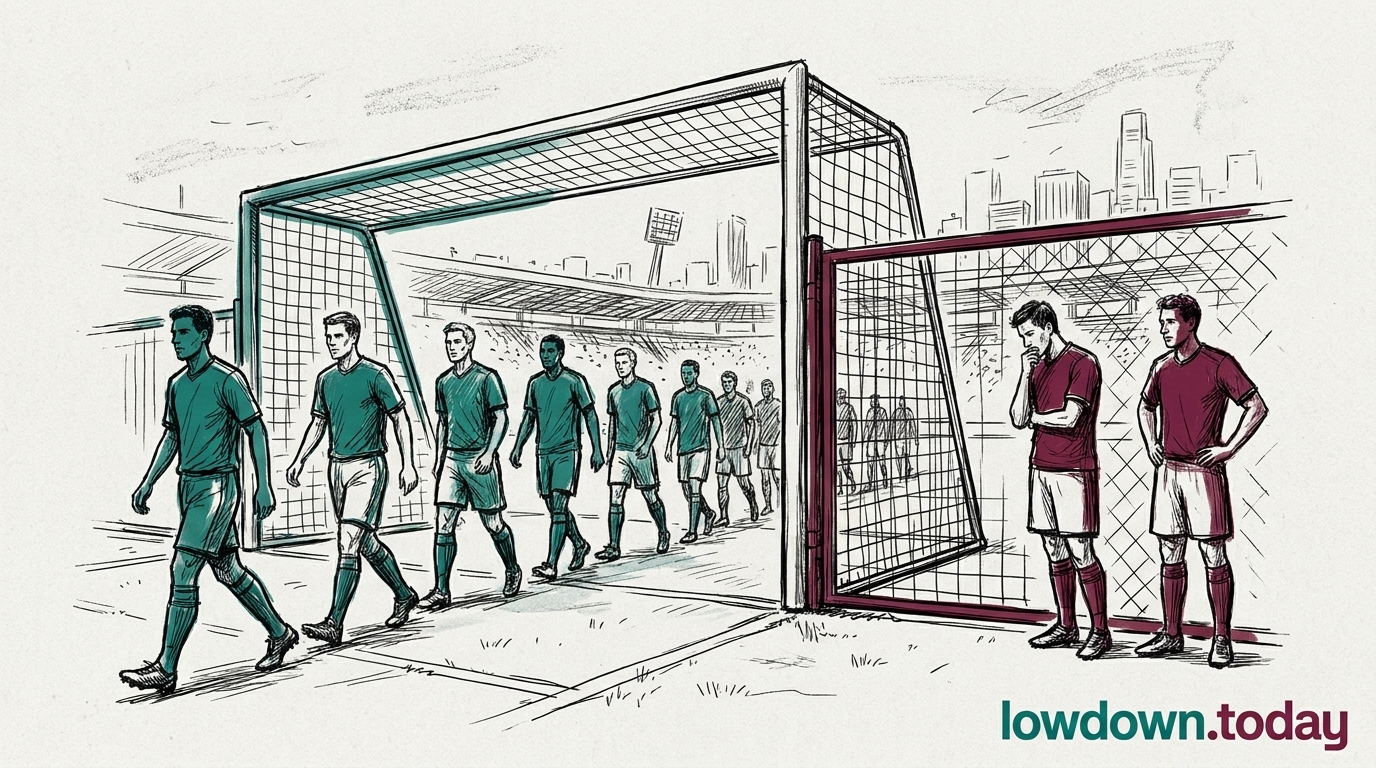
New York's busiest commuter terminal will lock out 650,000 daily passengers for four hours before each MetLife match, with one closure landing on a Monday evening rush hour.

SportDeveloping
Key takeaway

Penn Station will close to commuters for four hours before each MetLife match, an unprecedented prioritisation of tournament traffic.

Penn Station will not close for security but for capacity: NJ Transit has designated the terminal as fan-only: NJ Transit has designated the terminal as fan-only for four hours before each match to move 40,000 of the 80,000 expected fans per game. MetLife Stadium's pre-existing infrastructure constraints directly drove this decision.

No previous World Cup has required this. Brazil 2014, Russia 2018, and Qatar 2022 managed crowd flow alongside regular service or built dedicated links. MetLife Stadium was not designed for rail-dependent crowds at this scale; NJ Transit's network converges on Penn Station with no equivalent bypass.

Political exposure sits sharpest at the 22 June Norway-Senegal closure: a Monday at 4pm–8pm, directly overlapping evening rush hour. Alternative routes (PATH, ferries, Amtrak via Moynihan Train Hall) exist but none matches Penn Station's capacity or geographic reach.

Assemblyman Bhalla's framing captures the equity dimension precisely: the closure penalises the 99% who cannot afford tournament tickets in order to ease access for those who can.


Deep Analysis

In plain English

If you commute through Penn Station in New York, you will be locked out for four hours before each of eight World Cup matches so football fans can use the trains instead. One of those closures is on a Monday evening rush hour.

Deep Analysis
Root Causes

MetLife Stadium's design pre-dates the era of mega-event, rail-dependent crowd management. Built in 2010, it has 82,500 seats and minimal dedicated rail infrastructure.

The Meadowlands Rail Line—a seasonal, single-service line operated by NJ Transit—connects directly to Penn Station but was never designed for sustained World Cup-scale loads across eight matches. The capacity gap between what MetLife needs (40,000 fans moved by rail per match) and what the Meadowlands Line can deliver without disrupting the broader Penn Station network is the structural cause of the closure decision.

What could happen next?
  • The precedent of closing a major public commuter terminal for a commercial sporting event creates a template other host cities may replicate in future tournaments.

    Long term · 0.6
  • Commuters on the Monday 22 June evening rush (Norway vs Senegal) face the highest disruption; PATH and ferry alternatives cannot match Penn Station's throughput during peak demand.

    Short term · 0.85
  • The equity dimension—wealthy ticket holders prioritised over working commuters—will generate sustained political pressure on NJ Transit and the host committee.

    Short term · 0.8
First Reported In

Update #6 · FIFA's stealth price hike

CBS New York· 10 Apr 2026
Read original
Causes and effects
This Event
Penn Station bars commuters for eight World Cup matches
No previous World Cup has closed a host city's primary commuter terminal to accommodate tournament traffic. The decision creates a legal and political precedent for prioritising commercial event access over public transit.
Different Perspectives
FIFA
FIFA
FIFA remains publicly silent on every open dispute touching the tournament: no response to the UNITE HERE ICE-moratorium demand since April, no on-record comment on the Iran visa reversal, no intervention on the FIGC election. Its governance architecture, which routes bilateral matters to governments and domestic federation matters to national bodies, structurally precludes a direct answer on all three.
Andrea Abodi / Italian Sports Ministry
Abodi's ANAC referral is the first formal institutional step in his challenge to Malagò, converting a legal argument into a timed procedural clock, with both bodies reportedly receiving the request with "considerable frustration". The 15 June deadline means Italy's federation crisis will peak mid-tournament regardless of the ruling's direction.
Mauricio Pochettino / USMNT
Pochettino confirmed the 4-3-3 with Reyna and Pulisic starting against Germany, resolving the formation question at the cost of a 3-1 defeat that exposed the defensive axis. His public frustration over Richards's fitness, "I got a little annoyed", frames the 11 June deadline as an emotional as well as a tactical decision.
FFIRI / Mehdi Taj
FFIRI / Mehdi Taj
FFIRI confirmed the squad's clearance but stated five federation staffers were blocked under a "false pretences" finding, and denied separately reported player rejections, insisting the playing group travels intact. Taj's 5 June deadline expired; the approval arrived the same day, meeting the form of the demand while leaving the delegation short.
US State Department / UNITE HERE Local 11
Unnamed US officials approved Iran's squad visas via Ankara without a formal State Department statement, leaving Taremi's individual file unconfirmed; at the same venue system, UNITE HERE Local 11's 96% strike mandate among 2,000 SoFi workers, following FIFA's silence since 7 April, means US immigration enforcement runs as two parallel pressure tracks through the opener.
France (FFF)
France (FFF)
Manager Didier Deschamps confirmed William Saliba will play, reversing the 'very doubtful' briefing from earlier in the week and deferring any surgery until after the tournament. France recovers its first-choice central defender for the group stage at a point when rivals were adjusting their tactical assessments.


