Skip to content
You can now search across every topic, entity and event.What's new
2026 FIFA World Cup
29MAY

Iran FA chief turned back at Pearson

3 min read
15:10UTC

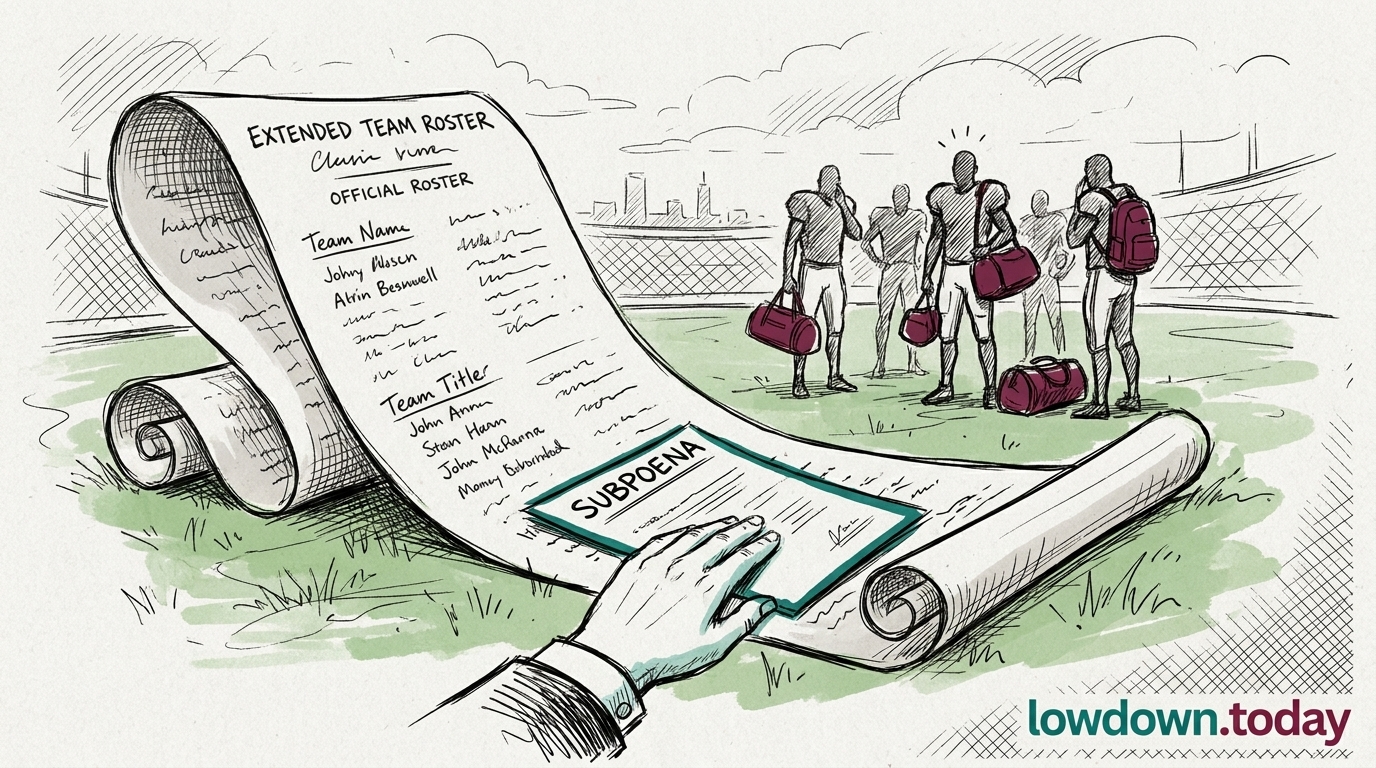
Canadian border officers revoked Mehdi Taj's entry permission at Toronto Pearson on 29 April, citing his reported former command role in the IRGC. The FFIRI delegation flew back to Turkey within hours, missing the Vancouver Congress.

SportDeveloping
Key takeaway

Canada's IRGC designation, working through CBSA discretion, denied a sitting federation president entry.

Mehdi Taj, Hedayat Mombeni and Hamed Momeni, the three senior officials of the Iranian Football Federation (FFIRI, Iran's governing body for football), landed at Toronto Pearson Airport with valid Canadian visas on Tuesday 28 April 2026 and were turned away at immigration the following morning. Canadian border officers cited Taj's reported former command role in the Islamic Revolutionary Guard Corps (IRGC, Iran's parallel military and intelligence force), which Canada designated a terrorist organisation in 2024 1.

The delegation flew back to Turkey on the first available service. FFIRI said its officials had returned 'due to the unacceptable behaviour of immigration officials' 2. The visa had been issued the day before; the discretionary security check at the port of entry overrode it. FIFA contacted the Iranian delegation on Wednesday afternoon to express regret, and Gianni Infantino offered to meet them at FIFA headquarters 3.

The denial closed a 28-day gap that had begun reassuringly. Infantino had met Taj and head coach Amir Ghalenoei in Antalya on 1 April and told them Iran would be at the World Cup . Two weeks later he repeated the line to CNBC: Iran is coming 'for sure' . The federation's own preparation, including the Kino Sports Complex training base near Tucson, has continued without interruption since early April . Pearson is the first concrete border-friction point Iran has hit on the continent, and it landed not on a player or a trainer but on the federation's chief executive.


Deep Analysis

In plain English

Iran's head of football, Mehdi Taj, flew to Toronto with two colleagues to attend FIFA's annual meeting. They had valid travel documents from the Canadian government. When they landed, airport border officers stopped them and cancelled their permission to enter, pointing to Taj's past role in the IRGC, Iran's parallel military force, which Canada banned as a terrorist organisation in 2024. That meant the entire Iranian football federation delegation missed the meeting where FIFA confirmed Iran would play in the World Cup. It also raised a more urgent question: if the same security check applies when Iran's squad arrives in Arizona on 10 May, some or all of the officials accompanying the players could face the same outcome.

Deep Analysis
Root Causes

Canada's 2024 IRGC terrorist designation created a two-tier vetting structure. The consular tier produces the visa; CBSA's discretionary security assessment at the port of entry runs against classified databases the consulate does not access at visa-issue stage. Because the designation is categorical rather than person-specific, any individual with a documented command-level IRGC history faces second-tier reversal regardless of visa validity.

FIFA's accreditation system treats a tournament delegation credential as equivalent to diplomatic travel clearance, but in designating-state law it carries no such weight. Article 6 of the 2026 World Cup Regulations gives FIFA no legal mechanism to override a member-state's border enforcement decision.

What could happen next?
  • Precedent

    The first documented case of an IRGC-designation-based airport revocation of a FIFA delegation credential sets a template other designating states (US, UK, Australia, EU members) may follow at their own ports of entry.

    Immediate · 0.8
  • Risk

    If US CBP officers apply the same discretionary logic at Tucson on 10 May, FFIRI officials travelling with the squad delegation under FIFA accreditation face the same outcome as Taj, potentially triggering a force majeure review under Article 6 of the World Cup Regulations.

    Short term · 0.75
  • Consequence

    The incident broadens the IRGC carve-out, publicly framed as targeting support staff posing as journalists or trainers, to cover federation governance officials, a category FIFA's own assurances had not contemplated.

    Immediate · 0.85
First Reported In

Update #9 · Iran's Pearson test

Al Jazeera· 1 May 2026
Read original
Different Perspectives
Spain
Spain
Spain face France on Tuesday for the second semi-final place, the last unresolved tie in the bracket.
France
France
France already through to the other semi-final, await Tuesday's result against Spain to know who plays the England-Argentina winner in the final.
Switzerland
Switzerland
Switzerland reached their first World Cup quarter-final since 1954 and led Argentina before Breel Embolo's second yellow card left them a man down for the last half-hour. They expect the run to raise expectations for the next cycle rather than close a chapter.
Norway
Norway
Norway leaned on Erling Haaland to reach a first modern-era quarter-final, and he nearly took them further before a disallowed goal and England's late double ended the run. Their tournament closes as the best World Cup performance in the country's history.
Argentina national team
Argentina broke down a 10-man Switzerland late, extending Scaloni's run of reaching every semi-final he has managed since 2019. Messi will make his first World Cup appearance against England, a fixture Argentine coverage framed around that unbroken run rather than the personal narrative.
England
England
England needed a 93rd-minute Bellingham winner to see off Norway, the third straight knockout tie settled in its closing stages rather than controlled. They travel to Atlanta as favourites but with Declan Rice a fitness doubt and Jarell Quansah suspended.


