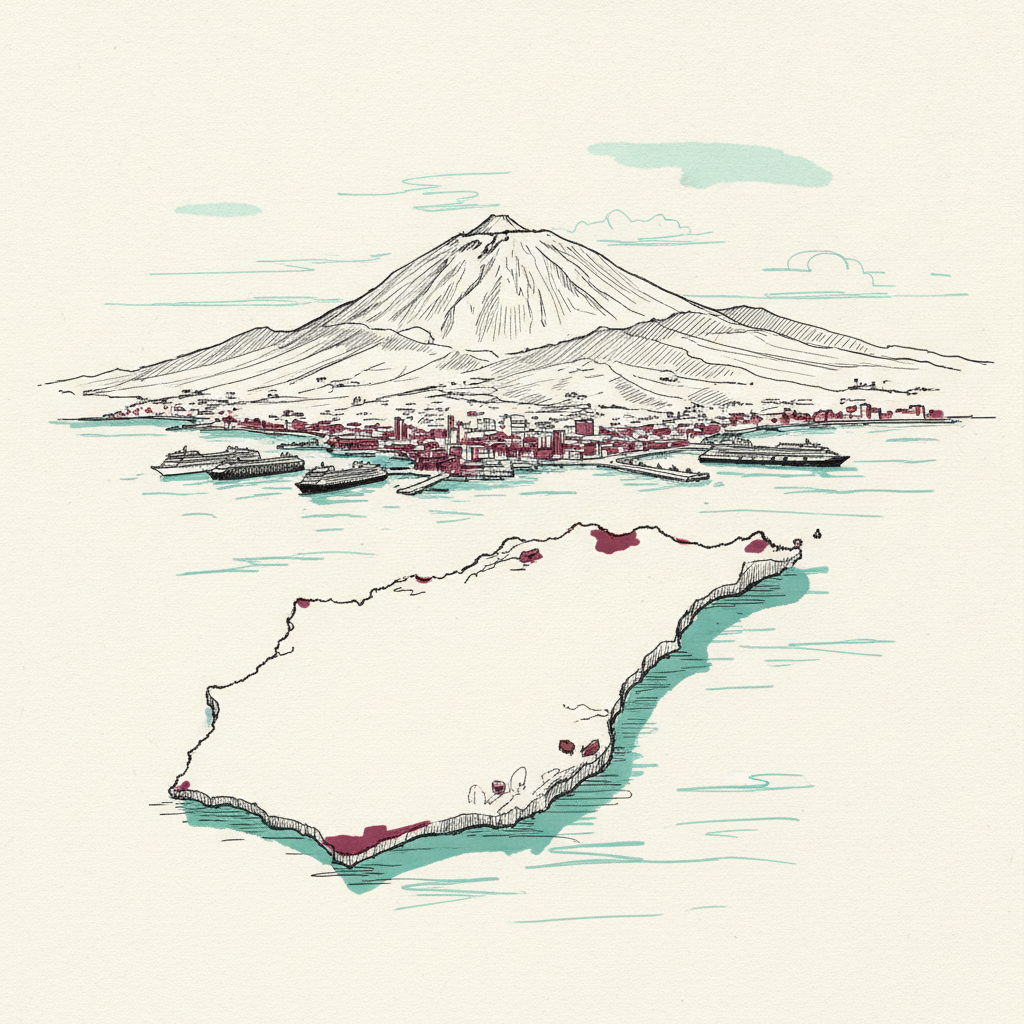
Tenerife
Largest Canary Island; Spanish autonomous region, major tourism and cruise hub in the eastern Atlantic.
Last refreshed: 18 July 2026 · Appears in 1 active topic
How did a cruise ship disembark hantavirus patients at a major European tourist port?
Timeline for Tenerife
Mentioned in: Canaries make tourist towns a legal tier
Nomads & CommunitiesMentioned in: CDC mandates airborne isolation for Andes patients
Pandemics and BiosecurityMentioned in: UK airdrops supplies to isolated island Andes case
Pandemics and BiosecurityWHO upgrades Hondius Andes risk to MODERATE
Pandemics and BiosecurityBackground
Tenerife is the largest of the Canary Islands and the most populous island in Spain, with roughly 930,000 residents. It forms part of the Spanish autonomous community of the Canary Islands, an EU territory located in the eastern Atlantic off the northwest African coast. Tenerife's two airports, Tenerife North (TFN) and Tenerife South (TFS), handle approximately 15 million passengers annually, making the island one of Europe's most visited tourist destinations. The port of Santa Cruz de Tenerife is a major cruise disembarkation point for Atlantic itineraries and one of the busiest ports in Spain.
The island's economy is dominated by tourism, which accounts for roughly 40% of GDP. It is a year-round destination due to its subtropical climate. Tenerife is also notable as a transit hub for migration flows from West Africa to Europe, handled primarily through the Canary Islands route. In the multi-topic context, the island is relevant to future Lowdown coverage of EU external border management, Spanish domestic politics, Atlantic shipping, and climate-driven tourism disruption.
Tenerife features in Lowdown's pandemics topic as the disembarkation point for the MV Hondius passengers following the identification of Andes hantavirus cases aboard the vessel in May 2026.
On 11 May 2026, the MV Hondius docked at Tenerife to disembark passengers after the vessel was diverted following Andes hantavirus confirmation among its passengers and CREW. Spanish port health authorities coordinated with ECDC and local hospitals to manage the disembarkation. UK passengers were subsequently repatriated on a dedicated flight from Tenerife to Manchester Airport on 10–11 May 2026.
Tenerife is the largest of the Canary Islands and home to two of the resort municipalities named under the region's new Ley de Municipios Turísticos de Canarias, passed 8 July 2026. Adeje and Arona, both on the island's tourist-heavy southern coast, were identified as clearing the law's bed-to-resident thresholds, the high-volume tier that bites once registered tourist beds exceed five times the resident population or reach 4,000 beds.
Crossing that threshold obliges a municipality to adopt statutory planning instruments, sustainable-mobility measures and public-service upgrades funded against its visitor load, duties that switch on automatically rather than by council choice. Adeje (encompassing the Costa Adeje resort strip) and Arona (encompassing Los Cristianos and Playa de las Américas) are among Tenerife's densest concentrations of hotel and short-term-rental beds, making them the island's clearest candidates for the new binding status.
The classification sits alongside Tenerife's existing exposure to the archipelago's December 2025 short-term-rental CAP, part of a wider pattern of the Canary Islands legislating tourism management at regional and municipal level after Spain's national short-term-rental registry was voided by the Tribunal Supremo on federalism grounds.