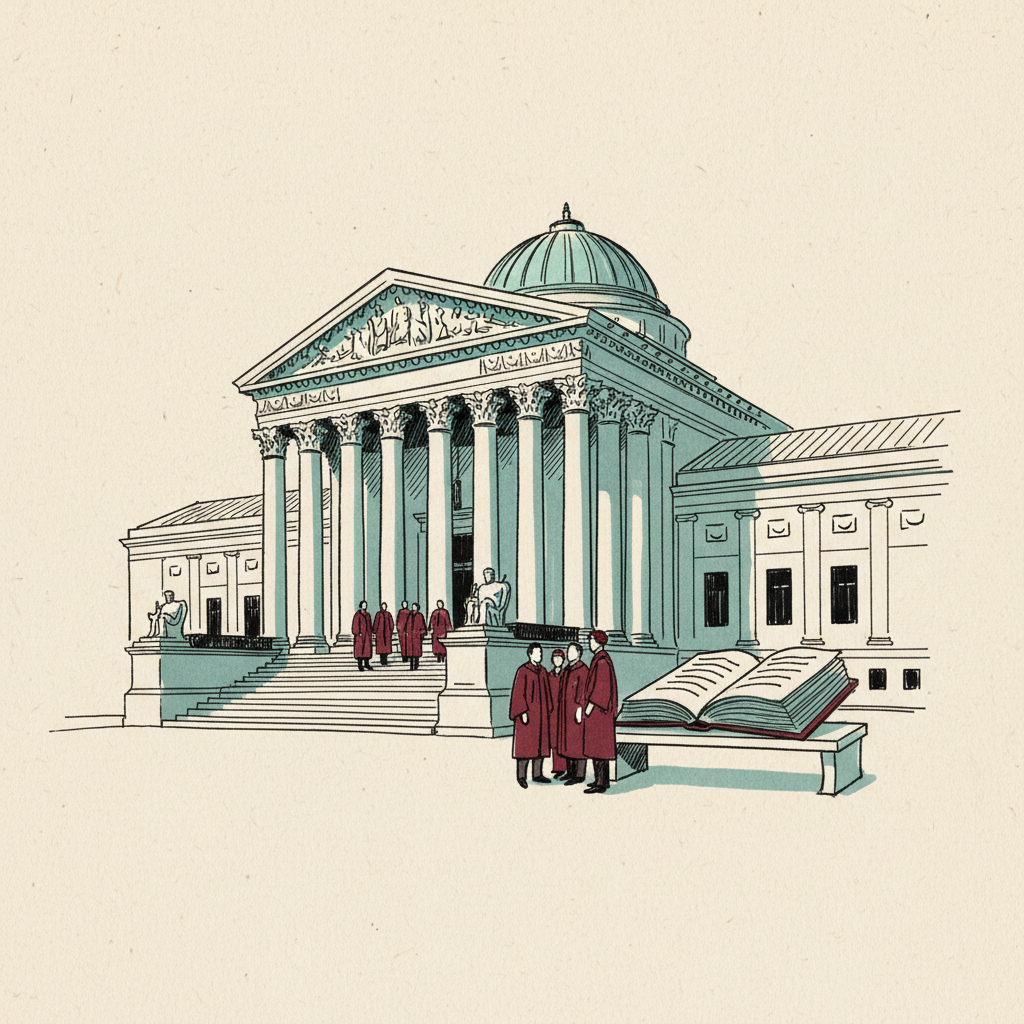
Supreme Court of the United Kingdom
United Kingdom Supreme Court — final court of appeal for UK civil cases and English/Welsh/NI criminal cases; established 2009.
Holyrood's 84 to 18 vote on 22 September 2026 backing Scotland's right to decide its future ran up against the Supreme Court's November 2022 ruling that the Scottish Parliament cannot legislate for an independence referendum without Westminster's consent.
Last refreshed: 7 October 2026
Could the election postponement case have reached the Supreme Court?
Timeline for Supreme Court of the United Kingdom
Mentioned in: Marra's MSPs vote for right to decide
UK Local Elections 2026Mentioned in: Iran: 22 political executions in six weeks
Iran Conflict 2026Mentioned in: Hengaw logs Tabriz hanging, two more
Iran Conflict 2026Mentioned in: Iran executes karate champion at Dastgerd
Iran Conflict 2026Mentioned in: Three Iran teens days from execution
Iran Conflict 2026Background
the Supreme Court of the United Kingdom hears final appeals in civil cases from all three UK jurisdictions and in criminal cases from England, Wales and Northern Ireland. Scottish criminal appeals end at the High Court of Justiciary, except where they raise devolution or human-rights questions. the Court also rules on whether devolved legislatures have acted within their powers, which is how it came to decide in 2022 that Holyrood could not legislate alone for an independence referendum.
It opened on 1 October 2009 under the Constitutional Reform Act 2005, taking over the judicial work of the Appellate Committee of The House of Lords. The move separated the country's top judges from the legislature. Twelve justices sit in the former Middlesex Guildhall on Parliament Square, opposite the Palace of Westminster.
Its constitutional rulings carry the most political weight. The two Miller cases tested the limits of executive power: in 2017 the Court held that ministers needed an Act of Parliament to begin leaving the EU, and in 2019 it ruled the prorogation of Parliament unlawful.
The 2022 referendum ruling still binds Holyrood
In November 2022 the Supreme Court decided unanimously that a Scottish Parliament bill for an independence referendum would relate to matters reserved to Westminster, among them the Union and the UK Parliament. Without a Section 30 order transferring the power, Holyrood cannot pass one. The 2014 vote went ahead only because the 2012 Edinburgh Agreement supplied that order.
That judgment framed the vote of 22 September 2026, when all 17 Labour members, newly led by Michael Marra, backed John Swinney's motion asserting Scotland's right to choose its future. The motion carried 84 to 18. Under the Court's reading of the devolution settlement, a declaration of that kind opens no lawful route to a referendum, and Labour's support for it carried no promise of one.