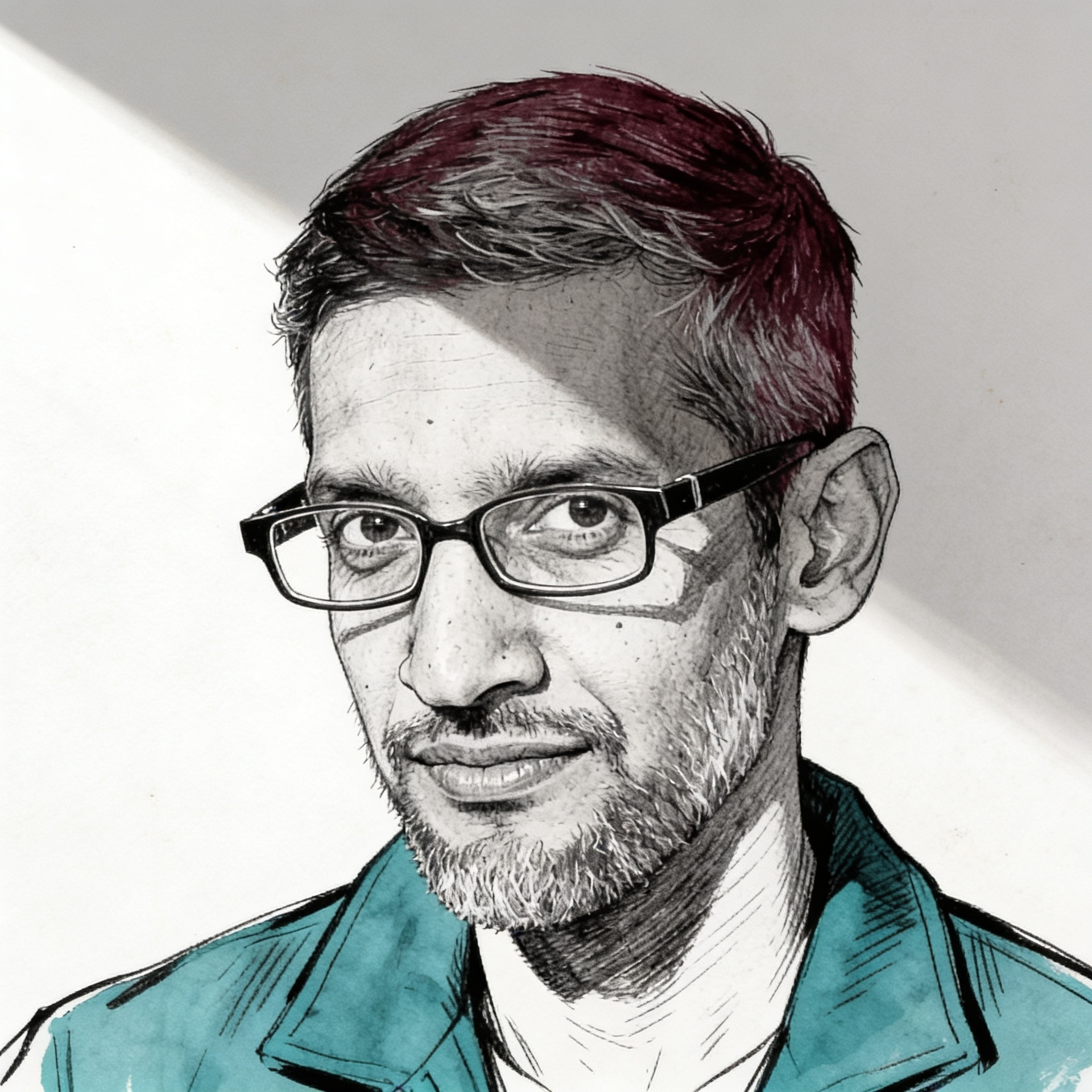
Why is Alphabet raising 2026 capex to $205bn under Pichai?
Timeline for Sundar Pichai
Mentioned in: Alphabet lifts 2026 capex to $205bn
Data Centres: Boom and BacklashStated Alphabet is compute constrained with cloud backlog above $460bn
Data Centres: Boom and Backlash: Hyperscalers post record $110.75bn Q1 capexStated Google was compute constrained in the near term on the Q1 2026 earnings call
AI: Jobs, Power & Money: Alphabet books $35.7bn Q1 capex; backlog hits $460bnBackground
Sundar Pichai's Alphabet raised its full-year 2026 capital-expenditure guidance to $195-205 billion at Q2 2026 results on 22 July, up from $180-190bn, as Google Cloud revenue grew 82% to $24.8 billion and contracted backlog crossed $500 billion for the first time to reach $514 billion. The results extend the pattern Pichai flagged on the Q1 call, when Alphabet booked $35.7bn in quarterly capex and he said Google was "compute constrained in the near term".
Pichai has served as CEO of Alphabet since 2015 and as Google CEO since 2019, when the two roles were merged; he joined Google in 2004 and rose through product leadership roles before becoming CEO. He oversees a group employing roughly 180,000 people globally, and his tenure has been defined by Google Cloud's buildout, the integration of AI across Google's core products, and the competitive response to the generative AI wave triggered by OpenAI's ChatGPT in 2022.
The scale of Alphabet's 2026 capex commitment, more than double its 2023 level, signals that even record infrastructure investment cannot currently meet AI demand under Pichai, a dynamic that benefits semiconductor suppliers such as Nvidia and TSMC and keeps raising questions about whether Google's AI product Velocity is supply-constrained rather than demand-constrained.