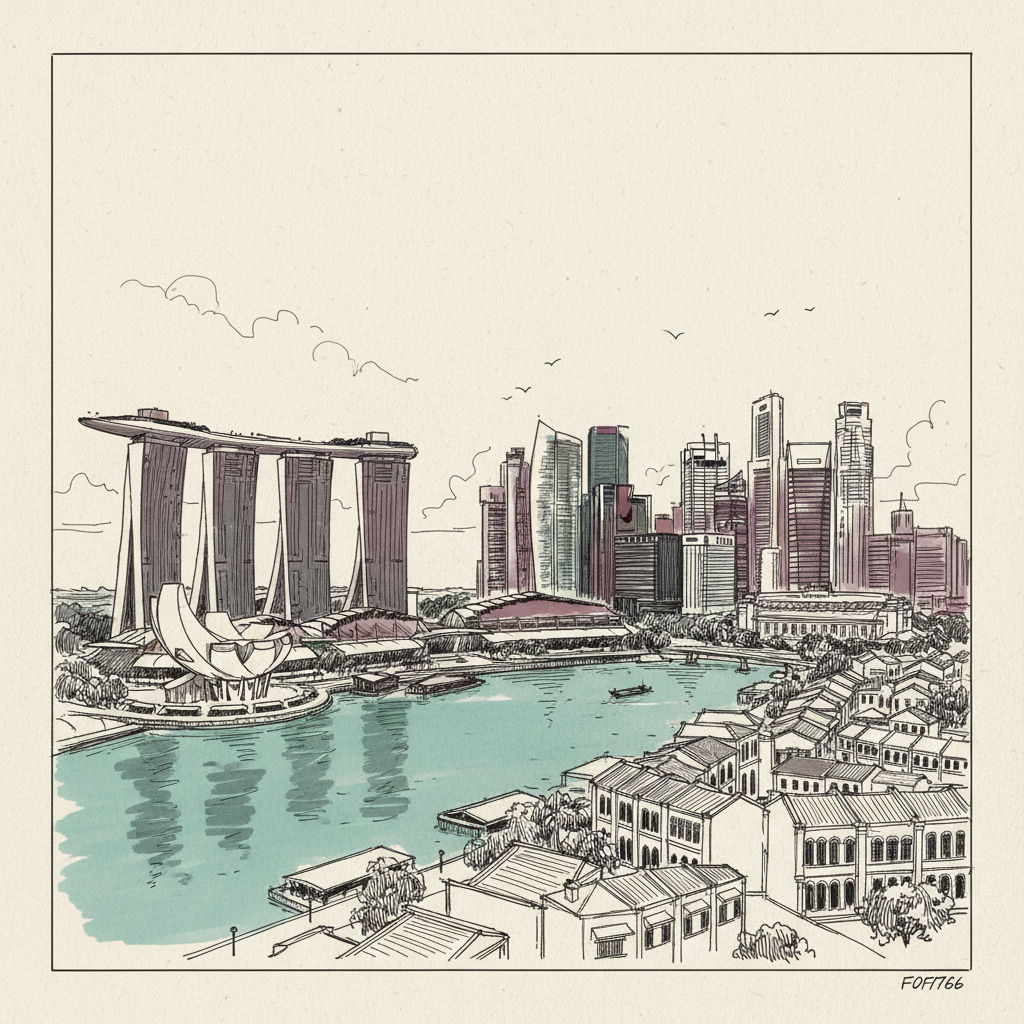
Singapore
City-state and global trading hub; site of Hengli's OFAC-insulation restructuring.
Singapore tabled a Digital Infrastructure Bill on 8 September that would turn voluntary data-centre security and energy-efficiency standards into licences enforced by the Infocomm Media Development Authority.
Last refreshed: 3 October 2026 · Appears in 8 active topics
With Hengli's Singapore office shedding staff, is Singapore's regulatory framework fast enough to prevent it becoming an enforcement gap?
Timeline for Singapore
Mentioned in: EU grades data centres from A to G
Data Centres: Boom and BacklashSingapore buys its citizens AI access
AI: Jobs, Power & MoneyMentioned in: Lula signs Redata law with water cap
Data Centres: Boom and BacklashMentioned in: Iran declares a restricted sea area
Iran Conflict 2026Singapore to license data centres by law
Data Centres: Boom and BacklashBackground
Singapore is a city-state at the southern tip of the Malay Peninsula and one of the world's main trading, port and financial centres. About 6 million people live under a common-law system with English-language administration. The Monetary Authority of Singapore combines central-bank and financial-regulatory duties, and the state investor Temasek is a major backer of overseas technology firms; it led PhysicsX's $300m round on 8 June 2026.
The government shapes markets through rules and state programmes. On 16 September 2026 it launched a Skills and Workforce Development Agency and gave citizens six months of free access to premium AI tools plus more than 200 AI courses. Its Cyber Security Agency issues public warnings on actively exploited flaws, as it did for two SharePoint Server vulnerabilities on 28 August.
That mix gives Singapore influence beyond its size. It hosts the annual Shangri-La Dialogue, where AUKUS announced its first Pillar II project on 30 May 2026, and its regulatory choices affect data-centre investment, sanctions compliance and regional fuel supply.
Singapore turns data-centre standards into law
Singapore reopened to new data-centre capacity on 30 May, releasing 500 MW under its Green Data Centre Roadmap with a power-use effectiveness target of 1.3 or better and data halls run at 26 degrees Celsius. On 21 August the Economic Development Board and IMDA split a 200 MW tranche among Digital Realty, Equinix, Keppel and ST Telemedia at 50 MW each, and a liquid-cooling standard for tropical sites, SS 726:2026, followed on 27 August.
On 8 September the government tabled a Digital Infrastructure Bill for first reading. It would replace voluntary standards with licences covering security and energy efficiency, enforced by IMDA, making Singapore's metered approach to capacity a legal requirement.
Singapore hosts Hengli's ownership shift
On 29 April Hengli Petrochemical cut its stake in its Singapore trading Arm from 100% to 5%, with the remaining 95% passing to a Chinese local government entity. The Arm kept pre-positioned crude inventory and continued yuan-settled procurement, a structure that pushed residual exposure below the US Treasury's 50% ownership threshold.
The US wind-down licence expired on 24 May, by which time the Singapore Arm had begun laying off staff. On 25 May the US sanctions office posted no guidance on Dalian Changxing, the named holder of the 95% stake, leaving banks that clear dollar trades through Singapore to judge their own exposure.
Singapore keeps its distillate barrels
Singapore's middle-distillate stocks rose 12% in July to 8.91m barrels, and fuel-oil stocks topped 19m barrels after a 105% jump in imports, figures reported on 20 July.
The build reflects Singapore's role as Asia's main oil storage and bunkering hub. With Gulf freight and war-risk insurance both higher, shipping diesel and fuel oil west to Europe stopped paying, so traders held the barrels in Singapore tanks instead. That leaves the city-state holding product that would normally have gone to the Amsterdam-Rotterdam-Antwerp market.
Singapore hosts Hengli's ownership shift
Why is Hengli laying off staff in Singapore?
What is Singapore's role in the Hengli OFAC case?
Is Singapore being used to evade Iran sanctions?
Why did Hengli restructure its Singapore company because of Iran sanctions?
Reference
What is Singapore's role in global oil trading?
Why did Oman use Singapore's strait as a model for its Hormuz fee plan?

