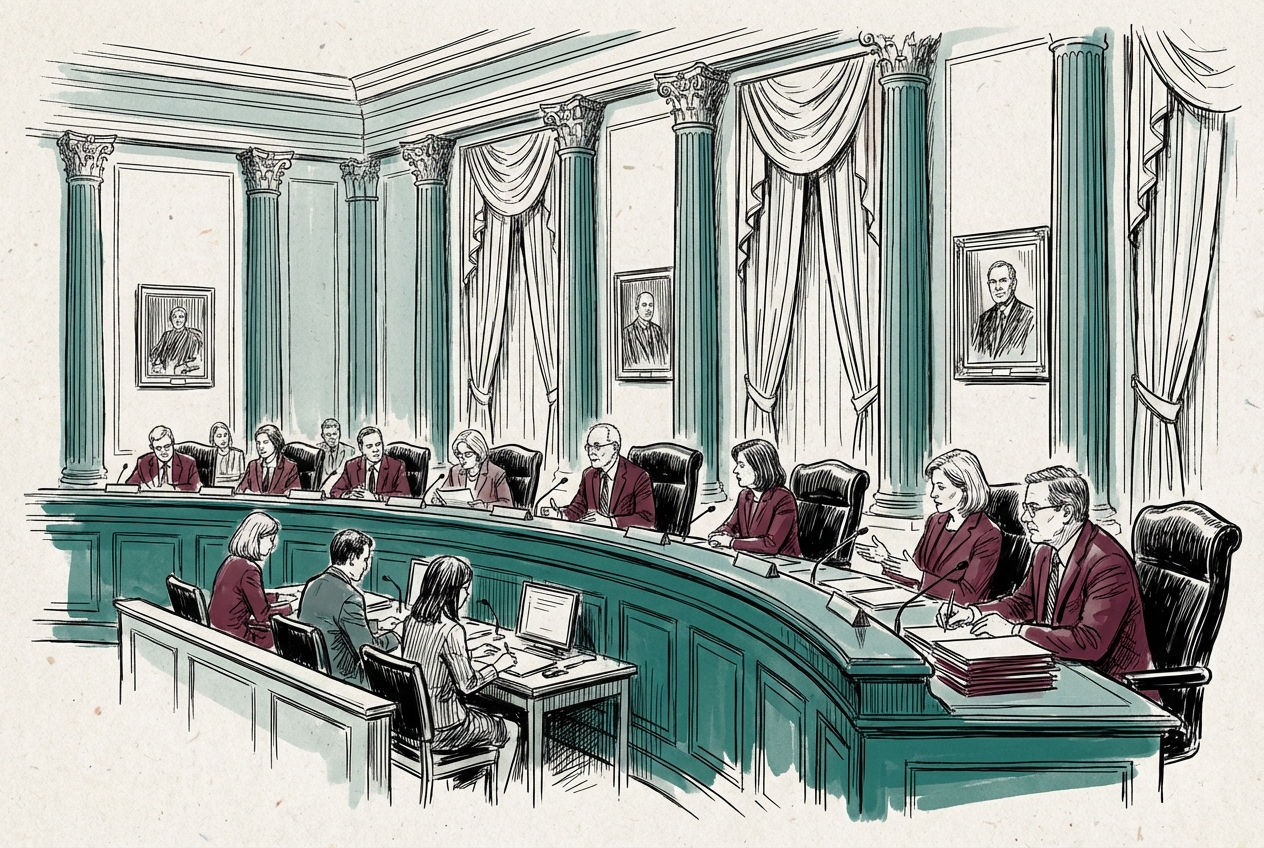
Senate Appropriations Committee
US Senate committee that controls all discretionary federal spending; venue of Hegseth's Article 2 war-authority testimony, 12 May 2026.
Last refreshed: 13 May 2026 · Appears in 3 active topics
The committee controls $29 billion of Iran war spending but cannot authorise the war. What can it actually do?
Timeline for Senate Appropriations Committee
Mentioned in: AUMF unfiled, blackout hits 1,728 hours
Iran Conflict 2026Mentioned in: Trump flies east, desk still empty
Iran Conflict 2026Received Hegseth's testimony on Article 2 war authority and $29 billion Iran war spending
Iran Conflict 2026: Hegseth: Article 2 covers Iran warMentioned in: US Iran war cost hits $29bn on 12 May
Iran Conflict 2026- How does the Senate Appropriations Committee affect NASA?
- It writes the spending bills that set NASA budgets into law. The President requests a figure; the committee can accept, raise, or cut it. It has rejected identical White House NASA cuts before, funding the agency at $24.4 billion last cycle.Source: background
- What is Congress's position on the FY2027 NASA budget?
- Broadly resistant. The Senate Appropriations chair expressed bipartisan concern. Congress rejected an identical $18.8 billion request the prior year and passed $24.4 billion instead.Source: background
- What is the difference between authorisation and appropriation for NASA?
- The House Science Committee authorises programmes (sets policy and direction). The Appropriations Committee funds them. NASA can be authorised for a programme but receive no money if appropriations fail.Source: background
- What is the difference between the Senate Appropriations Committee and Armed Services Committee?
- The Appropriations Committee controls how much money agencies receive (spending). The Armed Services Committee authorises military activities — it can legally approve or constrain what the military does. For the Iran war, Appropriations reviews the $29 billion cost but cannot force a war authorisation; that power rests with SASC (Senate Armed Services Committee) and HASC.
- What did Hegseth say to the Senate Appropriations Committee about Iran?
- On 12 May 2026, Hegseth told the committee that Trump has 'all the authorities he needs under Article 2' and that an AUMF on Iran is not required. The testimony was the first time a cabinet officer formally stated this as policy rather than leaving it implicit.Source: US Senate Appropriations Committee testimony
- Can the Senate Appropriations Committee stop funding the Iran war?
- Theoretically yes, by attaching a spending rider blocking Iran war funds. In practice, such a rider would risk a presidential veto and require a veto-proof majority (67 senators) to override. No such rider has been filed as of 13 May 2026, and committee members have not indicated one is being drafted.
- Is the Senate Appropriations Committee cutting the NASA budget?
- The committee has resisted White House cuts to NASA, with chair Susan Collins expressing bipartisan concern over the FY2027 request to cut NASA to $18.8 billion. Congress funded NASA at $24.4 billion the previous cycle against an identical request, and the CJS Subcommittee chair Jerry Moran has stated he intends to fund the agency at roughly FY2026 levels.Source: Senate Appropriations Committee, Space Symposium
Background
The Senate Appropriations Committee is the body that translates White House budget requests into binding federal spending law. For NASA, it is the single most consequential legislative body: no matter what the House Science Committee authorises or the President requests, the final dollar figure depends on the Appropriations Committee's markup. When the FY2027 proposal to cut NASA to $18.8 billion emerged, the committee's chair, Sen. Susan Collins, expressed bipartisan concern, signalling resistance.
The committee has 30 members split between twelve subcommittees, one of which covers Commerce, Justice and Science, giving it direct authority over NASA's appropriation. It writes the spending bills that fund the government, and in recent years it has consistently rejected White House NASA cuts: Congress funded NASA at $24.4 billion in the previous cycle against an identical $18.8 billion request.
The FY2027 fight is particularly acute because Artemis is entering a critical capital phase, with the Lunar Gateway, advanced spacesuits, and Artemis III surface hardware all requiring sustained multi-year investment. A cut to $18.8 billion would force programme delays or cancellations at the precise moment Artemis II is demonstrating crewed deep-space capability.
On 12 May 2026, the Senate Appropriations Committee became the venue for the war's most significant constitutional moment. Appearing on $29 billion of Iran war spending, Defence Secretary Pete Hegseth testified under oath that Donald Trump holds 'all the authorities he needs under Article 2' and that 'we don't need' an AUMF. Senator Lisa Murkowski asked the opening question; her threatened AUMF was rendered procedurally moot by Hegseth's answer .
The exchange exposed a structural distinction that has run beneath the Iran war since 28 February 2026: the Appropriations Committee controls spending on the conflict but has no authority to force a formal authorisation for it. That power belongs to the Senate Armed Services Committee (SASC) and the House Armed Services Committee (HASC), neither of which has produced a binding instrument. The Appropriations Committee can theoretically attach a rider blocking war funds, but doing so risks a veto and has not been tested. The reaction to Hegseth's testimony was described as intense bipartisan frustration (WaPo); the war has now consumed $29 billion under no signed presidential instrument, a streak of 75 consecutive days .