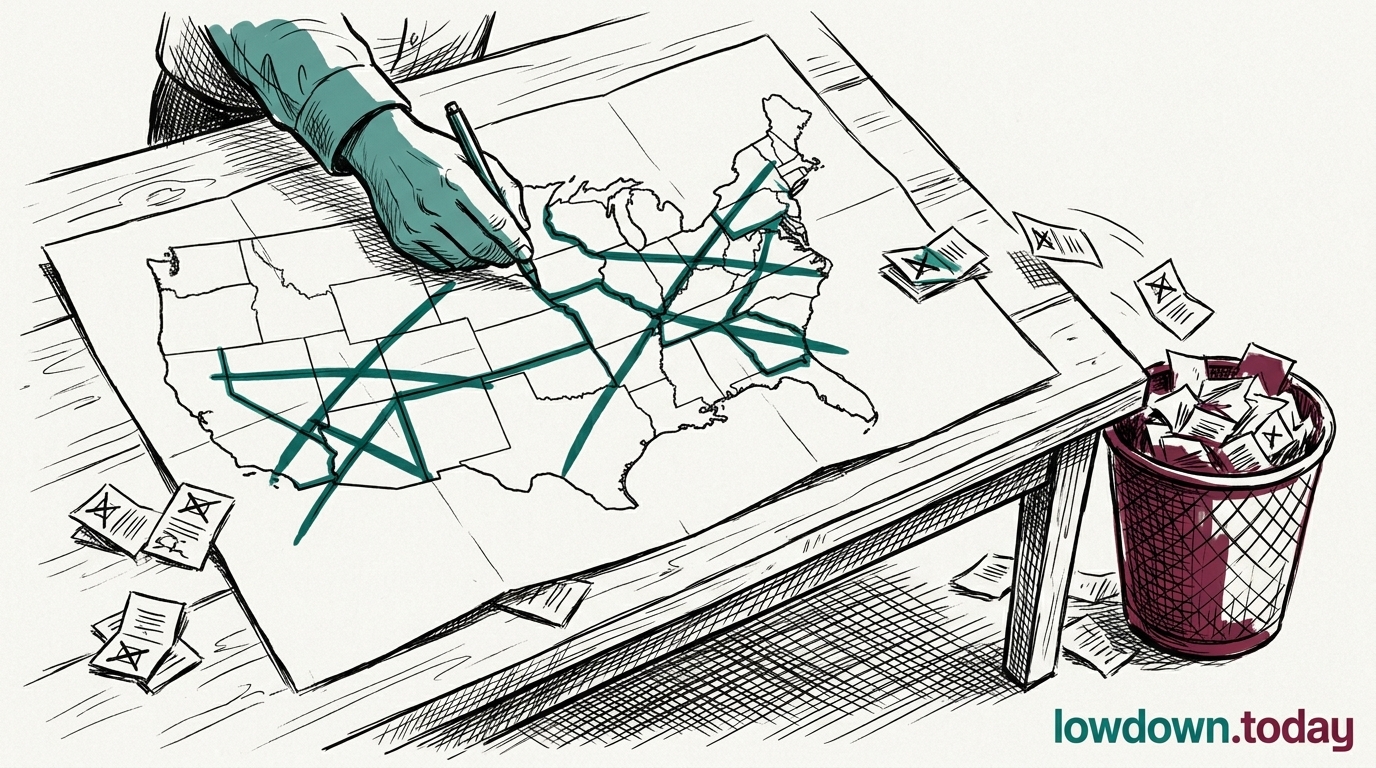
Leon County Circuit Court Judge Joshua Hawkes consolidated the Fair Districts Amendment challenges to Florida's congressional map and heard oral argument on Friday 15 May and Saturday 16 May. The challenge was filed within hours of Ron DeSantis signing the 24R-4D map on 4 May. Plaintiffs argue the map uses partisan data in drawing every district, the precise pattern the Fair Districts Amendment bans. DeSantis's counsel argues that Louisiana v. Callais now nullifies the Fair Districts Amendment by removing the racial baseline that the state constitution's partisan provisions presupposed1.
Hawkes said he would issue a written decision in coming days. The ruling lands inside a hard deadline. Florida congressional qualifying opens Monday 8 June, leaving a narrow window for any injunction to take effect before candidates file under the disputed map. A plaintiffs' win arriving after 8 June still moves the legal question forward, but the political effect on 2026 is largely lost.
The doctrinal question is whether a state constitutional amendment passed by Florida voters in 2010 survives a federal Supreme Court ruling that did not name it. The Fair Districts text bans partisan intent independently of any racial baseline; the DeSantis brief is in effect arguing that Callais drained partisan-intent doctrine of its enforcement architecture nationwide. University of Florida election-law professor Mary Adkins called the argument a stretch that nonetheless tracks the conservative federal direction; the counter-view, from former Florida Supreme Court Justice Barbara Pariente quoted in Florida Politics, is that Fair Districts is a state-law claim no federal ruling can touch.
A Hawkes ruling for plaintiffs before 8 June drops the Republican Callais harvest by up to four seats and forces the redraw to a still-pending appeal calendar. A ruling for DeSantis lands the 24R-4D map intact through November. Either way, the appellate sequence runs through the Florida Supreme Court and likely back to SCOTUS, where Callais was decided.



