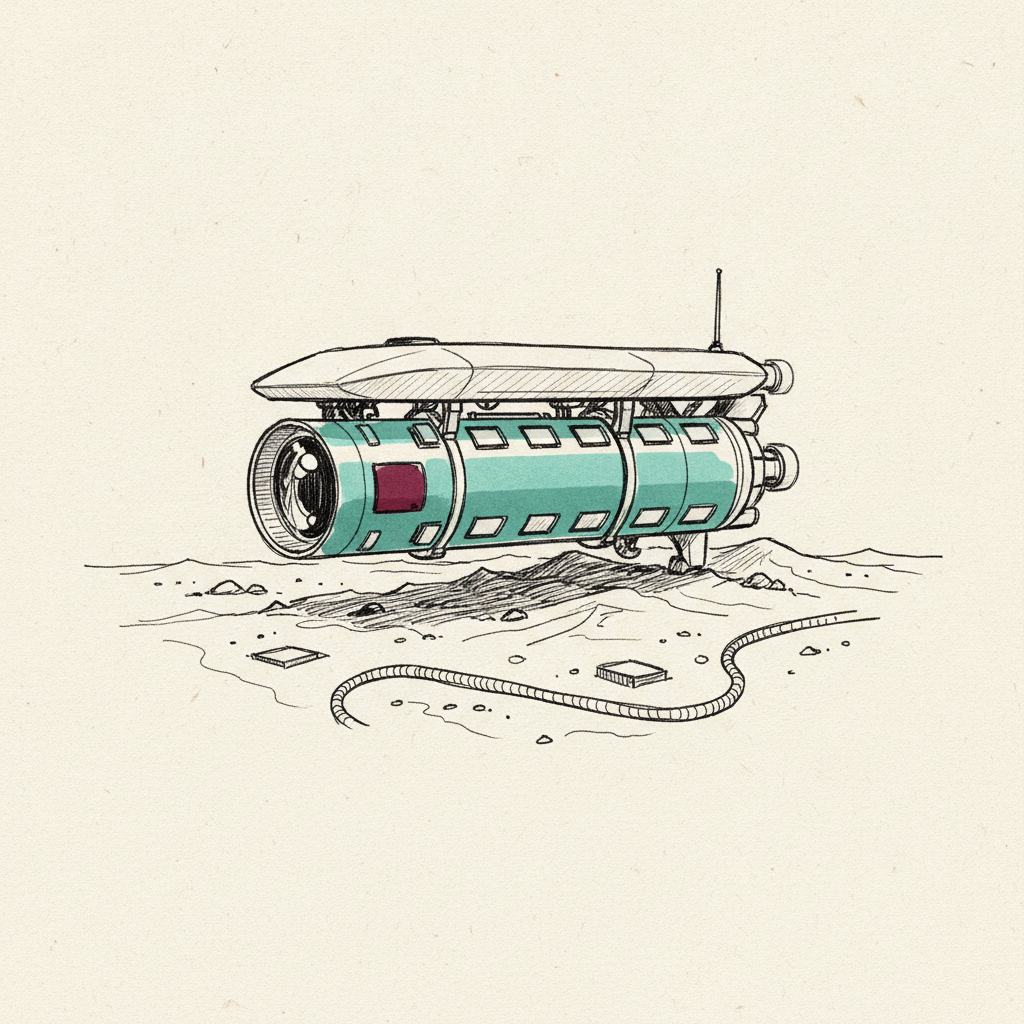
HISAS 1032
Kongsberg dual-receiver synthetic-aperture sonar; maps seabed mines and cables from HUGIN AUVs.
Last refreshed: 13 June 2026 · Appears in 1 active topic
How does HISAS 1032 sonar help NATO watch the seabed cables Russian submarines pass?
Timeline for HISAS 1032
Paired with HUGIN Superior as the sensor payload in the bid
Autonomous Systems: Land & Sea: Europe bids for the AUKUS seabed- What does synthetic-aperture sonar do that regular sonar cannot?
- Synthetic-aperture sonar (SAS) combines acoustic returns from multiple pings as the vehicle moves, producing sub-decimetre resolution seabed imagery at operational survey speeds. Regular sidescan sonar at the same speed produces coarser images. HISAS 1032 also maps sediment depth below the seabed surface, which regular sidescan cannot.Source: Kongsberg technical documentation
- Why is HISAS 1032 part of the AUKUS Pillar II bid?
- In the Kongsberg-DRASS AUKUS bid, HISAS 1032 is the seabed-detection layer: the sensor that finds mines or maps infrastructure. It is paired with HUGIN Superior (the AUV) and hosted aboard the DRASS DG-900 compact submarine. The combination was announced at ILA Berlin on 8 June 2026.Source: Tech Times
- Can HISAS sonar be used to protect undersea internet cables?
- Yes. HISAS-equipped AUVs can map and monitor seabed cable routes at high resolution. NATO's Task Force X-Arctic, launched 6 June 2026, targets the GIUK gap where 97% of transatlantic internet traffic passes through submarine cables; synthetic-aperture sonar is one of the sensor architectures being evaluated.Source: Naval Technology
Background
HISAS 1032 is Kongsberg's dual-receiver synthetic-aperture sonar, the sensor payload paired with the HUGIN Superior AUV in the joint Kongsberg-DRASS bid for AUKUS Pillar II procurement announced at ILA Berlin on 8 June 2026. The 1032 designation refers to the dual-receiver configuration, which improves along-track resolution and enables simultaneous bathymetric mapping alongside sidescan imagery. In the AUKUS bid architecture, HISAS 1032 is the detection and mapping layer; HUGIN Superior is the vehicle; the DG-900 compact submarine is the host.
Synthetic-aperture sonar works by combining acoustic returns from multiple pings as the AUV moves through the water, synthesising a longer effective aperture than a physically longer sonar array could provide at the same depth and speed. This produces sub-decimetre resolution imagery of the seabed at survey speeds practical for mine-hunting and seabed-infrastructure mapping. HISAS 1032 operates at low acoustic frequency, enabling penetration of seabed sediments in addition to surface imaging. It has been deployed on HUGIN-family AUVs across multiple allied programmes, and Kongsberg markets the sonar as a standalone payload compatible with third-party AUV platforms.
The military applications most relevant to current news are mine countermeasures and seabed-cable monitoring. NATO's Task Force X-Arctic, launched 6 June 2026, targets persistent awareness of the GIUK gap, where subsea cables and Russian submarine routes converge. HISAS-equipped AUVs are one candidate sensor architecture for that requirement, though NATO has not publicly confirmed which DIANA-selected systems are aboard NRV Alliance.