FAQ 1258
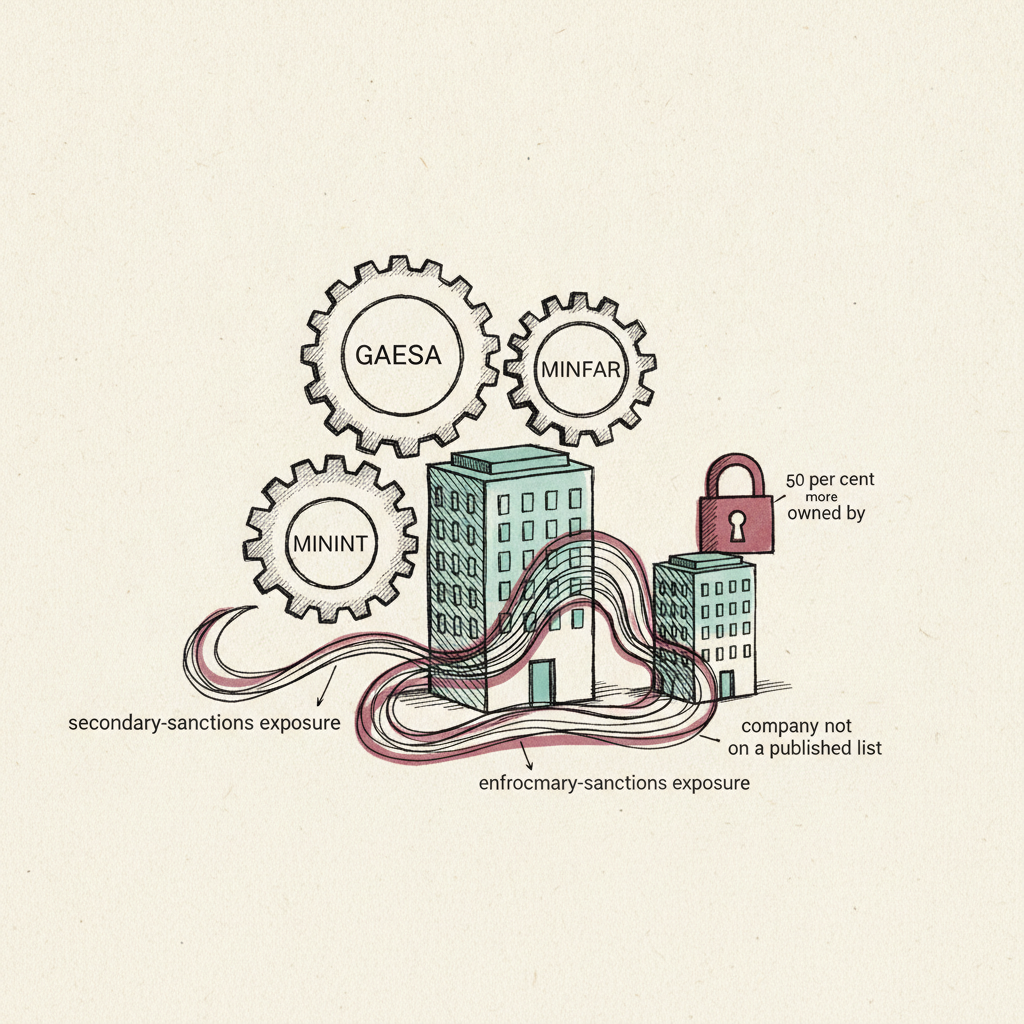
OFAC Frequently Asked Question 1258, issued 4 June 2026, extending secondary-sanctions exposure to any company 50 per cent or more owned by GAESA, MININT or MINFAR, even when that company does not appear on a published list.
FAQ 1258, issued by OFAC on 4 June 2026 alongside the Díaz-Canel sanctions designation, extends secondary-sanctions exposure to any firm 50 per cent or more owned by GAESA, MININT or MINFAR, even when that firm appears on no published list.
Last refreshed: 26 July 2026 · Appears in 2 active topics
How far does FAQ 1258 extend Cuba sanctions to companies never named on any published list?
Timeline for FAQ 1258
Mentioned in: OFAC names a Mariel evasion transfer
Cuba DispatchIssued concurrently, extending secondary-sanctions exposure to 50%-owned GAESA/MININT/MINFAR subsidiaries
Cuba Dispatch: Cuba's president lands on OFAC blacklistBackground
FAQ 1258 is a Frequently Asked Questions guidance document issued by the US Treasury's Office of Foreign Assets Control. OFAC FAQs are interpretive guidance rather than formal regulations, but compliance departments treat them as binding statements of how Treasury reads existing rules, which is what gives this one its practical force.
Its operative rule extends secondary-sanctions exposure to any entity that GAESA, Cuba's military-run business conglomerate, or the interior and armed forces ministries (MININT, MINFAR) own at 50 per cent or more, even where that entity does not appear on any published sanctions list and has never been individually designated. That marks a departure from prior Cuba-sanctions practice, which required a named entry on the SDN or Cuba Restricted List before exposure attached.
The document's significance lies less in any single designation and more in the compliance burden it creates: any foreign company transacting with a Cuban counterparty must now audit that counterparty's ownership chain rather than simply check it against a published list.
FAQ 1258 extends exposure to unlisted firms
FAQ 1258 was issued on 4 June 2026, the same day the US Treasury blacklisted President Miguel Díaz-Canel, his wife, her son and Cuba's armed forces ministry as part of the wider EO 14380 emergency-declaration package. Where the head-of-state designation grabbed the headline, FAQ 1258 did the structural work: it extends secondary-sanctions exposure to any company GAESA, MININT or MINFAR owns at 50 per cent or more, whether or not that company has ever been individually listed.
That rule forces any foreign hotel operator, bank, shipping line or insurer dealing with a Cuban counterparty to trace ownership back to Cuba's military and interior-ministry business empires before it can assess its own exposure. FAQ 1258, not the Díaz-Canel listing itself, is what does most of the package's structural work.
What is OFAC FAQ 1258 on Cuba?
How does FAQ 1258 change Cuba sanctions compliance for foreign companies?
Does FAQ 1258 mean all GAESA subsidiaries are now effectively sanctioned?
What is the legal status of an OFAC FAQ?
What is the difference between OFAC FAQ 1258 and FAQ 1262 on Cuba?
Has OFAC's 50-per-cent ownership rule been used against a real Cuban company yet?

