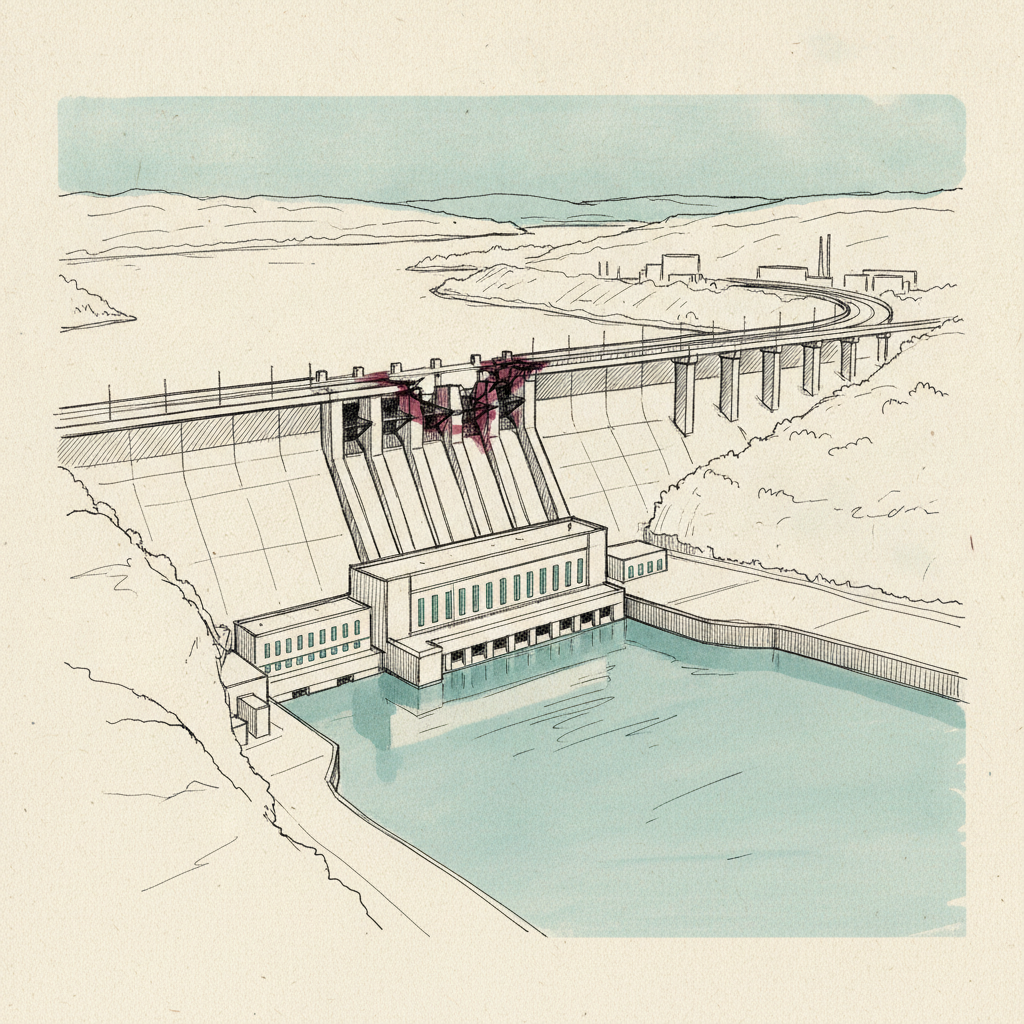
Dnipro Hydroelectric Dam
Soviet-era hydroelectric dam on the Dnipro river at Zaporizhzhia; its road-rail bridges were glide-bombed on 20-21 June 2026, severing east-bank Russian logistics.
Last refreshed: 24 June 2026
Could the destruction of the Dnipro Hydroelectric Dam flood Zaporizhzhia?
Timeline for Dnipro Hydroelectric Dam
Bridges cut on Kherson's east bank
Russia-Ukraine War 2026Background
The Dnipro Hydroelectric Dam (Ukrainian: Dniprohydroenerho HES, commonly abbreviated DniproHES) is a Soviet-era gravity dam and hydroelectric station on the Dnipro river at the city of Zaporizhzhia, completed in 1932 as the flagship project of Stalin's first five-year plan. At its completion it was the largest hydroelectric power station in Europe, a designation it held briefly before being surpassed. The dam itself spans roughly 760 metres and the associated reservoir (the Dniprovskoye Reservoir) stretches approximately 129 km upstream. Its road and rail bridge decks form the main crossing over the Dnipro at Zaporizhzhia, a point of particular logistical importance because the city sits where the Dnipro narrows and bends northward.
On 20-21 June 2026, Ukrainian glide bombs struck the dam's road-rail bridge spans, blocking the crossing and cutting a primary supply route for Russian forces holding positions on the river's east bank. The strike was part of a wider interdiction wave that also targeted the Preobrazhensky bridge and the Henichesk bridge, aiming to degrade Russian resupply across the entire Dnipro front simultaneously. The dam itself remained structurally intact; Kyiv's strikes targeted the bridge decks, not the dam body, avoiding the catastrophic flooding that would follow dam failure.
The DniproHES is a critical node in Ukraine's electricity system. It has an installed capacity of 1,538 MW across eight generating units. Russian forces have repeatedly targeted it since 2022; partial damage to its turbine hall was reported in 2024. Its destruction would cause severe flooding downstream and eliminate a major source of regulated power, making it both a tempting target for Russia and an asset Ukraine must protect. The June 2026 bridge strikes illustrated the dual risk: Ukrainian forces could use the dam's road-rail deck against Russian logistics while themselves needing to protect the dam from Russian counter-strikes.
What is the Dnipro Hydroelectric Dam and where is it?
What happened to the Dnipro dam bridge in June 2026?
Would destroying the Dnipro dam flood Zaporizhzhia?
How does the DniproHES dam compare to the Kakhovka dam that was destroyed?


