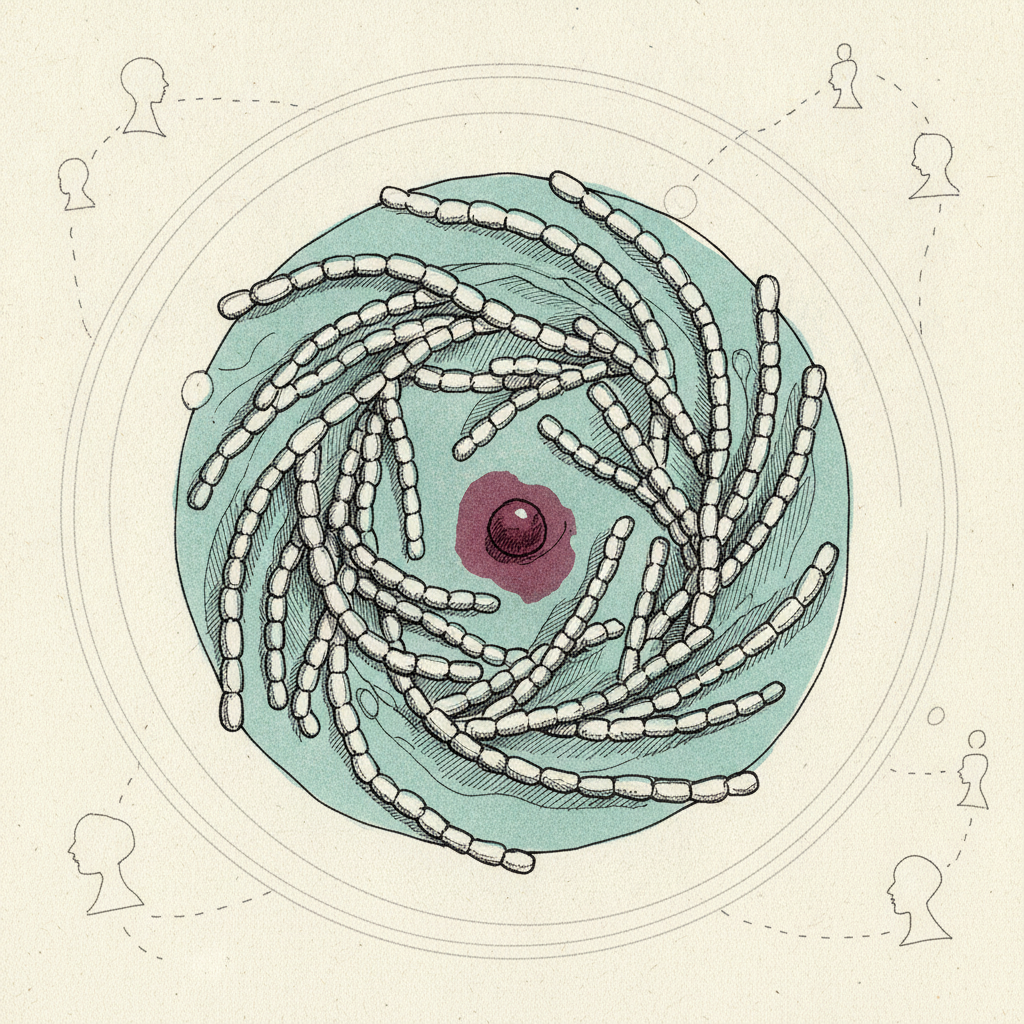
Dermatophilus congolensis
Livestock skin bacterium with first peer-reviewed evidence of person-to-person sexual transmission in Europe.
Last refreshed: 16 June 2026 · Appears in 1 active topic
Has a common livestock bacterium developed human-to-human spread in European saunas?
Timeline for Dermatophilus congolensis
207 salmonella cases point at eggs
Pandemics and BiosecurityAn animal microbe goes person to person
Pandemics and BiosecurityMentioned in: Mpox clade Ib now spreads in Europe
Pandemics and BiosecurityAnimal-associated bacterium showing apparent human-to-human spread
Pandemics and Biosecurity: Barnyard germ appears to spread in EU saunasDocumented in peer-reviewed evidence as transmitting sexually among MSM in two European countries
Pandemics and Biosecurity: A livestock germ spreads between peopleBackground
Two peer-reviewed papers in the June issue of Emerging Infectious Diseases have advanced the Dermatophilus congolensis transmission signal from surveillance observation to genetic evidence of person-to-person spread. The Barcelona series documented 9 cases among men who have sex with men, with whole-genome sequencing placing isolates 0 to 4 single-nucleotide differences apart, pointing to one human-transmitting lineage rather than repeated spillover from cattle. A parallel series covered cases in Lyon and Paris. This confirms and strengthens the earlier ECDC signal: a 50-case cluster across France, Germany and Spain, linked to sex-on-premises saunas between December 2025 and May 2026, flagged in ECDC's Week 23 communicable disease threats report. All cases were mild and resolved fully on antibiotics. The ECDC Rapid Risk Assessment is due 23 June 2026 and will determine whether this constitutes a confirmed new transmission route.
Dermatophilus congolensis is a gram-positive, filamentous actinobacterium that causes rain rot in horses and cattle. Human infection has historically been documented only in veterinarians, abattoir workers, and others with direct animal contact; sustained person-to-person transmission had not previously been reported. The bacterium establishes in broken or softened skin and is susceptible to penicillin and tetracyclines. Biological plausibility for environmental transmission in warm, humid settings is well-established; the peer-reviewed evidence adds genomic confirmation that one lineage is circulating within a human network rather than being repeatedly acquired from an animal reservoir.
The significance of the Barcelona whole-genome sequencing data is epidemiological precision: it narrows the hypothesis from "possible human transmission" to "a single human-adapted lineage circulating within a community where sexual-health screening is unusually dense." That screening density raises detection sensitivity, meaning the cluster may reflect better surveillance as much as novel biology. The 23 June ECDC RRA will assess whether the genomic evidence aligns with sustained transmission or a bounded outbreak already resolving. The pathogen remains primarily veterinary; the public-health question is whether this lineage represents a durable host-range shift.