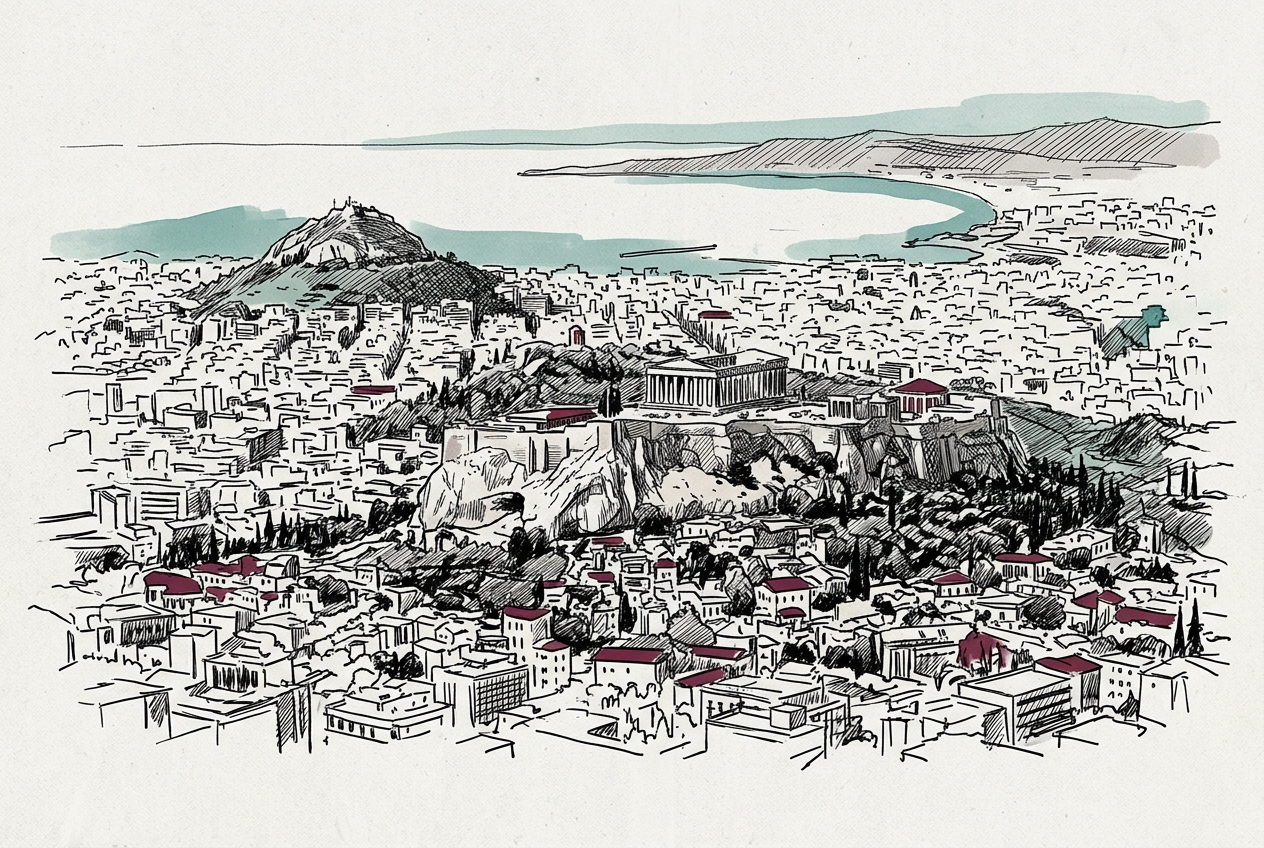
Athens
Greek capital; NATO southern flank anchor facing Iranian missile threats and Europe's strictest new STR registration rules.
Athens' central districts would stay closed to new short-let registrations until 31 December 2027 under an extension Greece's prime minister announced on 5 September, a year beyond the capital's current freeze, the first of its kind in Greece.
Last refreshed: 3 October 2026 · Appears in 1 active topic
Can Athens keep Souda Bay open while Iran targets its region and streets fill with protesters?
Timeline for Athens
Mentioned in: EU pays Kyiv €2.9bn with first budget-loan draw
Russia-Ukraine War 2026Mentioned in: Iran declares a restricted sea area
Iran Conflict 2026Faced a registration freeze in three central districts
Nomads & Communities: Greece plans to keep Athens lets frozenMentioned in: Majlis weighs 20% fine on Israel-linked cargo
Iran Conflict 2026Mentioned in: Greece's freezes miss half its nights
Nomads & CommunitiesBackground
Athens is Greece's capital and largest city, with a metropolitan population of around 3.7 million, and the seat of government of an EU member state that has belonged to NATO since 1952.
The capital anchors Greece's place on the Alliance's south-eastern flank, with the Souda Bay naval base on Crete as its main reference point. On 7 March 2026 Iran's deputy foreign minister, Majid Takht-Ravanchi, said European states joining the US-Israeli campaign would become legitimate targets, noting that Iranian missiles with a range of 2,000 to 2,500km can reach Greece.
Athens is also where Greece's short-let crackdown began. Its historic centre was the first zone to freeze new registrations and to end automatic licence transfer on sale or inheritance. Thessaloniki's historic centre followed on 1 July 2026, with fines of 50% of rental income, at least €20,000 and doubling to €40,000 for a repeat offence.
Athens' freeze sets the national template
Athens' historic centre was the first Greek zone to freeze new short-let registrations, and from March 2026 Law 5275/2026 carried the same limit to Thessaloniki, with islands under review. On 5 September 2026 the government announced that the capital's three central districts stay frozen until 31 December 2027; as of that date no ministerial decision gave the extension force.
The template reaches only part of the market. Final 2025 figures published on 27 July counted 38.2 million arrivals and 156.3 million overnight stays across Greece, and the South Aegean and Crete alone took 49.3% of those nights. Athens and Thessaloniki, the only cities under registration limits, account for roughly a quarter of arrivals.
Tourist stamps no longer convert in Athens
Since March 2026, Law 5275/2026 has barred in-country switching to Greece's Digital Nomad Visa. A remote worker in Athens on a tourist stamp must now leave Greece, obtain a Type D long-stay visa at a Greek consulate or embassy abroad, and re-enter before starting work.
The income floor is €3,500 a month net, roughly 70% above Portugal's D8 figure, and it now applies without the conversion route that had set Greece apart from consulate-only Spain. The same law ended automatic transfer of short-let licences on sale or inheritance inside the capital's restricted zone.
Reference
Why is Souda Bay important to Greece and NATO?
What happened at anti-war protests in Athens?
Did Iran threaten Athens with missiles?
What is Athens' role in current events?
Has Greece restricted Airbnb outside Athens?
What are the new rules for Greece's Digital Nomad Visa in 2026?

