Skip to content
Welcome, thoughtbot's Giant Robots listeners!Start here
US Midterms 2026
15SEP

Maryland's Own Senate Blocks Its Map

2 min read
14:21UTC

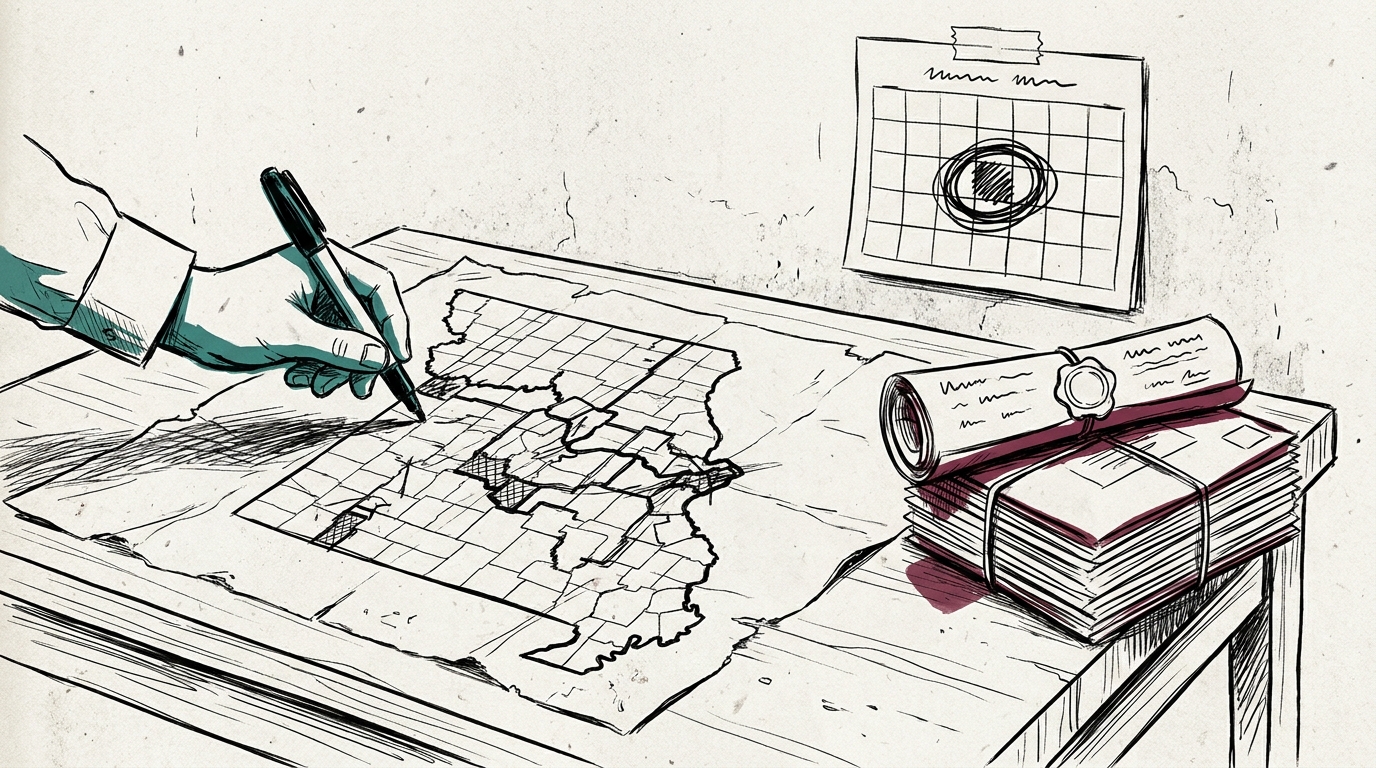
Maryland's House passed an all-Democratic congressional map 99-37, but Senate President Bill Ferguson refused to hold a vote, blocking his own party's gerrymander.

PoliticsDeveloping
Key takeaway

Democratic redistricting is blocked by internal resistance in Maryland and supermajority rules elsewhere.

Maryland's House passed an all-eight-districts-Democratic congressional map 99-37 on 2 February. Senate President Bill Ferguson refused to hold a Senate vote, effectively blocking it⁠1. Judicial Watch analysis characterised the proposed plan as replicating a gerrymander previously struck down as unconstitutional. Republican Representative Andy Harris, who would be drawn out under the new map, has threatened federal and state court challenges.

The Maryland block is self-inflicted. Ferguson, a Democrat, stopped his own party's map, a decision that has no equivalent on the Republican side this cycle. DeSantis in Florida is using executive coordination to accelerate redistricting; Maryland's Democratic leadership is using institutional prerogative to stop it. Washington state's constitutional amendment for mid-decade redistricting also lacks the two-thirds supermajority needed and requires Republican votes it will not get.

The net effect reinforces the redistricting asymmetry identified in the prior briefing. Republican states are redrawing maps; Democratic states are blocked by courts, their own leadership, or supermajority requirements. The structural seats that redistricting adds or subtracts operate independently of the voter sentiment visible in polls and special elections.


Deep Analysis

In plain English

Maryland's House of Delegates voted 99-37 in February 2026 to adopt a new congressional map that would give Democrats all eight of the state's congressional seats. To become law, the same map would need to pass the Maryland Senate. Bill Ferguson, the President of the Maryland Senate (the equivalent of the Speaker for the upper chamber), simply declined to schedule a vote on the map. In most legislatures, the chamber leadership controls the calendar, so Ferguson's refusal effectively killed the bill without a formal vote. Republican Representative Andy Harris , whose district would have been eliminated under the proposed map , has threatened legal challenges. A conservative legal group called Judicial Watch characterised the map as a copy of an earlier Maryland gerrymander that federal courts had already struck down as unconstitutional.

What could happen next?
  • Consequence

    Without a Maryland redistricting map, the current Republican incumbent (Andy Harris) retains a safe seat that would have been eliminated, leaving the Democratic mid-decade redistricting effort in the mid-Atlantic region at net zero.

First Reported In

Update #2 · First votes exceed every forecast

Ballotpedia· 12 Apr 2026
Read original →
Causes and effects
This Event
Maryland's Own Senate Blocks Its Map
Maryland's intra-party block on redistricting demonstrates that Democratic map-drawing faces internal resistance absent from the Republican equivalent in Florida.
Different Perspectives
Department of Justice (DOJ)
DOJ appealed to the 9th Circuit after Judge David O. Carter did not rule by a noon deadline on 22 October that DOJ itself had set, seeking to have California set aside mail ballots from more than 20,000 listed voters. Its case is that ineligible votes cancel lawful ones; the panel dismissed the appeal 2-1 on 26 October.
Lower Costs Now
Lower Costs Now
Lower Costs Now reported $7.37m in Kansas on 24 and 25 October, part of $65.65m in Senate races since its first independent expenditure on 1 October, including $17.21m for Josh Turek in Iowa. Its FEC filings show $50.18m raised by 14 October.
MAGA Inc
MAGA Inc
MAGA Inc, the super PAC aligned with Donald Trump, filed $7.20m against James Talarico on 22 October, taking its Texas spending to $37.65m. Of that, $30.12m is against Talarico and $7.53m is for Ken Paxton, the Republican nominee.
Senate Majority PAC (SMP)
SMP's pre-general report shows it spent $108.70m from 1 to 14 October, including $65.0m to WinSenate and $10.0m to Texas Forever, and ended with $32.72m. Texas Forever has reported $19.40m against Ken Paxton since 1 October.
Senate Leadership Fund (SLF)
SLF's pre-general report shows $88.42m in cash on 14 October and $18.98m raised in the fortnight, none of it from Elon Musk. It has since reported $12.07m against Sherrod Brown in Ohio, and its $2.7m to Plains PAC preceded that committee's first Kansas buy on 25 October.
National Republican Senatorial Committee (NRSC)
The NRSC's pre-general report shows nothing spent with Ashley Hinson in Iowa, or with its nominees in six other states, from 1 to 14 October, after $5.54m with Hinson in September. It took no new loan and ended the fortnight with $25.20m in cash and $20m of debt.

Written with AI from Lowdown's published reporting. Not individually reviewed by an editor. Editorial standards.