Skip to content
Welcome, thoughtbot's Giant Robots listeners!Start here
US Midterms 2026
7SEP

Supreme Court stays the Missouri TRO

2 min read
13:32UTC

All nine justices were needed to undo a single district judge's order, two days after one justice alone had been enough to leave a state court's injunction standing.

PoliticsDeveloping
Key takeaway

Nine justices were required to stop one district judge from overriding Missouri's own Supreme Court.

The US Supreme Court stayed Judge Stephen R. Clark's restraining order in Onder v. State of Missouri on 10 September, with no dissent noted⁠1. Justice Brett Kavanaugh put this application to the full bench instead of ruling on it himself, the opposite of his handling of the state's own application two days earlier. A stay suspends another court's ruling while an appeal proceeds, so Clark's command to use HB 1 stopped operating that day.

Kavanaugh's signature alone sufficed to let a state court's injunction stand on 8 September. Cancelling a federal judge's interference with that same injunction took all nine justices two days later. Whatever the Court thinks of mid-decade redistricting, it treated a district judge overriding a state Supreme Court on election administration as the question deserving nine votes.

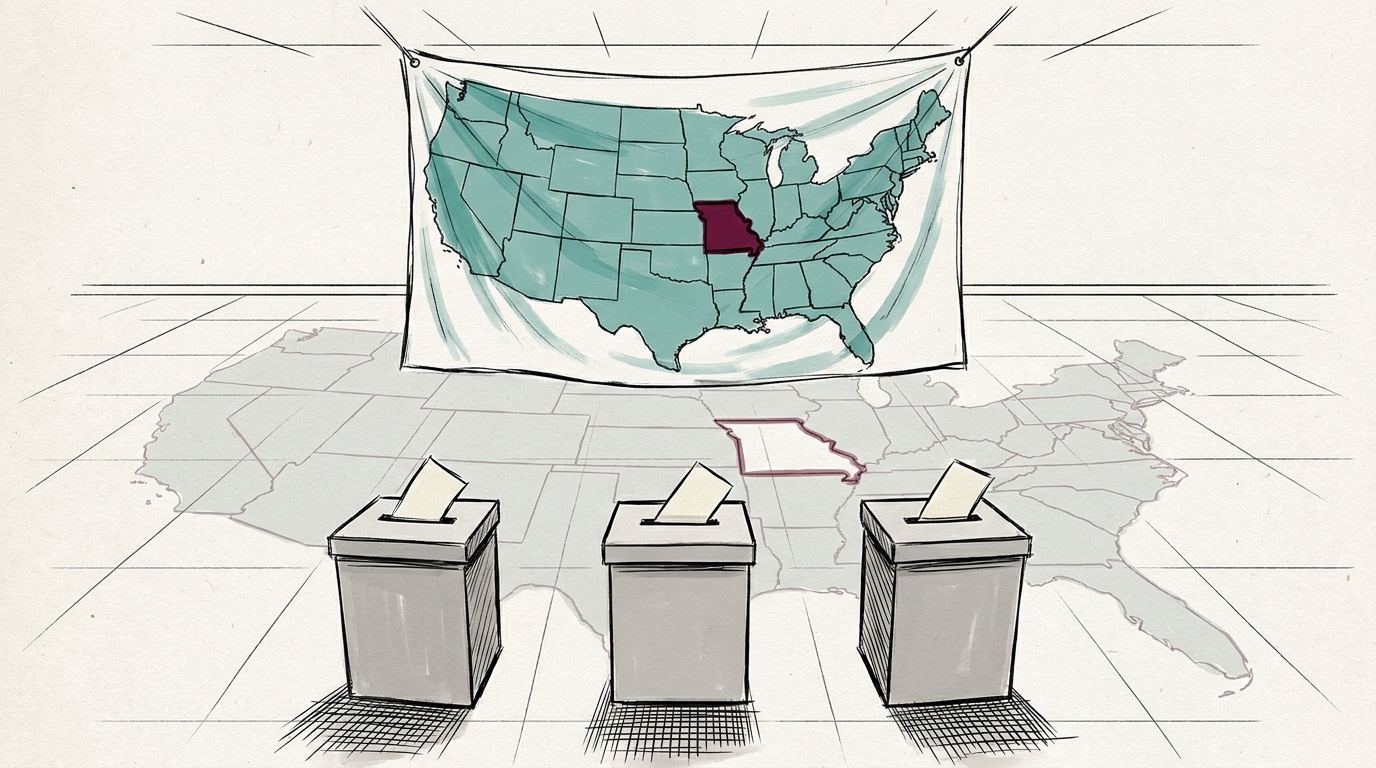
Missouri's 2022 boundaries now govern the 3 November vote, which is the result the state Supreme Court reached on 3 September. On that same ballot, Missouri Proposition A asks voters whether HB 1 should take effect at all; approval would bring the map into force 30 days later, around 3 December, too late to touch a single 2026 race. Maryland's highest court put a comparable redistricting question back before its own voters in early September. Two states have now handed the drawing of congressional lines to a referendum after the courts ran out of room.

Deep Analysis

In plain English

the Supreme Court paused Judge Clark's order, so Missouri no longer has to use the HB 1 map under that federal case. Lawyers call this a stay: it pauses a lower court's order temporarily and decides nothing about whether the map itself is legal. No justice publicly disagreed on the record, but that does not necessarily mean all nine agreed. the Court's emergency orders often do not show individual votes, so the public may never know exactly how each justice came down.

Deep Analysis
Root Causes

A stay pending appeal turns on the four-factor test the Court set out in Nken v. Holder: likelihood of success on the merits, irreparable harm absent a stay, the balance of harms between the parties, and the public interest. A majority satisfied on those factors can issue a stay without ever ruling on the merits of whether HB 1 or the 2022 map is lawful.

That structure is why Thursday's order settles which map Missouri uses for now while leaving the underlying legal question, which map the state constitution actually permits, undecided and still pending below.

What could happen next?
  • Consequence

    The stay leaves the 2022 map as the operative map for now, without deciding whether HB 1 is constitutionally valid, so the underlying dispute remains live below.

  • Risk

    Because the order carries no recorded vote, any later claim about which justices supported it will be difficult to verify against the public record.

First Reported In

Update #17 · Missouri's election chief held in contempt

CourtListener· 15 Sept 2026
Read original →
Different Perspectives
Judge Adolf Zeman, Alaska Superior Court
Zeman refused to dismiss the League of Women Voters, Alaska Black Caucus and ACLU of Alaska suit over the state giving DOJ its unredacted voter list. The privacy claims now go to evidence-gathering under the Alaska Constitution.
Judge Thomas Schroeder, US District Court for the Middle District of North Carolina
Schroeder refused on 19 October to block the State Board of Elections rule that rejects mail ballots with an unsealed or missing inner envelope. He found the challengers had delayed and that relief was infeasible with voting under way, and pointed to notice-and-cure provisions as a safeguard.
Stephen Richer, Republican former Maricopa County recorder
Richer submitted a brief on 20 October supporting the voting groups on documentary proof of citizenship at registration. He takes no position on the separate 90-day voter-removal question.
Senate Leadership Fund
The Senate Leadership Fund began spending for interim Senator Darline Graham Nordone on 19 October, taking its South Carolina total to $4.06m, including $2.25m against Democrat Annie Andrews. Republicans are now paying to defend a seat in a state Donald Trump carried in 2024.
WinSenate, the ad-buying affiliate of Senate Majority PAC
WinSenate began buying Kansas airtime against Roger Marshall on 10 October and had reported $8.14m there by 20 October. Marshall held $922,088 in cash on 30 September and the NRSC gave him no party money in September, so the Democratic side is spending where the Republican committee has not.
County Board of Arlington County
Arlington says federal Polling Place Policies allowing armed agents at polling sites breach 18 USC 592, the 1865 ban on troops or armed men at an election. It reads Markwayne Mullin's 1 September remarks as confirming such a policy, and asks Judge Brinkema to keep armed federal staff from its polls and drop boxes.

Written with AI from Lowdown's published reporting. Not individually reviewed by an editor. Editorial standards.
