Skip to content
You can now search across every topic, entity and event.What's new
US Midterms 2026
7SEP

South Carolina Senate blocks post-Callais redraw

3 min read
13:32UTC

South Carolina's state Senate rejected redistricting despite Governor Henry McMaster's pressure, and Mississippi narrowed its post-Callais session to state Supreme Court districts only.

PoliticsDeveloping
Key takeaway

South Carolina's rejection trims the Callais harvest from 15 toward 12 seats; the math, not solidarity, drove the dissent.

South Carolina's state Senate rejected congressional redistricting on the floor despite the House passing a calendar extension and Governor Henry McMaster applying pressure. Senate Majority Leader Davey Hiott told members the state would not proceed 1. Mississippi narrowed its post-Callais session to state Supreme Court districts only, declining to redraw the congressional map. Both states answered the post-Callais call along with Alabama and Tennessee in late April.

A governor pressing his own Senate majority on a partisan redistricting question and losing is rare on any calendar. The Hiott bloc's argument, reported by NPR, was that an in-cycle redraw would invite federal court intervention before November and produce no net seat gain over the existing 6R-1D map. The countervailing pressure from McMaster, per the same reporting, was that the Callais window will not stay open into 2027. Hiott's bloc judged the November risk larger than the foregone seat opportunity. Mississippi's narrowing was procedurally cleaner, scoping the special session to state court redistricting at the outset rather than calling and failing.

The two refusals shave the Callais harvest estimate from a notional 15 congressional seats toward the lower end of the 12-15 range cited by Cook Political Report. Of the seven candidate Republican states reckoned with mid-decade redistricting after Callais, two have now declined. The Republican track remains fast and asymmetric on the four states that have proceeded: governors' calendars in days against Democratic counter-mechanisms measured in months or years. But asymmetric does not mean uniform.

Brookings Institution redistricting scholar Joshua Douglas noted that intra-party rejections like Hiott's tend to track the specific math in each state rather than any national counter-current. South Carolina's existing 6R-1D map already absorbs most of the available partisan gain; the marginal seat from a redraw was not worth the federal court exposure. Indiana, Ohio and Missouri, where the partisan math leaves more upside, remain the next test of whether the pattern scales.

Deep Analysis

In plain English

After the Supreme Court struck down the rule requiring majority-minority congressional districts in late April 2026, Republican-controlled state governments across the South were expected to redraw their congressional maps to add Republican seats. Four states called special legislative sessions to do so. But two of those states decided not to proceed with full congressional redistricting. South Carolina's state Senate blocked the effort despite pressure from the governor. Mississippi narrowed its special session to redrawing state court districts only, leaving its federal congressional maps unchanged. The reason in both cases was practical: South Carolina's existing maps already give Republicans six of seven seats, leaving little extra to gain from redistricting, while the risk of a federal court challenge was real. Mississippi's heavily Black Jackson region made redrawing the congressional map legally complicated in a different direction. Both states judged the risks higher than the potential rewards.

What could happen next?
  • Consequence

    South Carolina and Mississippi's refusals trim the Cook Political Report's Callais harvest estimate from a notional 15 seats toward the lower end of the 12-15 range, narrowing the Republican baseline gain before any wave is measured against it.

    Immediate · 0.82
  • Precedent

    The SC Senate's floor rejection of a governor-backed redistricting plan demonstrates that the Callais harvest is bounded by the individual political math in each state, not by national party solidarity, which is relevant to projections for Indiana, Ohio and Missouri.

    Short term · 0.75
  • Risk

    McMaster's public pressure campaign against Hiott, and its failure, may reduce South Carolina governors' leverage over their own Senate majorities on future redistricting questions, weakening the executive-legislative alignment that made Alabama and Tennessee's fast timelines possible.

    Long term · 0.5
First Reported In

Update #6 · A primary nullified mid-vote

NPR· 19 May 2026
Read original
Different Perspectives
New Hampshire student voters
Students who hold no accepted photo ID under HB 323 cannot vote in the 8 September primary after Judge Laplante declined to block the law on timing grounds. Whether the same rule applies on 3 November is still open.
Alaska Democratic Party
The Alaska Democratic Party moved $884,835 in coordinated spending to Mary Peltola between 17 and 30 July, more than the DCCC spent nationally in the same fortnight.
National Republican Senatorial Committee
The NRSC, which sued to remove coordinated-spending caps in NRSC v. FEC, put $2,230,472 behind candidates in the first complete month after winning that case, more than double the total for the prior six months combined.
Supreme Court of Missouri
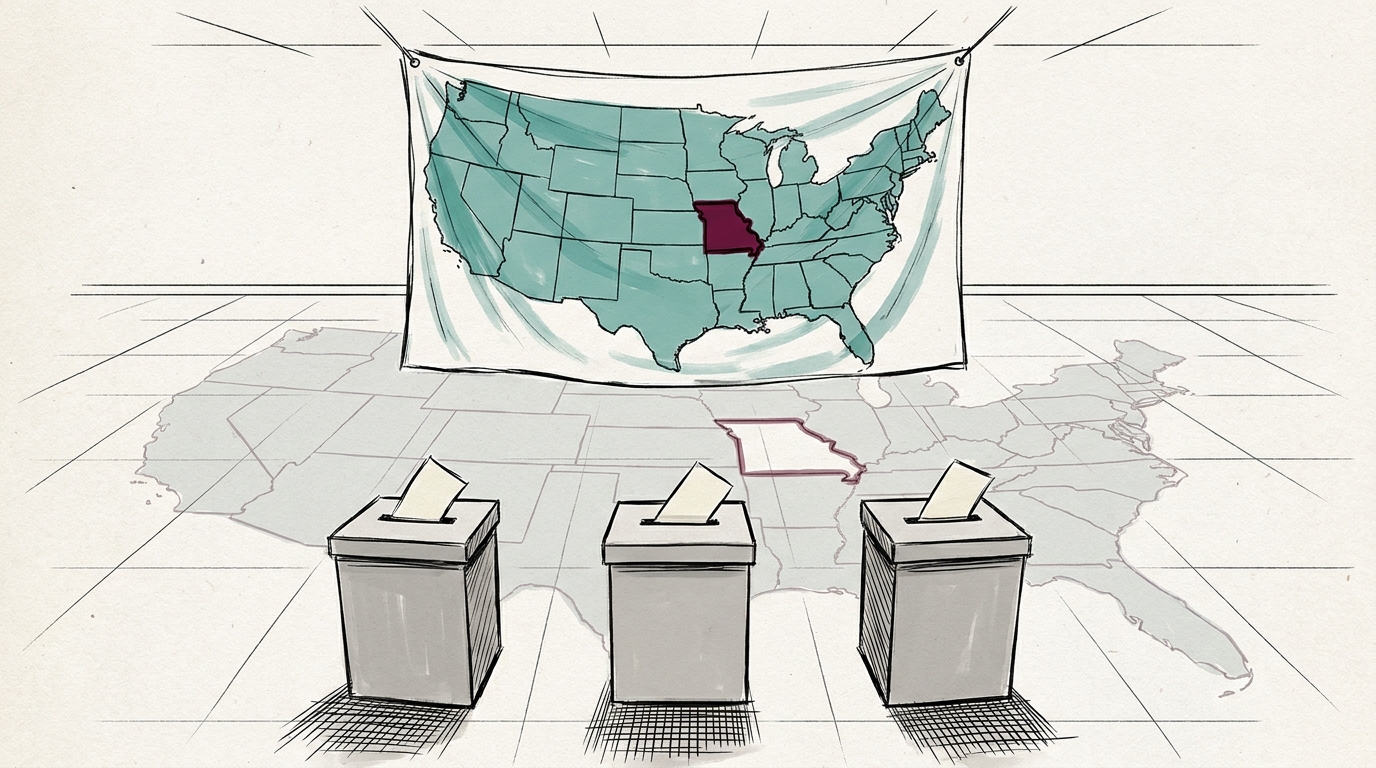
The unanimous court held that Article III, section 49 carries no redistricting exception, so a referendum petition against a congressional map is as valid as against any other law. It ordered the 2022 map to govern unless voters approve HB 1 on 3 November.
Denny Hoskins, Missouri Secretary of State
Hoskins told the Supreme Court that changing the congressional map after 1.2 million primary votes and ahead of the 19 September overseas-ballot deadline violates Purcell and the Elections Clause. He wants HB 1 reinstated before ballots print for November.
Senate Republican leadership
Floor time is finite at 51-47 with a bipartisan funding negotiation running, and a contested procedural fight over grant conditions is not the best use of it this month. Nothing has been abandoned; the resolution keeps its place on the calendar.
