Skip to content
You can now search across every topic, entity and event.What's new
US Midterms 2026
7SEP

June hiring stalls as jobs turn soft

2 min read
13:32UTC

June payrolls rose just 57,000 against a 115,000 forecast, the second soft economic signal of the year and the one variable this week's court fights could not touch.

PoliticsDeveloping
Key takeaway

June's weak jobs print is the fundamental now moving the midterm board while procedure stalls.

The Bureau of Labor Statistics (BLS) reported on 3 July that June nonfarm payrolls rose just 57,000, roughly half the 115,000 economists had expected. The BLS also revised April and May down by a combined 74,000. Unemployment held at 4.2%, but only because labour-force participation fell to 61.5%, its lowest since March 2021.

A flat jobless rate propped up by people leaving the workforce is weaker than the headline reads, because it counts discouraged job-seekers as no longer unemployed. Hiring at this pace, with participation sliding, describes a labour market losing momentum. This is the second soft reading after the first-quarter contraction in gross domestic product of 0.3%.

The figure feeds the generic-ballot environment that Silver Bulletin marked at D+6 , the kind of margin that in past midterms has cost the party in power 15 to 25 House seats. Every institutional fight this week re-ran a question the courts had settled in June. The economy moved the one number procedure cannot reach, and it moved against the incumbent party.

Deep Analysis

In plain English

Every month the government reports how many new jobs were created and what share of people are unemployed. In June, only 57,000 jobs were added, far below the 115,000 economists expected. Normally that would push the unemployment rate up, but it stayed at 4.2% because fewer people were actively looking for work, the lowest share since March 2021. Fewer job-seekers can make the unemployment rate look steady even when hiring is genuinely slowing down.

First Reported In

Update #12 · Voter-data drive stalls; jobs turn soft

U.S. Bureau of Labor Statistics· 9 Jul 2026
Read original
Causes and effects
Different Perspectives
New Hampshire student voters
Students who hold no accepted photo ID under HB 323 cannot vote in the 8 September primary after Judge Laplante declined to block the law on timing grounds. Whether the same rule applies on 3 November is still open.
Alaska Democratic Party
The Alaska Democratic Party moved $884,835 in coordinated spending to Mary Peltola between 17 and 30 July, more than the DCCC spent nationally in the same fortnight.
National Republican Senatorial Committee
The NRSC, which sued to remove coordinated-spending caps in NRSC v. FEC, put $2,230,472 behind candidates in the first complete month after winning that case, more than double the total for the prior six months combined.
Supreme Court of Missouri
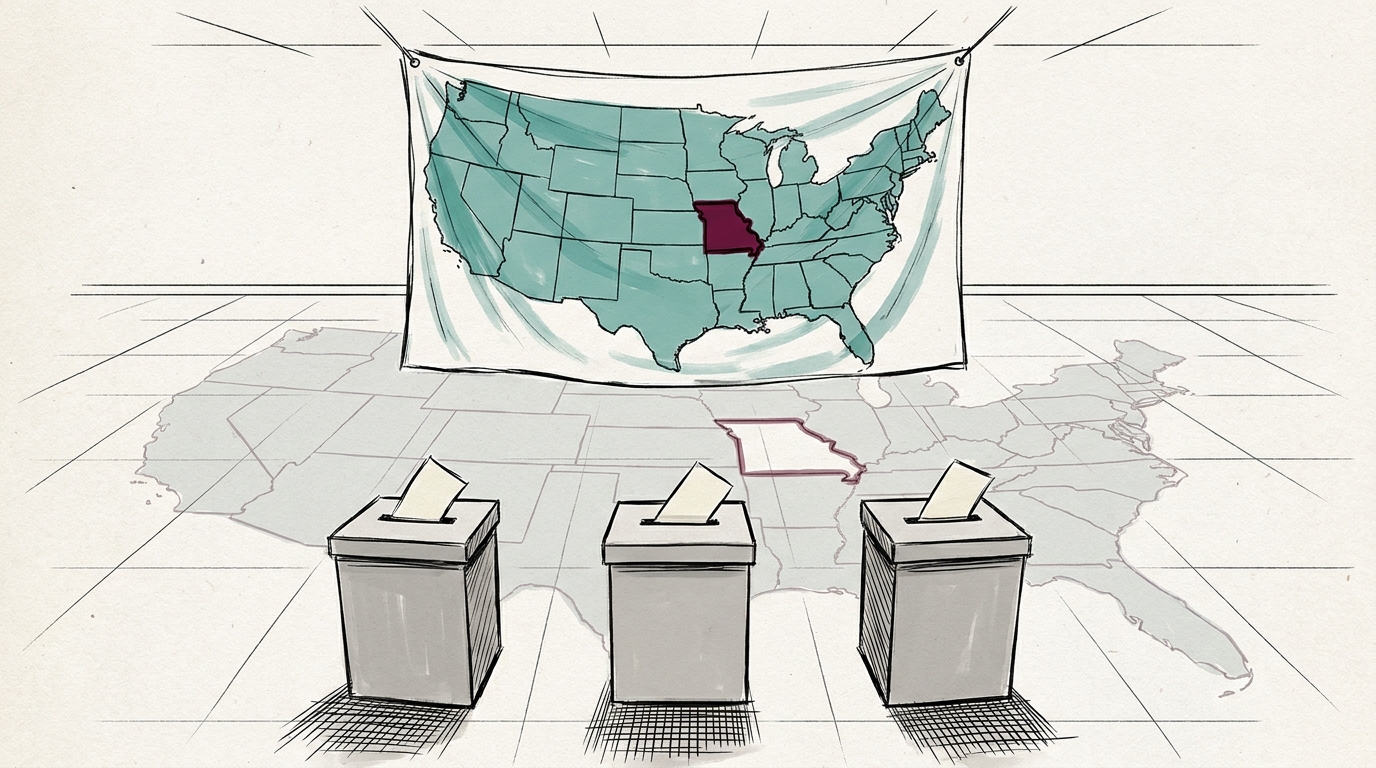
The unanimous court held that Article III, section 49 carries no redistricting exception, so a referendum petition against a congressional map is as valid as against any other law. It ordered the 2022 map to govern unless voters approve HB 1 on 3 November.
Denny Hoskins, Missouri Secretary of State
Hoskins told the Supreme Court that changing the congressional map after 1.2 million primary votes and ahead of the 19 September overseas-ballot deadline violates Purcell and the Elections Clause. He wants HB 1 reinstated before ballots print for November.
Senate Republican leadership
Floor time is finite at 51-47 with a bipartisan funding negotiation running, and a contested procedural fight over grant conditions is not the best use of it this month. Nothing has been abandoned; the resolution keeps its place on the calendar.
