Skip to content
You can now search across every topic, entity and event.What's new
US Midterms 2026
7SEP

Fry and Norman run, keep House seats

2 min read
13:32UTC

Russell Fry and Ralph Norman filed for South Carolina's Senate primary on 20 July against Trump's endorsed candidate, and neither surrendered his House seat to do it.

PoliticsDeveloping
Key takeaway

Without a resign-to-run law the candidates risk nothing and the House majority carries the vacancy.

Representatives Russell Fry and Ralph Norman filed for South Carolina's special Senate primary on 20 July, neither giving up his House seat to do it. The seat opened when Lindsey Graham died on 11 July . They join interim Senator Darline Graham Nordone, Graham's sister, appointed on 13 July and carrying Donald Trump's endorsement , alongside Duke Buckner, Mark Lynch, Mark McBride, Clark Neilson and Samuel Shepherd 1. Filing closes at noon on 28 July, so the field is not yet settled.

South Carolina has no resign-to-run law, the rule that in some states obliges an officeholder to quit one post before standing for another. Fry has said he will keep his House seat and stand for re-election there in November if the Senate primary goes against him 2. Neither man faces a choice about anything until January.

Norman has turned that arrangement into an argument against his own side. Whichever of the two wins is sworn into the Senate, his House seat empties on that day, and it stays empty until a separate special election fills it, plausibly well into 2027 3. Speaker Mike Johnson has no spare votes to lend to a colleague's ambition.

Where resign-to-run statutes do bind, as in Florida and Georgia, they price ambition and thin primary fields, because entering costs the officeholder the job he already has. Without one, the rational move for any House member sitting on a safe seat is to enter every open Senate primary going: lose and you go back to work, win and you move up. The cost does not disappear. It transfers to the conference, which carries the vacancy. Norman can argue against the arrangement and use it in the same week without contradicting himself.

Deep Analysis

In plain English

In some states, a politician who already holds one elected office must give it up before running for another. South Carolina has no such rule. That is why two sitting members of the US House of Representatives, Russell Fry and Ralph Norman, could file for the open Senate seat without resigning first. If either wins, his House seat sits empty for months until a separate election fills it, at a moment when the Republican majority in the House is thin enough that every vote matters.

Deep Analysis
Root Causes

South Carolina has never adopted a resign-to-run law, so a sitting House member loses nothing by entering a Senate primary: the downside is a lost primary and an uncontested return to the House seat already held.

The cost of the attempt does not disappear, it transfers to the Republican conference, which must find a way to hold a House majority with a seat vacant for the months a separate special election takes to complete. Because the candidate and the party bear different halves of the same risk, the rational move for any House member with a safe seat is to enter every open Senate primary within reach.

What could happen next?
  • Consequence

    A Fry or Norman win would empty an SC-05 or SC-07 seat on swearing-in and leave it vacant through a separate special election, plausibly stretching into 2027.

  • Precedent

    Trump's endorsement of Nordone failing to clear a field of sitting House members is a measurable test of endorsement discipline that other 2026 primaries will read.

First Reported In

Update #14 · 0-for-17 in court, and the map that held

SC Daily Gazette· 26 Jul 2026
Read original
Causes and effects
Different Perspectives
New Hampshire student voters
Students who hold no accepted photo ID under HB 323 cannot vote in the 8 September primary after Judge Laplante declined to block the law on timing grounds. Whether the same rule applies on 3 November is still open.
Alaska Democratic Party
The Alaska Democratic Party moved $884,835 in coordinated spending to Mary Peltola between 17 and 30 July, more than the DCCC spent nationally in the same fortnight.
National Republican Senatorial Committee
The NRSC, which sued to remove coordinated-spending caps in NRSC v. FEC, put $2,230,472 behind candidates in the first complete month after winning that case, more than double the total for the prior six months combined.
Supreme Court of Missouri
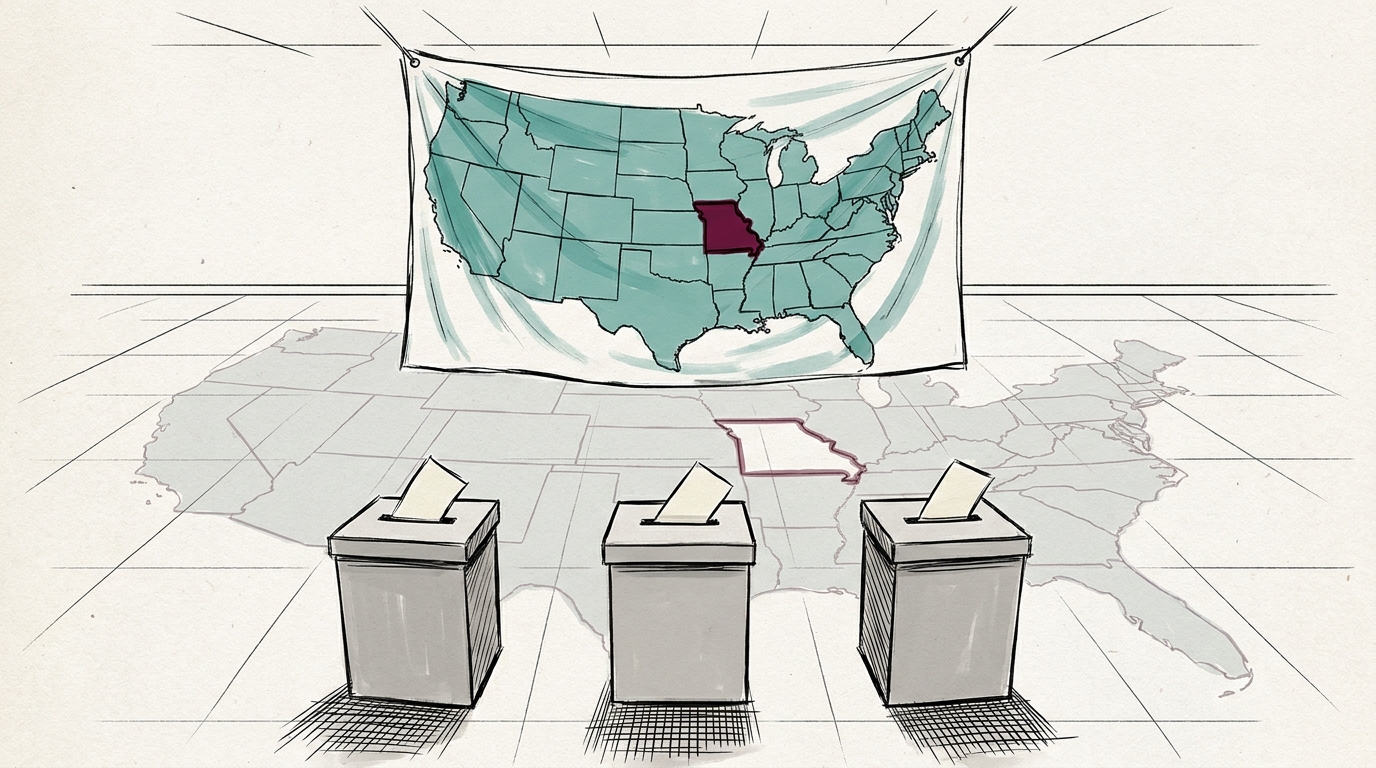
The unanimous court held that Article III, section 49 carries no redistricting exception, so a referendum petition against a congressional map is as valid as against any other law. It ordered the 2022 map to govern unless voters approve HB 1 on 3 November.
Denny Hoskins, Missouri Secretary of State
Hoskins told the Supreme Court that changing the congressional map after 1.2 million primary votes and ahead of the 19 September overseas-ballot deadline violates Purcell and the Elections Clause. He wants HB 1 reinstated before ballots print for November.
Senate Republican leadership
Floor time is finite at 51-47 with a bipartisan funding negotiation running, and a contested procedural fight over grant conditions is not the best use of it this month. Nothing has been abandoned; the resolution keeps its place on the calendar.
