Skip to content
You can now search across every topic, entity and event.What's new
Russia-Ukraine War 2026
27MAR

Navy buys seven years of Tomahawks

2 min read
20:48UTC

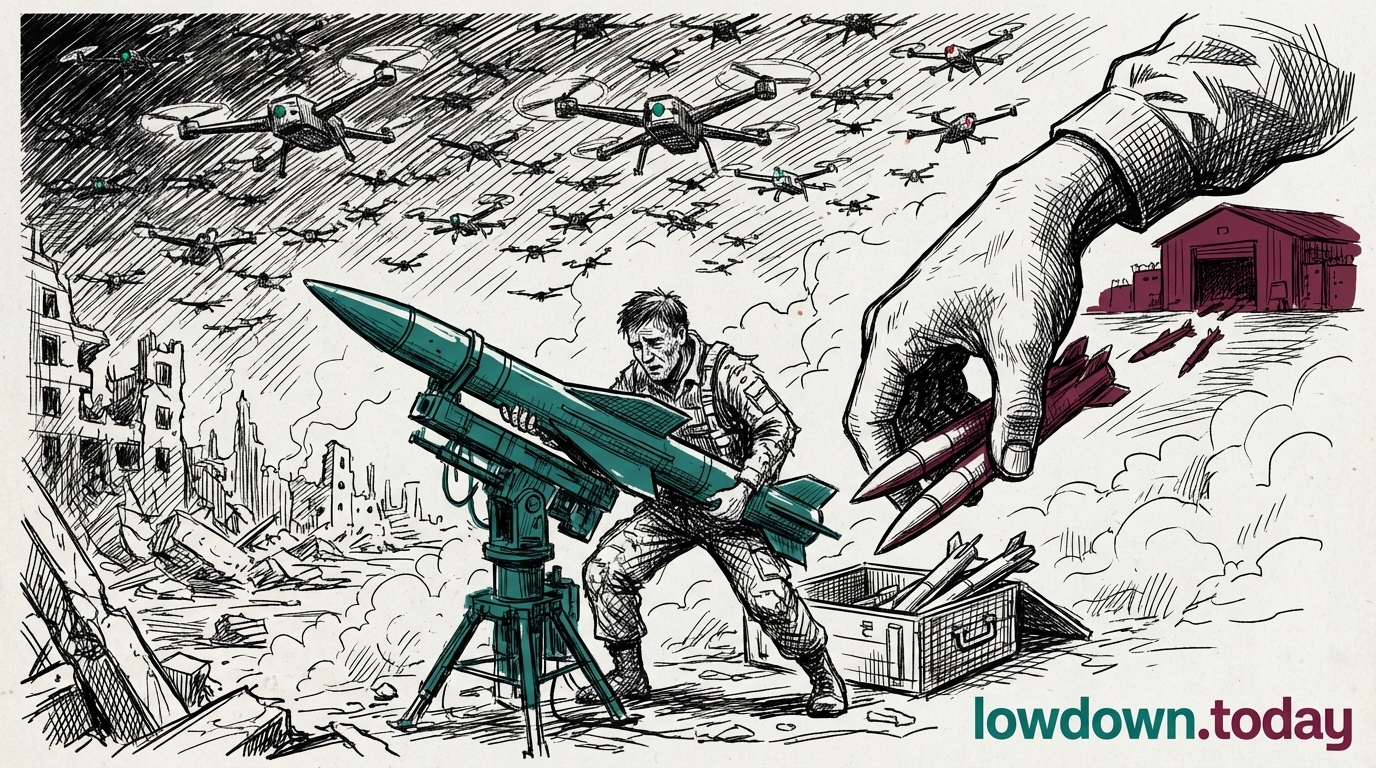
The US Navy signed a $22.9 billion contract with Raytheon on 17 August, lifting Tomahawk production from about 60 missiles a year to more than a thousand. It is the first hard number anyone has put on sustaining this war.

ConflictDeveloping
Key takeaway

The contract's seven-year term, not its value, is what states Washington's expectation about this war.

The US Navy signed a $22.9 billion, seven-year contract with Raytheon on Monday 17 August to lift Tomahawk production from about 60 missiles a year to more than a thousand 12. A Tomahawk is a long-range cruise missile launched from ships and submarines against targets hundreds of miles inland. US Central Command (CENTCOM), the American military command responsible for the Middle East, had fired 850 of them by 1 April, the most in any single American operation on record .

Do the sum. At 60 missiles a year, replacing those 850 alone takes 14 years. At more than a thousand a year, it takes about ten months. The award runs to 2033 and sits inside the Department of War's Arsenal of Freedom initiative, the department's programme for expanding munitions production, which means the Navy has priced this war past two presidential budget cycles 34.

Nobody had put a price on sustaining this war until the Navy signed one. A contract carries a value, a term and a rate, which a statement does not, and this one buys the capacity to keep firing at the pace of the past six months for the rest of the decade. Congress now has a recurring line item to attach conditions to, which is a lever the war powers votes have not produced.

Acting Secretary of the Navy Hung Cao wrote on X that industry had been asked to scale munitions output rapidly and that RTX was delivering 5. That is a social media post rather than a department release, and it is the only comment from a named official in either account of the award. Raytheon also dates the decision earlier than the war's heaviest month of firing: the company says it delivered three times more Tomahawks in the first half of 2026 than in the first half of 2025, and the 17 August award firms up a framework agreement signed with the military back in February 67. A build-out planned before the worst of this year's firing rate is a different thing from an emergency backfill.


Deep Analysis

In plain English

A Tomahawk is a long-range cruise missile the US Navy fires from ships and submarines at targets hundreds of miles away. The Navy has been firing them faster than factories could replace them. This $22.9 billion deal pays Raytheon, the manufacturer, to build far more of them each year, for the next seven years, so the stockpile does not run out.

Deep Analysis
Root Causes

Tomahawk production runs through a single Raytheon line in Tucson, Arizona, built around specialised components, including turbofan engines sourced from Williams International, that cannot be doubled by adding shifts alone.

The Department of War's Arsenal of Freedom initiative exists because the Pentagon's peacetime procurement cycle assumed replenishment over years rather than months; committing to 2033 locks in supplier investment the department could not otherwise guarantee year to year, the same industrial constraint already visible in the JASSM-ER cruise missile programme .

What could happen next?
  • Consequence

    Locking Tomahawk output through 2033 commits US defence budgets to sustaining this war's munitions pace well past any near-term ceasefire.

First Reported In

Update #174 · A $22.9bn missile order, and a hunger row

RTX· 23 Aug 2026
Read original
Causes and effects
This Event
Navy buys seven years of Tomahawks
A signed seven-year contract states an expectation about the war's length that no statement from either capital has.
Different Perspectives
Belarus
Belarus
Minsk announced completion of its own 37th Separate Airborne Assault Brigade near Gomel, under plans dating to August 2025 rather than a response to any single frontline event this window, keeping its hedge of hosting the war without formally joining Russia's mobilisation drive.
European Union / Operation IRINI states
Italy, Greece and Poland boarded the sanctioned tanker Toa Payoh off Pantelleria under a standing EU mandate rather than a national decision, extending enforcement from the Channel and Baltic and the Black Sea and Azov into the Mediterranean. Italian Defence Minister Guido Crosetto praised the crew; the captain's refusal to produce documentation left detention unconfirmed.
Poland and the NATO eastern flank
Warsaw's Coordination Team said explicitly its forces tracked the 30 July missile incursion and were ready to shoot it down, then flew air cover for an EU tanker interdiction three days later. Poland is simultaneously the war's nearest spillover victim and a contributor to enforcing sanctions against the state causing that spillover.
Ukraine (government, defence establishment and civilians)
Kyiv runs its manpower crisis through acting Defence Minister Yevhen Khmara, whose formal appointment waits for parliament's 18 August return, and a fortnight-old Commander-in-Chief, Mykhailo Drapatyi. Reported attacks on enlistment officers rose from 5 cases in 2022 to 341 in 2025, reaching Odesa's Territorial Recruitment Centre staff directly on 2 August.
Kremlin and Russian domestic economic voices
Moscow has not addressed July's advance-rate collapse or Sberbank's OFZ warning; Novak's diary ran to OPEC+ quota diplomacy with no diesel item logged since 15 July. Economist Nikolai Korzhenevsky calls the Central Bank's RUB 2.3tn in bank lending effectively deficit monetisation, a framing Sberbank's Skvortsov, with his own institutional interest, has not disputed.
IAEA (Rafael Grossi)
IAEA inspectors logged Zaporizhzhia's 22nd loss of off-site power, ten of them in the last three months, after a thunderstorm knocked out the plant's sole surviving backup line. Grossi reads the accelerating frequency, not any single outage, as the safety signal now that the plant's redundancy is exhausted.



