Skip to content
Welcome, thoughtbot's Giant Robots listeners!Start here
Russia-Ukraine War 2026
27MAR

Mach hits $1.8B in fintech-backed round

3 min read
20:48UTC

Mach Industries closed a $300M Series C at a $1.8B valuation, quadrupling its value in a year, with a fintech fund and mainstream tech investors crossing into attack-drone equity.

ConflictDeveloping

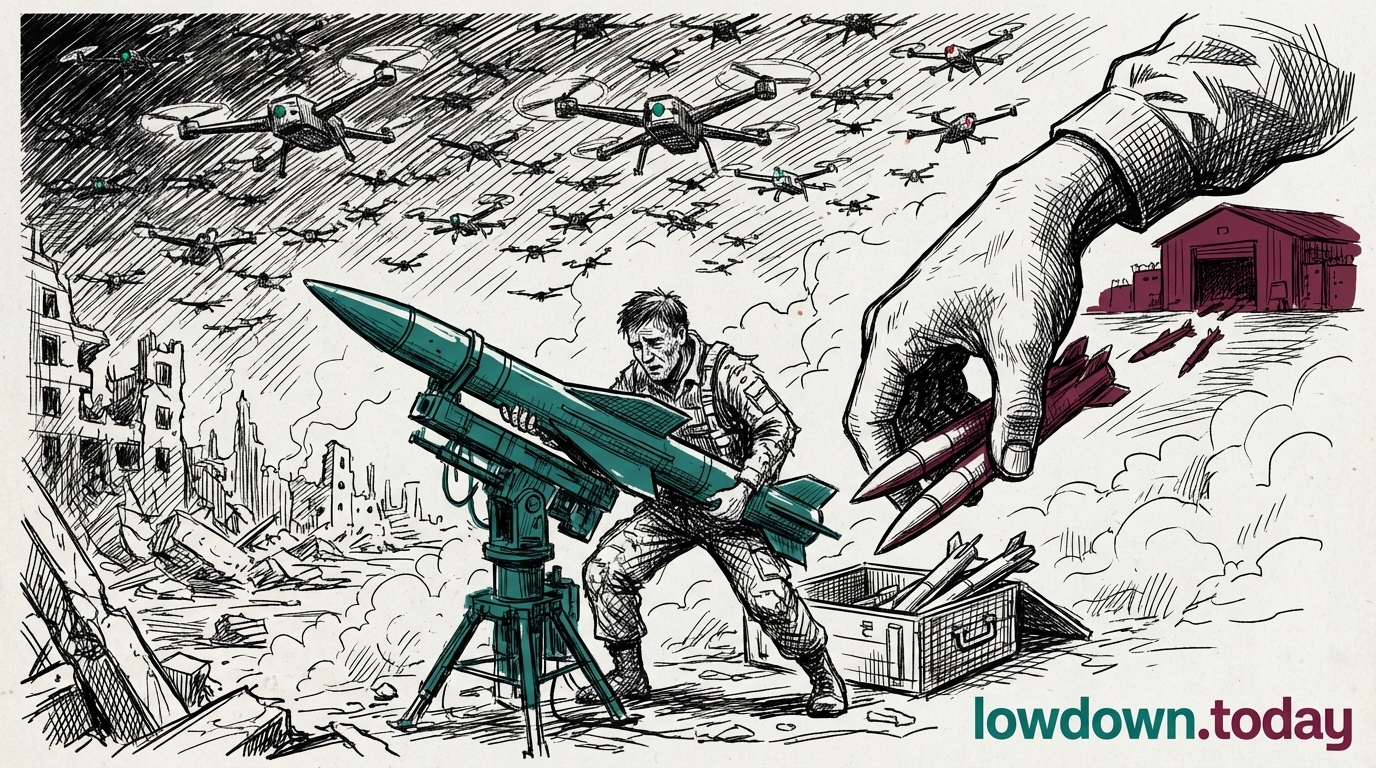
Mach Industries closed a $300M Series C at a $1.8B valuation on Monday 1 June, four times its level twelve months earlier⁠1. The round was co-led by Infinite Capital and Ribbit Capital, with Sequoia Capital, Khosla Ventures and Bedrock participating. Mach, a US defence-tech startup building low-cost strike drones and interceptors, simultaneously bought solid-rocket-motor firm Exquadrum for $50M.

The specialist rounds are already logged, including Anduril's $5bn and Helsing's $1.2bn, so the round's size is not the signal. Ribbit is a fintech fund; Sequoia and Khosla are mainstream technology investors. Generalist money crossing into attack-drone equity prices the category as ordinary venture tech rather than a government niche.

That repricing compresses the cost of capital across the cohort, but it carries a risk the specialist rounds did not. Mach's 4x step-up decouples valuation from revenue. If Pentagon order flow slows, valuations set on a mainstream-tech thesis correct faster than ones underwritten by defence specialists who price the procurement cycle into their models.

Deep Analysis

In plain English

Mach Industries is a young American company building low-cost attack drones and missiles. On 1 June 2026, it raised $300 million from investors, including Sequoia Capital, which also backed Apple and Google early on, valuing the company at $1.8 billion. That is four times more than it was worth just a year ago. At the same time, it bought a company called Exquadrum for $50 million. Exquadrum makes the solid rocket motors that power the kinds of missiles Mach builds. Buying the supplier means Mach controls more of its own production chain and does not depend on outside companies for a critical component.

Deep Analysis
Root Causes

Mach's valuation acceleration from ~$450M (twelve months prior, implied by the 4x step-up from the $1.8B post-money) reflects two concurrent forces: the Pentagon's FY2027 defence budget request lifting drone and counter-drone allocation to $70B gave investors a visible government demand signal, and Anduril's Arsenal-1 factory announcement created competitive urgency for a production-scale rival.

Exquadrum's $50M acquisition solves a specific bottleneck: Mach's five-vehicle programme requires solid-rocket-motor supply that it previously sourced externally. Bringing propulsion in-house reduces single-source supply risk and makes the company's cost structure more predictable for the LRIP contract negotiations it will need to enter.

What could happen next?
  • Consequence

    Ribbit Capital and Sequoia's participation in an attack-drone round will draw scrutiny from Congressional committees on investment in autonomous lethal systems, potentially triggering disclosure requirements for non-specialist VC firms in future defence rounds.

  • Opportunity

    Exquadrum integration gives Mach a credible proposition for Pentagon LRIP competitions where supply-chain independence is a scoring criterion, directly competitive with Kratos's Valkyrie LRIP negotiations.

First Reported In

Update #11 · Ukraine starts exporting the factory

Tech Crunch· 7 Jun 2026
Read original →
Different Perspectives
Government of Latvia
Latvia abstained on 22 September when the EU renewed its individual sanctions for 36 months at the price of delisting Alisher Usmanov and Mikhail Fridman, and promised national sanctions of its own. Riga's abstention marks how far a frontline member state will go to keep listed names listed.
India's Ministry of External Affairs
After the House passed the Graham bill on 16 September, India's foreign ministry said it would keep buying energy on market terms and protect its trade. Russia supplied 30.3% of India's crude imports in fiscal 2026, so the tariff decision due around 18 October falls directly on New Delhi.
Kaja Kallas, EU foreign policy chief
Kallas answered the US licence on 10 October by saying Europe would not ease pressure, and EU ministers adopted a 22nd package of nearly 1,600 listings two days later. Brussels is tightening as Washington loosens, though TASS reported the package adds no significant new trade restrictions.
Donald Trump and the US Treasury
The Treasury licensed Russian diesel imports until 7 April 2027 on the day of Trump's call with Putin, and Trump then told reporters Ukraine should find a new leader. Washington is trading sanctions relief for fuel supply while pressing Kyiv to halt the refinery strikes behind the shortage.
Kremlin and Deputy Prime Minister Alexander Novak
After the 9 October call the Kremlin said Russia was ready to supply oil and petroleum products to American and global markets, and Novak brought forward the end of diesel export curbs. Moscow is selling the shortage back as goodwill, with volumes that Decree No. 686 now hides from outside checks.
Volodymyr Zelenskyy, President of Ukraine
Zelenskyy called GL 135 an investment in prolonging the war and offered to stop striking Russian refineries if Russia stops destroying Ukraine's energy system. Answering Trump's call for a new leader, he set a total 60-day ceasefire as the condition for elections, which puts the next move on Moscow.
