Skip to content
You can now search across every topic, entity and event.What's new
Russia-Ukraine War 2026
27MAR

Lebanon death toll passes 1,000

3 min read
20:48UTC

Since Israel's ground offensive began on 2 March, Lebanon has lost more than a thousand lives — 118 of them children — while displacement has crossed one million, roughly a fifth of the country's population.

ConflictDeveloping
Key takeaway

Lebanon's pre-existing economic collapse means this war is the third layer of catastrophe on an already failed state.

One thousand and one people have been killed in Lebanon since 2 March, according to Lebanon's Health Ministry 1. The dead include 118 children, 79 women, and 40 healthcare workers. Another 2,584 are wounded. Displacement has crossed one million.

The toll has accelerated: 826 dead on 14 March , 968 on 18 March , 1,001 on 19 March. Two Israeli armoured divisions — the 36th and the 91st Galilee — are now operating south of the Litani , and the IDF has destroyed bridges over the river to seal the area . Evacuation orders cover 1,470 square kilometres — 14% of Lebanon's territory . A Northern Command officer told Yedioth Ahronoth the ground operation could last until late May .

Forty healthcare workers killed in seventeen days degrades the medical system treating the wounded. Hospitals in southern Lebanon are physically cut off by the bridge destructions. The IRC reported thousands sleeping in streets as early as 16 March ; the displaced figure has since grown past one million — nearly one in five Lebanese forced from home.

The population bearing this cost has no seat at any table where decisions are made. Hezbollah committed 30,000 fighters and framed the conflict as existential ; Israel plans to hold all territory south of the Litani through at least late May . The Washington Post reported that Shiite communities forming Hezbollah's core base are "increasingly furious" with the group for pulling Lebanon into the war . For Lebanon's displaced million, the conflict has reduced to the destruction of daily life's infrastructure — homes, roads, bridges, hospitals, and the people who staff them.


Deep Analysis

In plain English

Lebanon was already in crisis before this conflict. Its banking system collapsed in 2019, wiping out most depositor savings. The currency lost 98% of its value. The country had been running on rationed electricity for years, and was already hosting 1.5 million Syrian refugees. Now, roughly one in four Lebanese — one million people in a country of four million — have been displaced. There is no functioning state apparatus to absorb them and no fiscal capacity to rebuild. The healthcare system that survived the economic collapse is now losing workers at more than two per day, degrading the one resource that treats the wounded.

Deep Analysis
Synthesis

A 25% displacement rate in a country of four million — layered on top of 1.5 million existing Syrian refugees — creates a system with no internal absorption capacity whatsoever. International aid flows are simultaneously being triaged across Iran civilian needs and ongoing Gaza requirements, structurally under-resourcing the Lebanese response regardless of donor intentions. The 40 healthcare worker casualties also represent a self-compounding harm: as medical capacity degrades, casualty-to-death ratios worsen, inflating future death counts without any increase in military intensity.

Root Causes

Lebanon entered this conflict at a critically low humanitarian baseline: sovereign debt default since 2020, a banking system that has frozen depositor assets, a government unable to sustain basic services, and a security apparatus that could not control its own territory. The marginal harm of additional displacement and infrastructure destruction is higher than in a functioning state precisely because there is no domestic absorption capacity at any institutional level.

Escalation

The 40 healthcare worker deaths in 18 days — approximately 2.2 per day — indicate either deliberate targeting of medical facilities or extreme front-line exposure. Either trajectory progressively degrades the healthcare system's capacity to treat the wounded, increasing the ratio of deaths to casualties as the conflict continues, independent of military intensity.

What could happen next?
2 consequence3 risk
  • Consequence

    A 25% displacement rate in a state with no domestic absorption capacity requires sustained international humanitarian financing that has no existing framework.

    Immediate · Assessed
  • Risk

    Degradation of healthcare capacity through worker casualties will progressively worsen the wounded-to-dead conversion rate as the conflict continues.

    Short term · Assessed
  • Risk

    Lebanon's pre-existing 1.5 million Syrian refugee population creates a secondary displacement cascade as host communities collapse under new conflict pressure.

    Short term · Suggested
  • Consequence

    Future accountability proceedings will be structurally complicated by Lebanon's lack of a functioning state authority capable of cooperating with international legal mechanisms.

    Long term · Suggested
  • Risk

    Human capital emigration, already accelerated by the 2019 banking collapse and 2020 port explosion, will permanently reduce Lebanon's reconstruction capacity.

    Long term · Assessed
First Reported In

Update #42 · Iran hits four countries; Brent at $119

Al Jazeera· 20 Mar 2026
Read original
Causes and effects
This Event
Lebanon death toll passes 1,000
The toll reflects the pace of a two-division ground invasion with 40 healthcare workers among the dead, eroding the medical system's capacity to treat 2,584 wounded. One million displaced exceeds Lebanon's institutional capacity to shelter its own population.
Different Perspectives
North Korea / DPRK
North Korea / DPRK
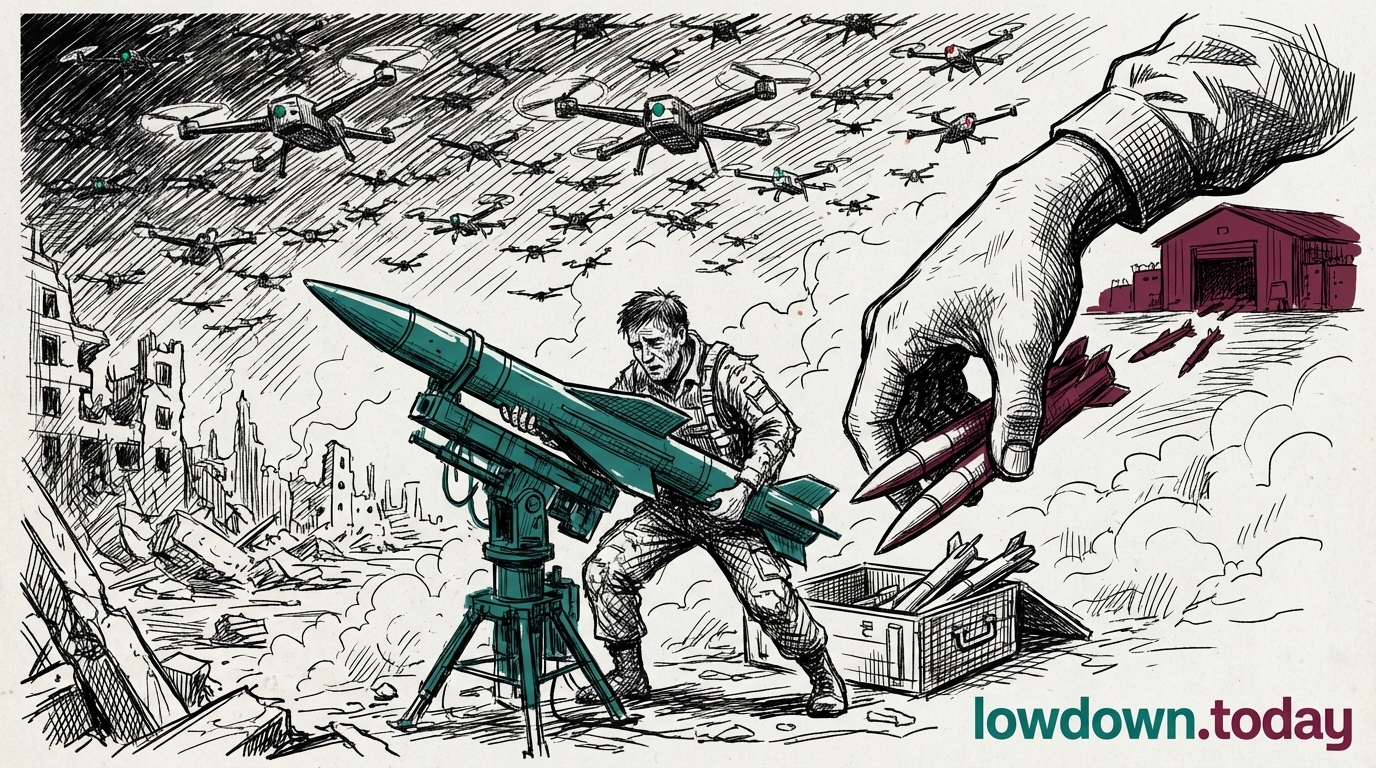
ISW confirmed the first mounting of DPRK Type-75 MLRS on Russian autonomous UGVs near Kharkiv on 7 June, the latest step in a supply axis that escalated from shells in 2023 to troops in 2024. Pyongyang gains live battlefield data on its ordnance and on Russia's uncrewed-systems programme.
IAEA / Rafael Grossi
Grossi confirmed Chornobyl structural damage with nuclear material metres away and could not attribute the ZNPP 15-hour blackout during the agreed repair window. Six ceasefires brokered and broken at ZNPP, compounded by Rosatom's May attack on IAEA neutrality, have eroded his ability to enforce the windows he negotiates.
Emmanuel Macron / France
Macron co-signed the E3 framework whose line-of-contact baseline marks Europe's first formal acceptance that 1991 borders are not the opening position. France's role carries weight because Macron had previously proposed a European force for Ukraine, and the framework's multinational force point is the vehicle for that.
Keir Starmer / E3
Keir Starmer / E3
Starmer, Macron and Merz met Zelenskyy on 7 June and backed a five-point framework taking the line of contact as the talks baseline, conceding roughly one fifth of Ukraine in exchange for a multinational force and frozen assets. With US mediation ended, the NATO Ankara summit on 7-8 July is the next test.
Vladimir Putin / Kremlin
Putin used SPIEF to reject Zelenskyy's summit letter, citing 'elements of rudeness', and repeated the pre-agreed treaty precondition that has frozen every diplomatic round since May. The SPIEF platform's message of investor confidence was punctured by naval fires visible from St Petersburg, which Moscow declined to dispute in scale.
Ukraine / Unmanned Systems Forces
Commander Brovdi confirmed USF units tracked and set fire to Boikyi at Kronstadt, while Code 9.2 struck the Chonhar Bridge the following day. Ukraine is sequencing strikes for rear-area interdiction and political timing rather than ground gains, trading the Baltic Fleet's home base for the logistics squeeze Russia cannot absorb without rationing its own occupied territory.



