Skip to content
Briefings are running a touch slower this week while we rebuild the foundations.See roadmap
Russia-Ukraine War 2026
27MAR

Israel: no Hezbollah figure has immunity

4 min read
20:48UTC

Israel declared Hezbollah's politicians, military figures, and even civilian 'supporters' legitimate targets — a category broad enough to encompass much of southern Lebanon's population.

ConflictDeveloping
Key takeaway

Israel's declaration that no immunity extends to any Hezbollah politician, military figure, or 'supporter' effectively dissolves the legal and operational distinction between Hezbollah as an armed group and the Lebanese population and political system that intersects with it.

Israel declared that 'no immunity' would be extended to 'any politician or military figure in Hezbollah, even supporters.' The statement accompanied overnight strikes on Beirut's Dahieh district that had already killed 31 and wounded 149 , and evacuation orders issued to dozens of villages in southern Lebanon. An Israeli military source described the operation as 'broad and comprehensive' and stated it 'may include a ground invasion.'

The reported killing of Mohammad Raad, head of Hezbollah's parliamentary bloc , shows the policy in action. Raad was a legislator in Lebanon's National Assembly, not a field commander. Israel's position — shared by the US, UK, and several EU member states that designate Hezbollah in its entirety — is that the group's political and military wings are inseparable. Hezbollah itself does not formally distinguish between them. But international humanitarian law requires individual combatant-status assessment, not categorical designation by organisational affiliation.

The word 'supporters' carries the broadest implication. Hezbollah drew roughly one million votes in Lebanon's most recent elections and operates hospitals, schools, and social services across the south. If 'supporter' encompasses voters or beneficiaries of that infrastructure, the category covers a large share of the Shia population. During the 2006 Lebanon war, the IDF treated civilians who remained after evacuation orders as presumed combatants — a practice Human Rights Watch documented and condemned, and which Israel defended on the grounds that Hezbollah deliberately embedded among civilians.

Israel characterised Hezbollah's rocket and drone attacks as an 'official declaration of war' . The 'no immunity' declaration translates that characterisation into targeting authority. If a ground invasion follows, the IDF would be fighting across three fronts simultaneously — Iranian missile barrages from the air, Gaza on the ground, Lebanon to the north. The last time the IDF fought a multi-front war was October 1973. It has never done so against an adversary with Hezbollah's estimated arsenal of 150,000 rockets and missiles.


Deep Analysis

In plain English

In wars involving terrorist or militant groups, there are internationally recognised rules about who can be targeted. Combatants — fighters — are legitimate targets. Civilians are not. Political figures who also command military wings occupy a contested middle space. Israel's declaration goes further than this: it says that even 'supporters' of Hezbollah have no immunity from Israeli strikes. The problem is that Hezbollah is not just a militia — it is a political party with elected members of the Lebanese parliament, a social services network, and hundreds of thousands of Lebanese Shia who vote for it. 'Supporter' is a term without clear military or legal definition, meaning Israel is asserting the right to strike an undefined category of people who are connected to Hezbollah in ways that may have nothing to do with combat operations. This has significant implications for civilians and for Lebanon's political institutions.

Deep Analysis
Synthesis

The 'no immunity for supporters' declaration is the most legally and politically consequential statement in this set of events. It places Israel on a collision course with international humanitarian law's principle of distinction — the requirement that parties to a conflict differentiate between combatants and civilians. Hezbollah's integration into Lebanese political life means that 'supporter' could encompass elected officials, religious community leaders, teachers employed by Hezbollah's social institutions, and ordinary citizens who voted for Hezbollah's parliamentary candidates. If Israel strikes individuals in these categories, it will face significant international legal exposure and almost certainly trigger International Criminal Court scrutiny, regardless of whether the strikes are militarily effective. More immediately, the declaration complicates Lebanese PM Nawaf Salam's effort to publicly distance the Lebanese government from Hezbollah: if Israel targets Hezbollah's parliamentary bloc members, it is effectively striking Lebanese state institutions. That dynamic pushes Lebanon toward a formal state of war with Israel that Salam is plainly trying to avoid — and collapses the distinction between Hezbollah and Lebanon that both the Lebanese government and the international community have relied on as a diplomatic circuit-breaker.

Root Causes

The declaration reflects Israel's strategic assessment that Hezbollah's military and political wings are inseparable — that political figures provide financing, legitimacy, recruitment, and diplomatic cover that sustains the military capacity. This is analytically accurate in significant respects: Hezbollah's parliamentary bloc controls budget allocations, legitimises arms imports as 'resistance' rather than illegal weapons transfers, and provides the political architecture that prevents the Lebanese state from acting against Hezbollah's arsenal. Israel's targeting logic therefore treats the political wing as a force enabler indistinguishable from the military command. The phrase 'even supporters' may also serve a deterrence function — signalling to Lebanese politicians and civil society figures who have provided Hezbollah with political cover that this conflict will impose personal costs on them, with the aim of breaking the tacit coalition that has protected Hezbollah's position within the Lebanese system.

Escalation

The targeting declaration is a significant escalatory statement because it removes a definitional constraint on Israeli strike authorisation that, if applied, would encompass Lebanese members of parliament, municipal officials, social workers, and potentially ordinary voters. In operational terms, it signals that Israel will not limit its strike list to individuals with a direct role in military planning or execution — the standard it applied (at least formally) in Gaza. The declaration that 'even supporters' have no immunity, combined with ongoing strikes on the Dahieh district of Beirut and the reported killing of Mohammad Raad, suggests Israel is constructing a legal and rhetorical framework to justify strikes on Hezbollah's political infrastructure in advance of executing them. This risks triggering broader Lebanese civilian casualties and drawing Lebanon's non-Hezbollah government and military into the conflict as parties, rather than bystanders — particularly given Lebanese PM Nawaf Salam's already-strained position of distancing his government from Hezbollah while Israeli strikes make no such distinction.

What could happen next?
2 risk1 consequence1 meaning1 precedent
  • Risk

    Strikes on Hezbollah political figures who hold Lebanese parliamentary seats would constitute attacks on a sovereign state's legislature, triggering a formal Lebanese government response and potentially drawing the Lebanese Armed Forces into the conflict.

    Short term · Assessed
  • Risk

    The 'no immunity for supporters' framing, if operationalised broadly, creates significant ICC and UN legal exposure for Israeli military and political leadership and may erode international coalition support for Israel's military campaign.

    Medium term · Assessed
  • Consequence

    The declaration will accelerate civilian displacement from areas associated with Hezbollah's political and social infrastructure, compounding the humanitarian crisis generated by the evacuation orders in Event 2.

    Immediate · Assessed
  • Meaning

    The targeting declaration effectively collapses the distinction between Hezbollah and the Lebanese state, removing a key diplomatic tool — treating Lebanon as a separate actor from Hezbollah — that intermediaries such as France and the UN have relied on to manage past Lebanon-Israel tensions.

    Immediate · Assessed
  • Precedent

    If applied and unchallenged, this doctrine would establish a precedent that state actors can target political supporters of designated terrorist organisations, with implications for future conflicts involving hybrid political-military groups globally.

    Long term · Suggested
First Reported In

Update #8 · Patriot fratricide downs US F-15 in Kuwait

Al Jazeera· 2 Mar 2026
Read original
Different Perspectives
North Korea / DPRK
North Korea / DPRK
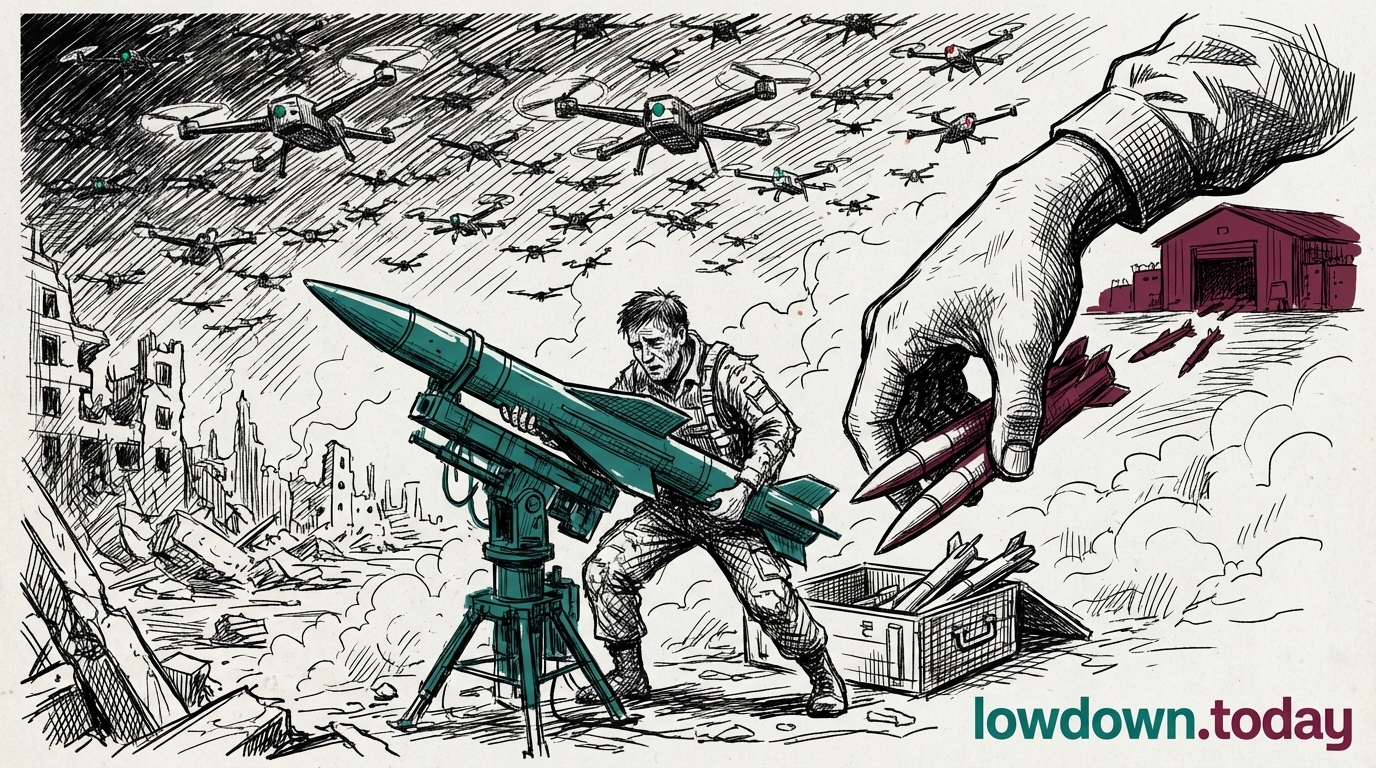
ISW confirmed the first mounting of DPRK Type-75 MLRS on Russian autonomous UGVs near Kharkiv on 7 June, the latest step in a supply axis that escalated from shells in 2023 to troops in 2024. Pyongyang gains live battlefield data on its ordnance and on Russia's uncrewed-systems programme.
IAEA / Rafael Grossi
Grossi confirmed Chornobyl structural damage with nuclear material metres away and could not attribute the ZNPP 15-hour blackout during the agreed repair window. Six ceasefires brokered and broken at ZNPP, compounded by Rosatom's May attack on IAEA neutrality, have eroded his ability to enforce the windows he negotiates.
Emmanuel Macron / France
Macron co-signed the E3 framework whose line-of-contact baseline marks Europe's first formal acceptance that 1991 borders are not the opening position. France's role carries weight because Macron had previously proposed a European force for Ukraine, and the framework's multinational force point is the vehicle for that.
Keir Starmer / E3
Keir Starmer / E3
Starmer, Macron and Merz met Zelenskyy on 7 June and backed a five-point framework taking the line of contact as the talks baseline, conceding roughly one fifth of Ukraine in exchange for a multinational force and frozen assets. With US mediation ended, the NATO Ankara summit on 7-8 July is the next test.
Vladimir Putin / Kremlin
Putin used SPIEF to reject Zelenskyy's summit letter, citing 'elements of rudeness', and repeated the pre-agreed treaty precondition that has frozen every diplomatic round since May. The SPIEF platform's message of investor confidence was punctured by naval fires visible from St Petersburg, which Moscow declined to dispute in scale.
Ukraine / Unmanned Systems Forces
Commander Brovdi confirmed USF units tracked and set fire to Boikyi at Kronstadt, while Code 9.2 struck the Chonhar Bridge the following day. Ukraine is sequencing strikes for rear-area interdiction and political timing rather than ground gains, trading the Baltic Fleet's home base for the logistics squeeze Russia cannot absorb without rationing its own occupied territory.



