Skip to content
You can now search across every topic, entity and event.What's new
Russia-Ukraine War 2026
16JUN

Oil keeps its war premium near $78

2 min read
10:25UTC

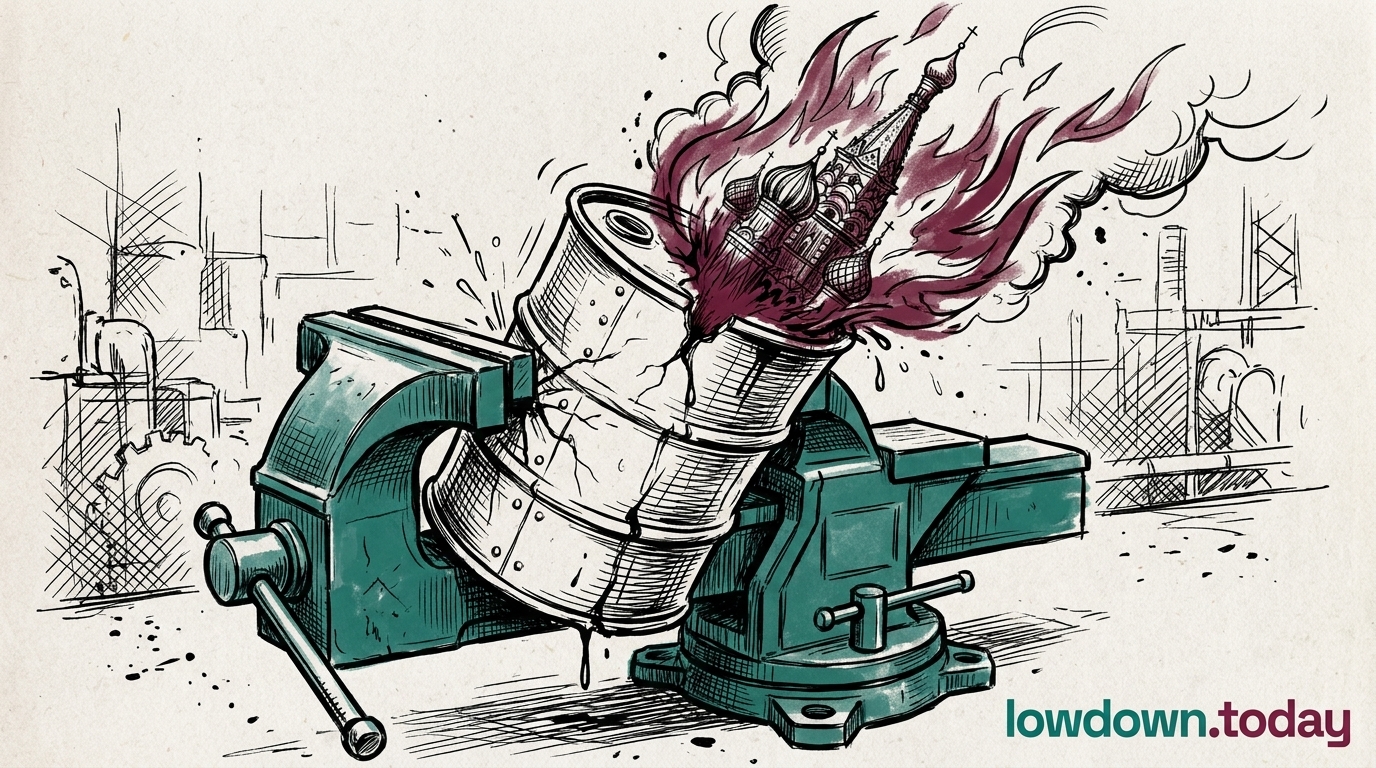
Brent crude held near $78 on 9 July, barely off its 8 July spike, keeping the six per cent war premium in place ahead of a 17 July sanctions deadline.

ConflictDeveloping
Key takeaway

Brent's held premium shows the market pricing an open-ended war, with a US sanctions cliff due 17 July.

Brent Crude traded at $78.17 to $78.21 on Thursday 9 July, barely below the $78.67 it reached on 8 July after the strike-and-retaliation spike . Brent is the benchmark that prices roughly two-thirds of the world's traded oil, so where it settles feeds straight into fuel costs and government revenues. The premium held through a second round of exchange rather than fading on relief. Earlier war spikes had drained away within a session or two; this one has not.

The next scheduled pressure point falls on 17 July, when the wind-down deadline on the revoked oil-sanctions waiver strips Iranian crude sales of US authorisation 1. Traders are pricing an open-ended fight rather than a contained flare-up, holding the six per cent jump in place ahead of a deadline that could tighten Iranian supply further.


Deep Analysis

In plain English

Brent crude is the main global price benchmark for oil, and it affects petrol and diesel prices worldwide. After the US and Iran traded strikes on 8 and 9 July, the price barely moved down from its spike, staying just above $78 a barrel. That matters because previous rounds of fighting this year saw prices spike and then fall back quickly. This time the price is staying high, partly because a US licence that currently allows some Iranian oil sales is due to expire completely on 17 July.

Deep Analysis
Root Causes

Brent's refusal to fade after the strike-and-retaliation exchange reflects a structural shift in what the market is pricing.

The benchmark has absorbed months of recurring strikes without moving much; what is new is the compounding effect of a hard licence deadline landing eight days later, when General License X1's wind-down window closes entirely.

First Reported In

Update #150 · Second US strike wave, first heavy toll

Windward· 9 Jul 2026
Read original
Different Perspectives
Belgium
Belgium
Belgium blocked outright confiscation of the roughly EUR 210bn in frozen Russian assets held at Euroclear in December 2025, because Euroclear would carry the legal liability. Ukraine has since proposed moving custody to the EU instead.
European Commission
European Commission
The Commission said on 2 September that Ukraine has drawn EUR 3.2bn against an EUR 8.35bn annual target, and that a revenue-mobilisation law stuck in the Rada is one of twelve conditions for the next EUR 3.7bn payment.
Steve Witkoff and Jared Kushner
The US envoys met Putin in Moscow on 5 September and Zelenskyy in Kyiv on 6 September without an announced result from more than three hours of talks. Their mediation continues with no public outcome to show for this round.
Robert Brovdi
Robert Brovdi
Brovdi said on 12 September that his Unmanned Systems Forces struck 285 Russian tankers in ten weeks. His own monthly breakdown sums to 79, and he has given no account of the remaining 206.
Sergei Lavrov
Sergei Lavrov
Lavrov said on 12 September that Russia is ready to negotiate but will not suspend military operations while it does. He treats talking and fighting as compatible policies, ruling out a ceasefire as a precondition for further talks.
Belarus
Belarus
Minsk announced completion of its own 37th Separate Airborne Assault Brigade near Gomel, under plans dating to August 2025 rather than a response to any single frontline event this window, keeping its hedge of hosting the war without formally joining Russia's mobilisation drive.


