Skip to content
You can now search across every topic, entity and event.What's new
Russia-Ukraine War 2026
16JUN

Brent gives back its $100 handle

2 min read
10:25UTC

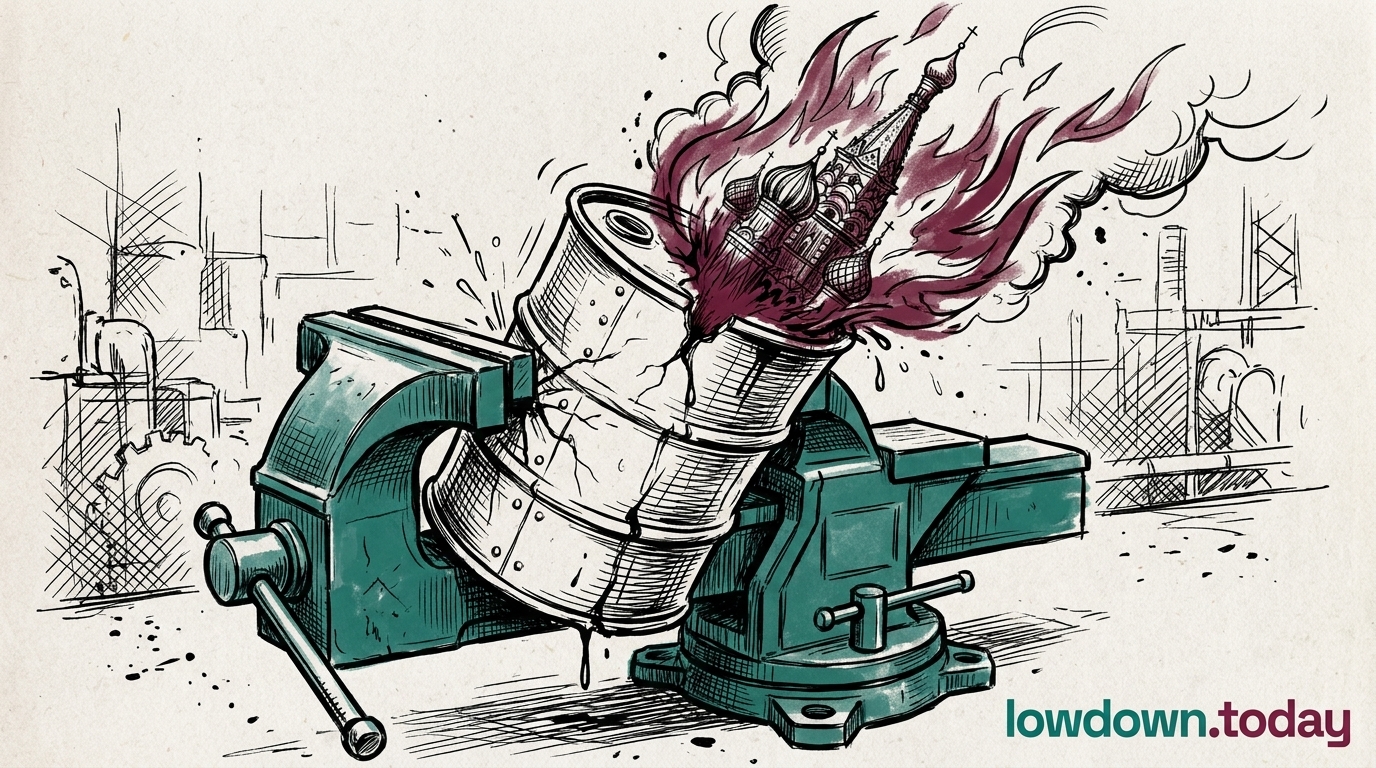
Brent surrendered the $100 level it had first closed above on 23 July, dropping as much as 7.4% intraday on 26 July to settle near $91 as reports of a US-Iran strike pause spread.

ConflictDeveloping
Key takeaway

Brent's slide off $100 is a war-risk unwind; the durable trade stays in freight, not the flat price.

Brent surrendered the $100 level it had first closed above since May on 23 July , dropping as much as 7.4% intraday on 26 July to settle near $91 a barrel, while WTI slid to about $83.51 by 27 July 1 2. Brent is the North Sea benchmark used to price roughly two-thirds of internationally traded crude; WTI is its US counterpart on NYMEX.

The trigger belongs to a different topic. Reports of a pause in US strikes on Iran, with Pakistan said to be mediating a route back to talks, bled the war-risk premium out of the price. That geopolitical read is owned by the Iran conflict coverage; this desk owns the spread and freight consequence, not the diplomacy.

For a spreads desk the round-trip reads as a risk-premium unwind, not a change in physical supply. The barrels are still leaving through Yanbu, still paying the Suezmax penalty, still rounding the long way to Asia. A flat price that swung roughly 9% on a single headline can reverse on the next one, whereas the freight and routing dislocation accrues on every cargo regardless of direction. That is why the position sits in the structure and the flat price is left to whipsaw.


Deep Analysis

In plain English

Oil prices had climbed above $100 a barrel because traders were worried about the fighting between the US and Iran and the blockade near Yemen making it harder to ship oil. On 26 July, reports that US and Iran might pause their strikes were enough to send Brent crude down 7.4% in a single day, settling near $91, with the US benchmark WTI falling to about $83.51 by 27 July. Much of the price rise had been about fear of worse fighting, so even a pause, not a full resolution, was enough to knock a large chunk of that fear-driven premium back out of the price.

Deep Analysis
Root Causes

Brent's climb above $100 was driven overwhelmingly by an escalation premium tied to active US strikes on Iranian targets and the Bab el-Mandeb blockade, not by a change in physical crude balances, which is why a single unconfirmed report of a strike pause was enough to unwind most of the gain in one session.

Because managed money had already cut net long exposure by 69% before the strike-pause reports emerged, the remaining positioning had little cushion left, so sellers faced comparatively thin resistance and the move ran further and faster than the underlying news, a pause rather than a resolution, would normally justify.

Escalation

De-escalatory: the reported strike pause, if confirmed, removes the active-conflict premium that drove Brent above $100, though the move is based on reports rather than a confirmed ceasefire and could reverse quickly.

What could happen next?
  • Risk

    Because managed-money long positioning was already thin before the drop, any confirmation the strike pause is genuine could trigger further downside with limited buying support to absorb it.

  • Consequence

    A widening Brent-WTI spread reversal is likely if the de-escalation premium continues unwinding faster on the international benchmark than on the domestic US contract.

First Reported In

Update #20 · Saudi crude reroutes to Suez, freight bites

TradingEconomics (aggregating Bloomberg)· 27 Jul 2026
Read original
Different Perspectives
Belgium
Belgium
Belgium blocked outright confiscation of the roughly EUR 210bn in frozen Russian assets held at Euroclear in December 2025, because Euroclear would carry the legal liability. Ukraine has since proposed moving custody to the EU instead.
European Commission
European Commission
The Commission said on 2 September that Ukraine has drawn EUR 3.2bn against an EUR 8.35bn annual target, and that a revenue-mobilisation law stuck in the Rada is one of twelve conditions for the next EUR 3.7bn payment.
Steve Witkoff and Jared Kushner
The US envoys met Putin in Moscow on 5 September and Zelenskyy in Kyiv on 6 September without an announced result from more than three hours of talks. Their mediation continues with no public outcome to show for this round.
Robert Brovdi
Robert Brovdi
Brovdi said on 12 September that his Unmanned Systems Forces struck 285 Russian tankers in ten weeks. His own monthly breakdown sums to 79, and he has given no account of the remaining 206.
Sergei Lavrov
Sergei Lavrov
Lavrov said on 12 September that Russia is ready to negotiate but will not suspend military operations while it does. He treats talking and fighting as compatible policies, ruling out a ceasefire as a precondition for further talks.
Belarus
Belarus
Minsk announced completion of its own 37th Separate Airborne Assault Brigade near Gomel, under plans dating to August 2025 rather than a response to any single frontline event this window, keeping its hedge of hosting the war without formally joining Russia's mobilisation drive.


