Skip to content
Briefings are running a touch slower this week while we rebuild the foundations.See roadmap
Russia-Ukraine War 2026
9JUN

410 Prisoners Home as Tranche One Lands

3 min read
11:54UTC

Ukraine and Russia exchanged 205 prisoners each side on 15-16 May, executing the first tranche of the Istanbul deal eight days after Putin had publicly blocked it by denying Kyiv submitted a list.

ConflictDeveloping
Key takeaway

410 people came home; the next tranche date is the test of the Istanbul format.

Ukraine and Russia exchanged 205 prisoners each side across Friday 15 and Saturday 16 May 2026, executing the first tranche of the 1,000-for-1,000 deal that had been blocked at announcement just over a week earlier 1. The hand-over took place at the Ukraine-Russia border crossing used for prior exchanges. 795 prisoners each side remain to be returned in subsequent tranches under the agreement signed in Istanbul.

The sequencing matters because Moscow had publicly killed the deal on 12 May. Putin himself stated that Ukraine had not submitted a list, that no agreement existed, and that the announcement was a Ukrainian misrepresentation. Eight days later 205 Ukrainians walked back across the border. Whatever the diplomatic theatre of denial, the operational pipeline had remained open enough to move 410 people in 48 hours.

For the soldiers and families involved this is the largest single-event prisoner return since 2024. Ukrainian recipients included servicemembers held since the Azovstal siege in 2022; Russian recipients included men captured during the Kursk incursion last summer. Neither side has published full nominal lists, which is consistent with prior exchanges where verification continues for weeks after the physical transfer.

Tranche pacing matters more than the headline number. The deal as written promises 795 more each side; Russia's pattern in earlier exchanges has been to release the easiest cases first and slow-roll the politically inconvenient ones, particularly Mariupol defenders and Crimean Tatar civilians. No date has been set for the second tranche, and that date will be the cleanest read on whether the Istanbul format is producing anything beyond an opening photograph.

Deep Analysis

In plain English

Ukraine and Russia exchanged 205 prisoners each side on 15 and 16 May 2026. This was the first part of a deal to exchange 1,000 prisoners in total. The transfer happened at the border. Just over a week earlier, Russia's president Putin had publicly said Ukraine had not submitted a list of prisoners to exchange, which seemed to kill the deal. Eight days later, 410 people crossed the border. Putin's 9 May denial and the operational exchange pipeline operated independently: one was information management, the other moved bodies across a border. For the families involved, this is the largest single exchange since 2024. But 795 prisoners from each side are still waiting. Whether the remaining tranches happen quickly or slowly will show how much Russia is using this process as a genuine humanitarian exchange or as diplomatic leverage.

What could happen next?
  • Consequence

    The 205-for-205 tranche demonstrates that the humanitarian pipeline can operate independent of political standoffs, providing a model for future exchanges even if the diplomatic track stalls.

  • Risk

    Russia's pattern of slow-rolling contested prisoner categories could make the second tranche date the clearest signal of whether the Istanbul format is producing genuine humanitarian progress or serving primarily as diplomatic theatre.

First Reported In

Update #17 · Istanbul talks, refineries dark, deficit overruns

US News / Reuters· 22 May 2026
Read original
Causes and effects
This Event
410 Prisoners Home as Tranche One Lands
Two hundred and five families on each side received returned soldiers in the only deliverable the new diplomatic format has so far produced, with 795 each side still owed under the agreement.
Different Perspectives
North Korea / DPRK
North Korea / DPRK
ISW confirmed the first mounting of DPRK Type-75 MLRS on Russian autonomous UGVs near Kharkiv on 7 June, the latest step in a supply axis that escalated from shells in 2023 to troops in 2024. Pyongyang gains live battlefield data on its ordnance and on Russia's uncrewed-systems programme.
IAEA / Rafael Grossi
Grossi confirmed Chornobyl structural damage with nuclear material metres away and could not attribute the ZNPP 15-hour blackout during the agreed repair window. Six ceasefires brokered and broken at ZNPP, compounded by Rosatom's May attack on IAEA neutrality, have eroded his ability to enforce the windows he negotiates.
Emmanuel Macron / France
Macron co-signed the E3 framework whose line-of-contact baseline marks Europe's first formal acceptance that 1991 borders are not the opening position. France's role carries weight because Macron had previously proposed a European force for Ukraine, and the framework's multinational force point is the vehicle for that.
Keir Starmer / E3
Keir Starmer / E3
Starmer, Macron and Merz met Zelenskyy on 7 June and backed a five-point framework taking the line of contact as the talks baseline, conceding roughly one fifth of Ukraine in exchange for a multinational force and frozen assets. With US mediation ended, the NATO Ankara summit on 7-8 July is the next test.
Vladimir Putin / Kremlin
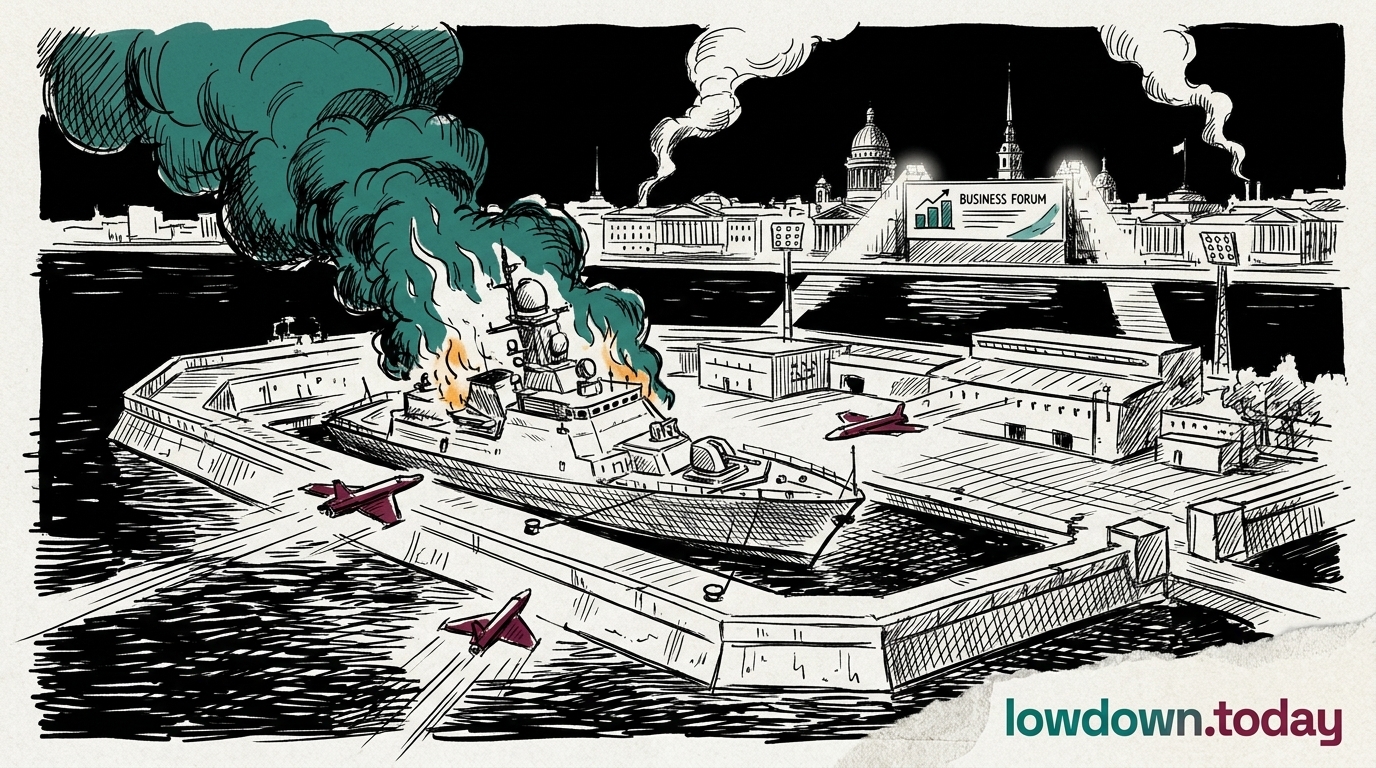
Putin used SPIEF to reject Zelenskyy's summit letter, citing 'elements of rudeness', and repeated the pre-agreed treaty precondition that has frozen every diplomatic round since May. The SPIEF platform's message of investor confidence was punctured by naval fires visible from St Petersburg, which Moscow declined to dispute in scale.
Ukraine / Unmanned Systems Forces
Commander Brovdi confirmed USF units tracked and set fire to Boikyi at Kronstadt, while Code 9.2 struck the Chonhar Bridge the following day. Ukraine is sequencing strikes for rear-area interdiction and political timing rather than ground gains, trading the Baltic Fleet's home base for the logistics squeeze Russia cannot absorb without rationing its own occupied territory.