Skip to content
You can now search across every topic, entity and event.What's new
Media's AI Pivot
17JUN

Allen buys BuzzFeed for the AI bet

4 min read
09:26UTC

Byron Allen paid $120m on Monday 11 May for a 52% stake in BuzzFeed Inc, with $20m cash at closing and a $100m five-year secured note at 5% interest. Jonah Peretti, ousted as CEO, becomes President of BuzzFeed AI.

IndustryDeveloping
Key takeaway

Allen paid $120m on 11 May for 52% of BuzzFeed, pricing AI strategy as the asset.

Byron Allen took majority control of BuzzFeed Inc on Monday 11 May, paying $120m for 52 per cent of the company and installing Jonah Peretti in a newly minted role as President of BuzzFeed AI 1. Allen Family Digital LLC, the billionaire's family office, bought 40 million new Class A shares at $3.00 each, structured as $20m cash at closing plus a $100m five-year secured promissory note carrying 5% annual interest. Allen becomes Chairman and Chief Executive on close, expected by end of May.

The transaction structurally resolves the going-concern doubt BuzzFeed had disclosed when launching its consumer AI app group Branch Office at SXSW in March . Q1 2026 results, filed the same day, showed group revenue down 12.4% year-on-year to $31.6m, a $15.1m net loss, and advertising revenue down 19.8% 2. One bright line stood out in the filing: content revenue up 69% to $7.5m, the segment closest to the Branch Office AI products Peretti pitched in March.

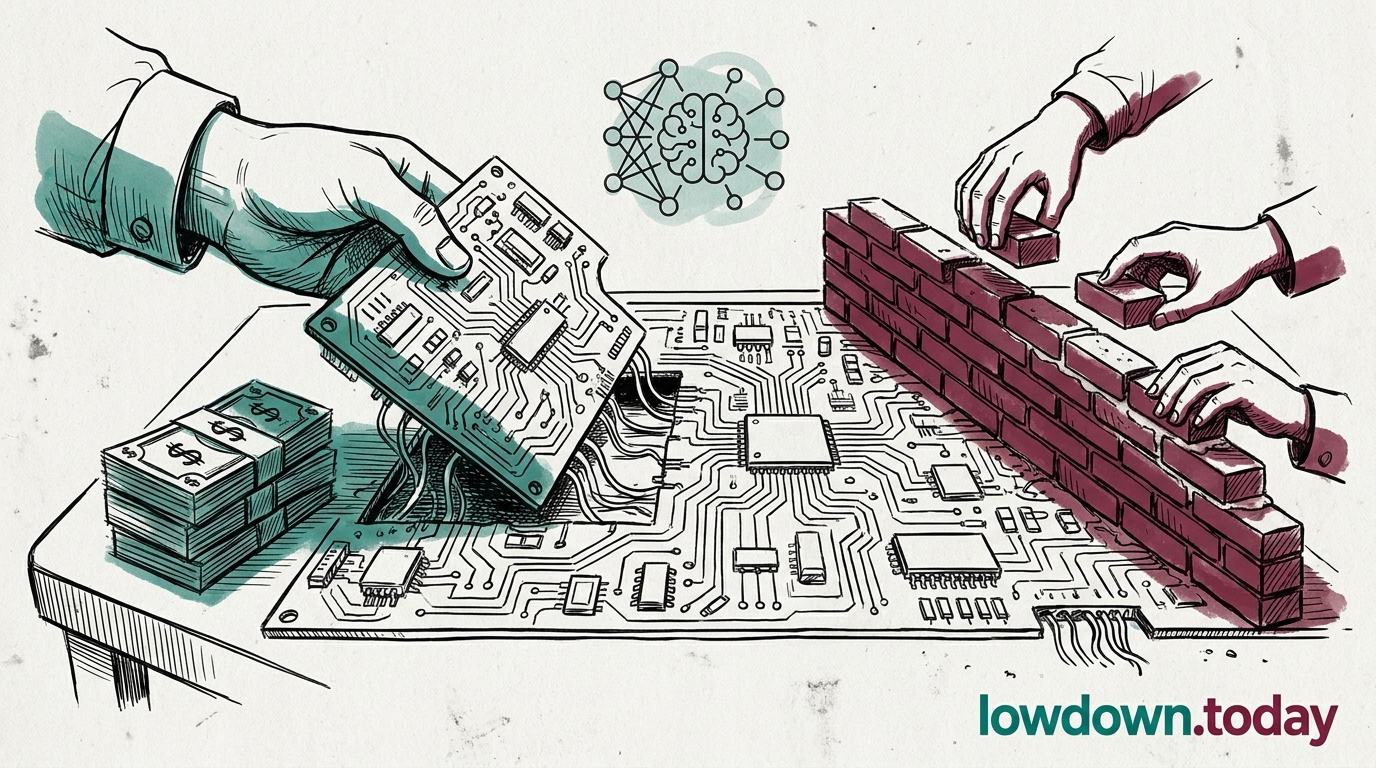
The $120m headline reframes the U#1 Branch Office story. Peretti had positioned Branch Office as an AI spin-out built to survive ad collapse; the actual outcome is that the AI strategy became the asset Allen financed against. A $120m valuation puts roughly a six-times multiplier on the implied Branch Office standalone at SXSW, and the $20m-cash plus $100m-secured-note structure (rather than all-cash) shows Allen is treating the AI roadmap as the asset he is financing against, not the BuzzFeed brand. Peretti's President of BuzzFeed AI title operationalises that bet inside the parent rather than as a separate vehicle.

For the prospect-facing reader, the named decision-maker shifts from Peretti to Allen. Allen Media Group runs a portfolio of broadcast and digital assets including the Weather Channel, Allen Media Broadcasting's 36 ABC, NBC, CBS and Fox affiliates, and TheGrio. Allen has been an opportunistic buyer of distressed media throughout the post-streaming-wars reshape, and now inherits the editorial-side AI deployment mandate Peretti was running as a separate vehicle. What the post-close BuzzFeed AI mandate commissions in the next six weeks, and from which named vendors, is the testable signal.


Deep Analysis

In plain English

BuzzFeed is the company behind viral quizzes and HuffPost. It has been losing money for years as fewer people arrive via Google search and Facebook. Byron Allen is a media billionaire who owns dozens of TV stations and the Weather Channel. He bought 52% of BuzzFeed for $120m, mostly on credit, because BuzzFeed has been building AI apps that generated $7.5m content revenue in Q1 2026, up 69% year on year. Jonah Peretti, who co-founded BuzzFeed, stays on to run the AI side. Allen takes over as boss.

Deep Analysis
Root Causes

BuzzFeed's structural decline has two independent drivers that converged in Q1 2026. First, Google's 2023 Helpful Content Update and subsequent algorithm changes reduced referral traffic to quiz-and-listicle formats by an estimated 60-70% for publishers in BuzzFeed's content tier, collapsing the programmatic CPM base the company had been built on.

Second, the shift of social-media reach from organic to paid has eroded the viral distribution model that made BuzzFeed's content economics work in the 2010s.

The going-concern disclosure in March 2026 was not a sudden crisis: BuzzFeed had lost $57.3m in 2025 on revenue of roughly $160m annualised, a cash burn rate that made continued standalone operation impossible without a capital event. Branch Office was as much a restructuring mechanism as a product launch, separating the AI-addressable asset from the legacy publishing liability before a buyer arrived.

What could happen next?
  • Meaning

    Allen inherits Peretti's AI vendor relationships and Branch Office's product roadmap at a moment when WBD (ID event-01), Netflix INKubator (ID event-05), and the broader publisher AI adoption surge (ID event-07) are all resetting buyer expectations. The named vendors BuzzFeed AI commissions in the six weeks after close will reveal whether Allen treats Branch Office as a distribution asset or a standalone AI business. A $120m price for a company at 12.4% revenue decline represents a distressed-media pricing floor for AI-strategy assets, below which no further digital-native acquisition in this cycle is likely to clear without a demonstrable AI revenue line.

First Reported In

Update #2 · BuzzFeed sold for AI; agentic ads go primetime

BusinessWire· 17 May 2026
Read original
Different Perspectives
Italian market: Fastweb signed, Mediaset and RAI did not
Fastweb, the Italian broadband operator, signed Section 2 as a deployer, while Mediaset and the state broadcaster RAI are both absent. Italy therefore shows the split in miniature: a telecommunications company with one obvious deployment surface accepted the standard, and the two companies that actually broadcast to Italian audiences did not.
Paramount Skydance and its French exposure
Paramount filed a stipulation not to close on 24 July and had trial specialists admitted three days later, after nine months arguing that antitrust risk was regulatory rather than judicial. Its 22 July European clearance obliges it to divest a stake in the Universal International Pictures distribution venture and to strike no Universal distribution deal in Europe for a decade.
Time and the agent-advertising camp
Time and Mobian treat AI agent traffic as sellable inventory rather than leakage, on a site where bots now outnumber humans most days. Chief operating officer Mark Howard frames agent impressions as an extension of sponsorship, against an industry consensus still pursuing compensation for scraping.
German broadcasters
German broadcasters
ARD, ZDF, RTL and ProSiebenSat.1 are all absent from the list, making Germany the largest single national bloc of non-signatories. Their position rests on three defensible grounds: signature is voluntary, most deployed systems are grandfathered to 2 December 2026, and a broadcaster's compliance surface spans production, archive, advertising and distribution rather than one product. None has publicly explained the decision.
Synthesia and the signed vendor layer
Synthesia signed Section 1 alongside Getty Images, Google, Meta, Microsoft, Anthropic, OpenAI, Mistral and Aleph Alpha, accepting a documented marking standard for the product they sell. London-headquartered Synthesia is the only pure AI-video vendor on the providers list, and gains a compliance artefact to put in front of European media buyers at the moment those buyers acquire a live obligation.
European Commission
European Commission
The Commission published its initial signatory list on 31 July with roughly 190 organisations and let Article 50 take effect on 2 August as scheduled. Its own page stresses that adherence to the Code is voluntary while the transparency requirements are legal obligations, which frames non-signature as an evidentiary choice rather than a breach.


