Skip to content
You can now search across every topic, entity and event.What's new
Media's AI Pivot
3AUG

Marking code draws 190, none of them TV

3 min read
17:21UTC

The Commission's initial signatory list carries 82 providers and 152 deployers, and no broadcaster, streamer or studio at all.

IndustryDeveloping
Key takeaway

The firms selling synthetic-media capability into Europe signed a marking standard; their broadcast customers did not.

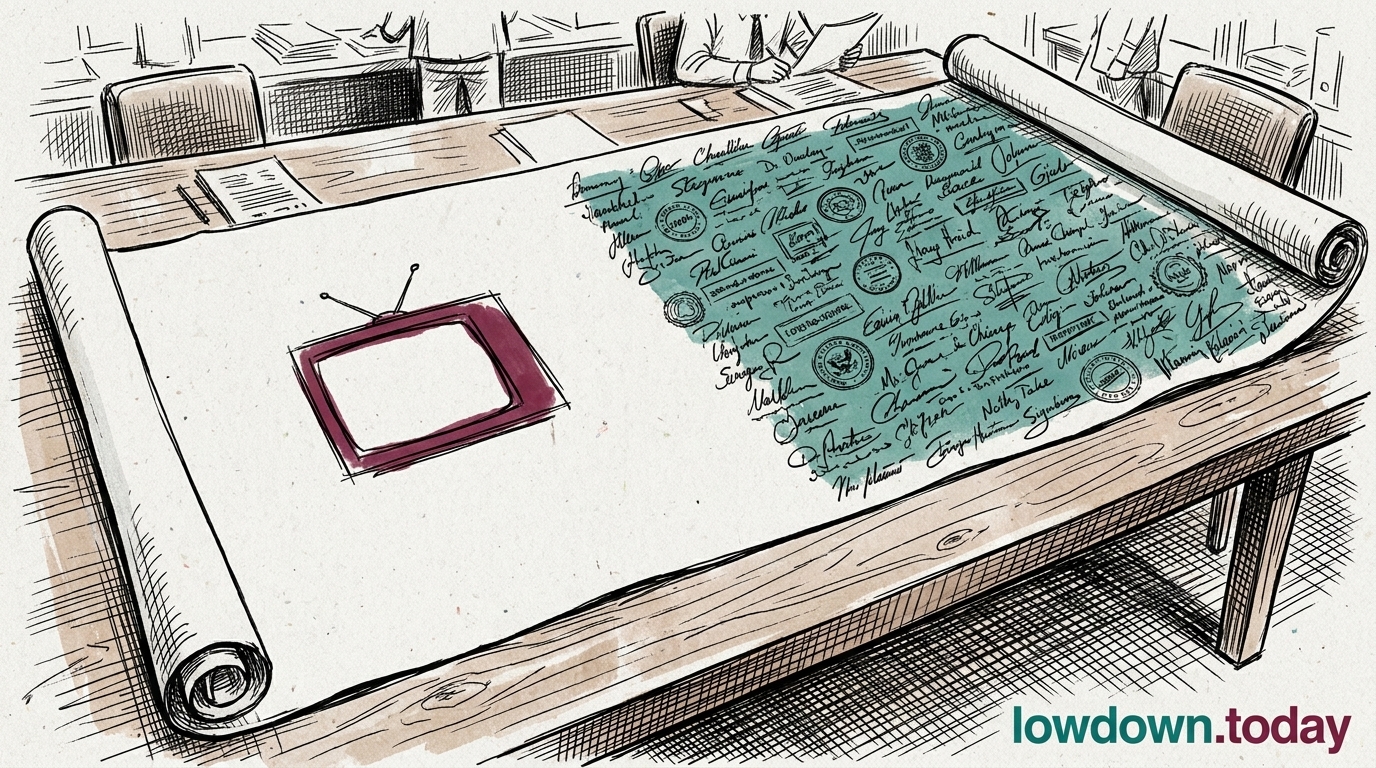
The European Commission published the initial signatory list for its Code of Practice on marking AI-generated content on 31 July 2026, carrying roughly 190 organisations split 82 to Section 1, for providers, and 152 to Section 2, for deployers 1. Not one of the 190 is a broadcaster, streamer, studio or sports rights-holder.

The media-relevant names sit almost entirely on the supply side. Synthesia, Getty Images, Google, Meta and Microsoft signed Section 1, alongside Anthropic, OpenAI, Mistral and Aleph Alpha 2. Section 2's closest equivalents are Fastweb, Flipsnack and TMP Worldwide Advertising & Communications. Absent: Netflix, Disney, Sky, ITV, the BBC, RTL, ProSiebenSat.1, ARD, ZDF, France Televisions, TF1, M6, Mediaset, RAI, Warner Bros. Discovery, Paramount, Comcast, NBCUniversal and DAZN.

That absence now reads differently. This briefing reported on 7 July that no broadcaster could sign an instrument the Commission had not yet certified as adequate , and treated the empty list as procedure rather than reluctance. The Code was finalised on 10 June with a signature window closing 27 July , and about 190 organisations went through it. Article 50 became binding two days after publication, on 2 August, with systems already deployed grandfathered to 2 December .

Section 2 drew nearly twice Section 1's signatures, which removes the easy explanation. Deployers as a class did not stay away. Broadcasters specifically did.


Deep Analysis

In plain English

The European Union has a new law requiring AI-generated video, audio and images to carry a hidden marker saying a machine made them. Alongside the law, Brussels wrote a voluntary code of good practice and invited companies to sign it. Signing is a way of saying you will follow the rules properly, and it makes life easier if a regulator ever asks questions. About 190 companies signed by the deadline. Almost all of the media-related ones make the AI tools: Synthesia, Getty Images, Google, Meta and Microsoft. Not a single television company, film studio or streaming service signed, anywhere in Europe or America. The law itself came into force two days later regardless.

Deep Analysis
Root Causes

Section 1 and Section 2 ask signatories to certify different things. A provider signs against a product with a single marking surface, the file it generates. A broadcaster deploys synthetic content across production, archive, advertising sales and distribution, frequently through third-party tooling it did not build and cannot fully inspect, which makes one signature a commitment it cannot evidence end to end.

The AI Omnibus supplies the timing. Systems already on the market before 2 August 2026 are grandfathered to 2 December, so an established broadcaster running existing tooling faces no immediate duty while a vendor shipping new deployments does. Vendors shipping new deployments therefore meet a deadline that established broadcasters do not.

A third cause sits in the tooling. Marking happens inside the generation step, which a broadcaster that buys rather than builds does not own, so it cannot promise a behaviour its vendor controls.

What could happen next?
  • Meaning

    The absence of every broadcaster from a list containing 152 deployers indicates a sector-specific decision rather than a general reluctance among deployers.

    Immediate · Assessed
  • Consequence

    European broadcasters deploying new synthetic content after 2 August carry the evidentiary burden themselves rather than resting on a presumption of conformity.

    Short term · Assessed
  • Risk

    Whether the Commission publishes later tranches, which would reveal whether broadcasters were absent by choice or by timing.

    Short term · Suggested
First Reported In

Update #11 · AI marking code gets 190 names, no broadcasters

European Commission· 3 Aug 2026
Read original
Different Perspectives
Italian market: Fastweb signed, Mediaset and RAI did not
Fastweb, the Italian broadband operator, signed Section 2 as a deployer, while Mediaset and the state broadcaster RAI are both absent. Italy therefore shows the split in miniature: a telecommunications company with one obvious deployment surface accepted the standard, and the two companies that actually broadcast to Italian audiences did not.
Paramount Skydance and its French exposure
Paramount filed a stipulation not to close on 24 July and had trial specialists admitted three days later, after nine months arguing that antitrust risk was regulatory rather than judicial. Its 22 July European clearance obliges it to divest a stake in the Universal International Pictures distribution venture and to strike no Universal distribution deal in Europe for a decade.
Time and the agent-advertising camp
Time and Mobian treat AI agent traffic as sellable inventory rather than leakage, on a site where bots now outnumber humans most days. Chief operating officer Mark Howard frames agent impressions as an extension of sponsorship, against an industry consensus still pursuing compensation for scraping.
German broadcasters
German broadcasters
ARD, ZDF, RTL and ProSiebenSat.1 are all absent from the list, making Germany the largest single national bloc of non-signatories. Their position rests on three defensible grounds: signature is voluntary, most deployed systems are grandfathered to 2 December 2026, and a broadcaster's compliance surface spans production, archive, advertising and distribution rather than one product. None has publicly explained the decision.
Synthesia and the signed vendor layer
Synthesia signed Section 1 alongside Getty Images, Google, Meta, Microsoft, Anthropic, OpenAI, Mistral and Aleph Alpha, accepting a documented marking standard for the product they sell. London-headquartered Synthesia is the only pure AI-video vendor on the providers list, and gains a compliance artefact to put in front of European media buyers at the moment those buyers acquire a live obligation.
European Commission
European Commission
The Commission published its initial signatory list on 31 July with roughly 190 organisations and let Article 50 take effect on 2 August as scheduled. Its own page stresses that adherence to the Code is voluntary while the transparency requirements are legal obligations, which frames non-signature as an evidentiary choice rather than a breach.


