Skip to content
You can now search across every topic, entity and event.What's new
Is Britain Actually Broke?
3SEP

45% of universities spent beyond income

3 min read
15:29UTC

The Office for Students put 45% of English higher education providers in deficit for 2025-26, and forecasts that share falling to 41% next year once tuition fees track inflation.

EconomicDeveloping
Key takeaway

The universities ledger deteriorates through closed courses and frozen hiring, not through anything that looks like a failure.

The Office for Students put 45% of English higher education providers in deficit for 2025-26 1. The OfS is the regulator for universities and colleges in England, and it publishes this share annually. Deficit here means an institution spent more in the year than it earned, covered from reserves, from borrowing, or from maintenance it decided not to do. Nearly half the sector.

The regulator expects it to improve. Its forecast puts the share at 41% in 2026-27, once the government's decision to link tuition fees to inflation feeds through 2. Both numbers are the regulator's own modelling rather than audited outturns, which is why the trigger we declare on this ledger watches the outturn and not the forecast: if 2026-27 comes in above 45%, the improvement everyone has been assuming did not arrive.

What makes higher education a slow ledger rather than a dramatic one is the gap between the accounts and the consequences. No English university has failed outright. What happens instead is a hiring freeze, a modern languages department merged into something else, a chemistry course withdrawn, a building left to leak. Those decisions surface one to two years after the deficit that caused them, and they land unevenly: a city where the university is among the largest employers feels a restructuring in the local economy long before it appears in any national figure.

Deep Analysis

In plain English

English universities charge domestic students a capped tuition fee, set by government, and international students an uncapped fee that is usually much higher. For years the domestic cap stayed roughly flat in cash terms while costs, staff pay and energy bills among them, kept rising with inflation, which is why nearly half of providers spent more than they earned last year. The government's decision to let the domestic fee rise with inflation from 2026-27 is meant to close that gap. The Office for Students forecasts the share of providers in deficit falling from 45% to 41% as a result, but a forecast is not an outturn: it assumes other things, most importantly international student numbers, stay roughly where they are.

Deep Analysis
Root Causes

English universities are structurally dependent on international student fees, which are uncapped, to cross-subsidise domestic teaching, where fees are capped and were frozen in cash terms for years even as costs rose with inflation. A domestic-only fee model would leave a much larger share of providers in deficit than the 45% reported.

Because the fee cap is a policy lever adjusted infrequently, deficits accumulate in the years between adjustments and only reverse when a government decides to move the cap, rather than responding continuously to cost pressure the way a fully market-priced service would.

What could happen next?
  • Risk

    The OfS's forecast improvement to 41% depends on stable international student recruitment; a continued decline in that market could keep the deficit share closer to 45% despite the fee rise.

First Reported In

Update #1 · The distress moved from banks to councils

Office for Students· 27 Jul 2026
Read original
Causes and effects
This Event
45% of universities spent beyond income
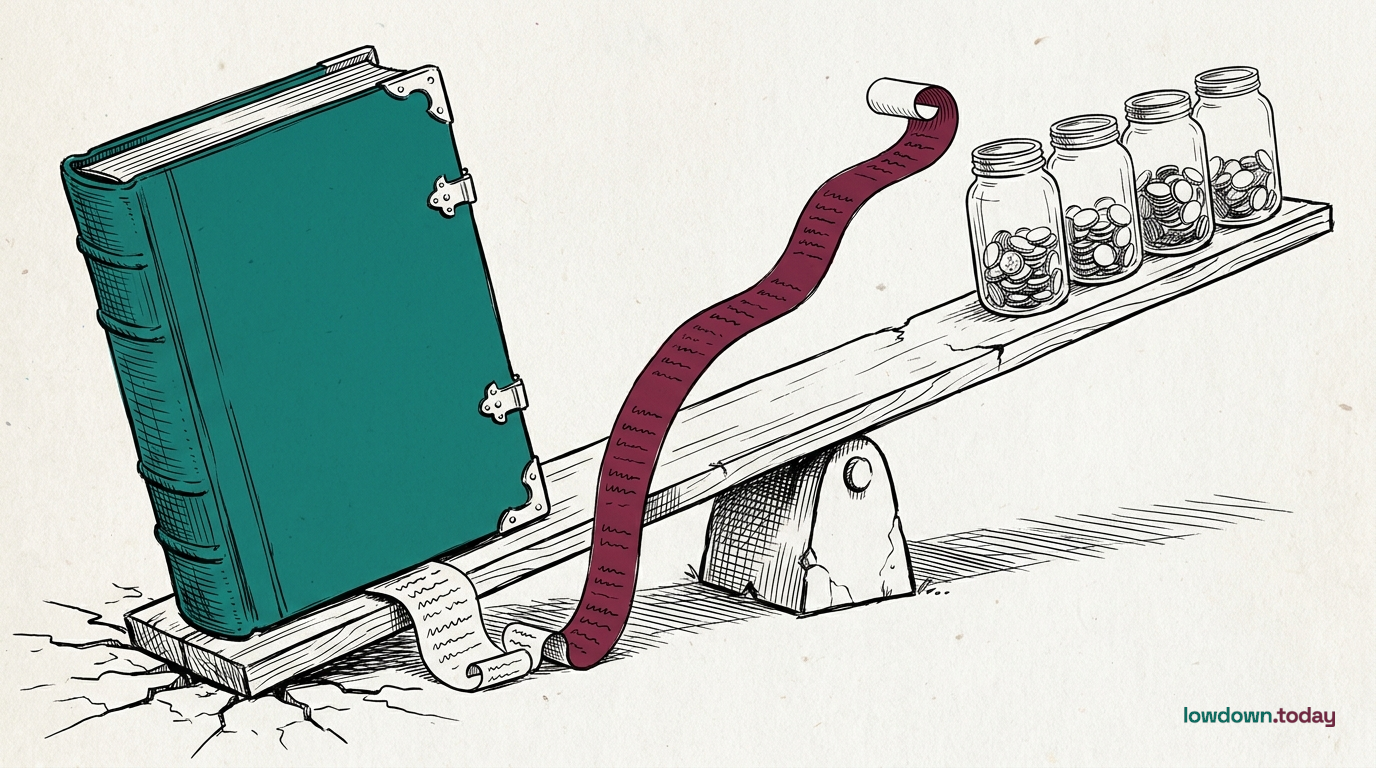
A university in deficit does not close; it quietly stops doing things, and students and local economies notice a year or two after the accounts do.
Different Perspectives
Structural case for reading the fall as genuine improvement
The debt ratio fell, borrowing fell year-on-year in cash terms by £6.0bn over the financial year to date, and two gilt auctions cleared at bid-to-cover ratios of 3.39 and 3.58 times with no sign of buyers demanding a premium for risk. On that reading, the state of Britain's public finances has not deteriorated this fortnight.
Office for Students
Office for Students
OfS's November 2025 modelled scenario puts 45% of providers in deficit for 2025-26; its separate May 2026 annual report, counting what providers actually filed for the identical year, puts the figure at 36.6%. Neither publication reconciles the two for the reader.
Regulator of Social Housing
The RSH's Q1 survey of 195 landlords found cash interest cover falling to 59% and described recovery as "slower than previously forecast", while recording the same sector raising £4.3bn and lifting its twelve-month development forecast to £16.0bn, a three-year high.
Chartered Institute of Public Finance and Accountancy
CIPFA's External Assurance Review, published by MHCLG on 18 August, found Worcestershire County Council does not anticipate exiting Exceptional Financial Support before 2028 at the earliest, based on the council's own overspend concentrated in adult and children's social care.
Ministry of Housing, Communities and Local Government
MHCLG's own guidance page still lists all 36 named authorities as support agreed "in-principle", stating final amounts and capitalisation directions follow "once confirmed", a status unchanged since February despite the list growing to 36 authorities by 18 August.
Office for Budget Responsibility
The OBR's Economic and Fiscal Outlook, the forecast the ONS bulletin was checked against, dates to 3 March 2026 and will not be updated until 28 October, with no change made in this window to the 1.4% long-run productivity assumption that most moves its debt projections. It made no comment on this fortnight's releases directly.