Skip to content
Briefings are running a touch slower this week while we rebuild the foundations.See roadmap
Iran Conflict 2026
16MAY

Debris near Knesset and Holy Sepulchre

3 min read
12:41UTC

Intercepted Iranian missile fragments landed within metres of Israel's parliament and Christianity's holiest church. Even accidental structural damage to the Holy Sepulchre would change how 2.4 billion Christians perceive this war.

ConflictDeveloping
Key takeaway

Debris near the Church of the Holy Sepulchre activates Jordan's Hashemite custodial obligations, testing Amman's fragile neutrality.

Fragments from intercepted Iranian missiles fell near the Knesset and the Church of the Holy Sepulchre in Jerusalem's Old City on Sunday 1. A large piece struck a home in East Jerusalem. One person suffered burns from touching hot shrapnel.

The debris is consistent with the cluster munitions that first penetrated Israeli air defences on Friday, when 11 Iranian cluster missiles reached central towns including Shoham, Holon, and Rishon LeZion . Interception does not neutralise a cluster warhead — it disperses the payload. Haaretz's analysis of Friday's strikes found one missile scattered 70 submunitions across a residential area. When these weapons reach Jerusalem, the debris field does not distinguish between a parliamentary building and the most contested religious terrain on earth.

The Church of the Holy Sepulchre — the site where Christians hold that Jesus was crucified, buried, and resurrected — is revered by 2.4 billion people. The Old City covers less than one square kilometre and contains the holiest sites of three religions within walking distance of each other. Confirmed structural damage to the Church, the Al-Aqsa Mosque compound, or the Western Wall would force a political reckoning in capitals where this war has so far registered as a fuel-price problem. European and Latin American governments that have confined their responses to economic diplomacy would face pressure from constituencies for whom Jerusalem's holy sites carry a weight that Gulf oil infrastructure does not.

The fragment that struck an East Jerusalem home landed in a Palestinian neighbourhood. Residents there have no access to the bomb shelters available in West Jerusalem and limited early-warning infrastructure. The geography of falling debris maps onto the geography of the occupation: the same interception that protects the Knesset scatters shrapnel onto people who have no part in the decisions that brought the missiles overhead.

Deep Analysis

In plain English

When Israel shoots down an incoming missile, the destroyed missile does not simply vanish — its wreckage falls somewhere. On Sunday, fragments landed near two of Jerusalem's most politically charged buildings: the Knesset, Israel's parliament, and the Church of the Holy Sepulchre, which Christians believe is the site of Jesus's crucifixion and burial. Nobody was seriously hurt, but the symbolic weight is enormous. The Church is the holiest site in Christianity for many denominations, and even accidental damage — a broken window, a scorched wall — would transform how billions of people around the world perceive this conflict. Right now, most Europeans and Latin Americans experience the war primarily through petrol prices. Physical damage to the Church would make it personal for many of them in a way that casualty statistics have not.

Deep Analysis
Synthesis

Jordan holds legal custodianship over the Islamic waqf in Jerusalem and has a formal role in Christian site protection under the 1994 Wadi Araba Treaty. Debris near the Church of the Holy Sepulchre obligates Amman to respond diplomatically — potentially straining Jordan's careful neutrality in ways that no previous incident in this war has.

What could happen next?
  • Risk

    Any visible damage to the Church of the Holy Sepulchre would trigger Vatican diplomatic intervention and European public pressure for an immediate ceasefire.

    Immediate · Assessed
  • Consequence

    Jordan's Hashemite custodianship obligations over Jerusalem's holy sites will force Amman to issue formal protests, testing its carefully maintained neutrality.

    Short term · Assessed
  • Precedent

    First instance of active missile intercept operations generating debris inside Jerusalem's protected Old City zone, establishing a contested legal and political baseline.

    Long term · Assessed
First Reported In

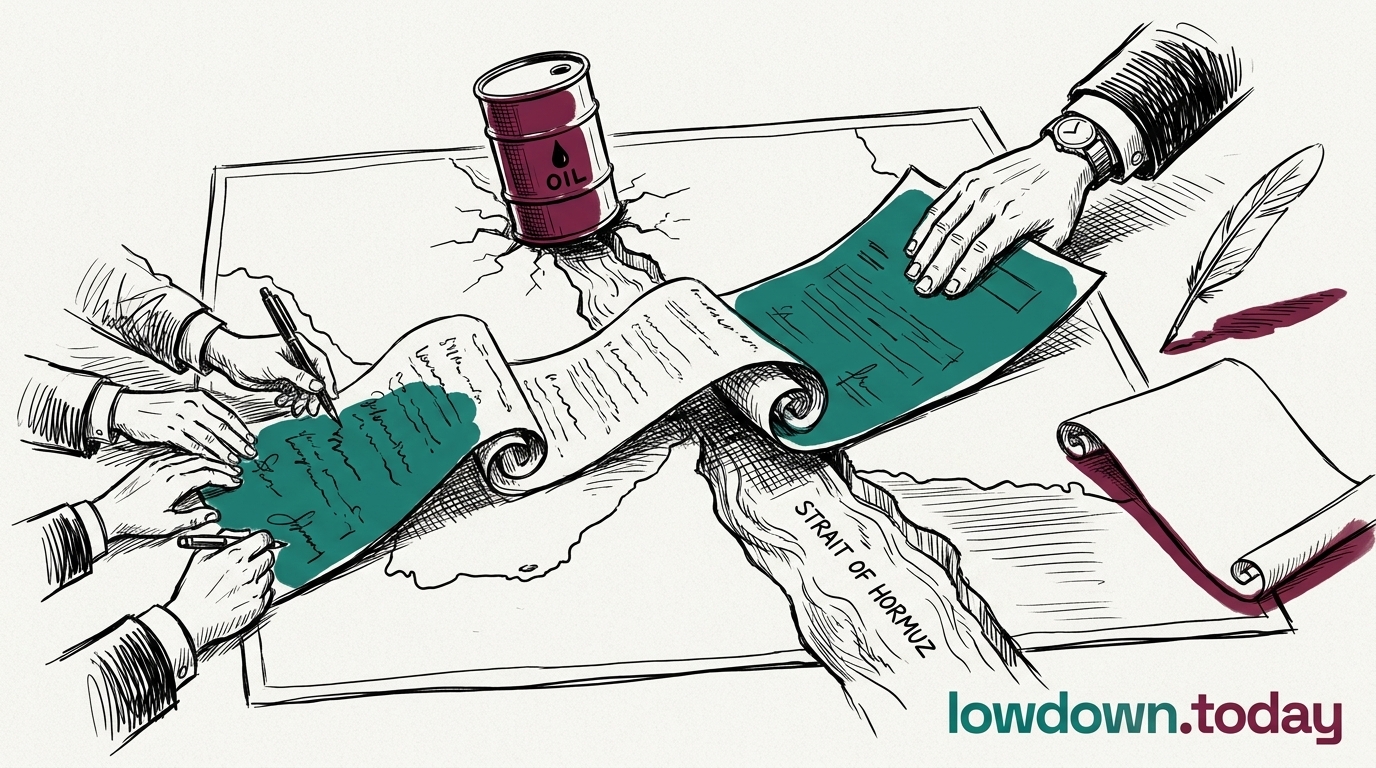
Update #38 · Israel enters Lebanon; Hormuz pact fails

ToI Knesset debris· 17 Mar 2026
Read original
Different Perspectives
India (BRICS meeting host, grey-market beneficiary)
New Delhi hosted the BRICS foreign ministers' meeting on 14 May that Araghchi attended under the Minab168 designation, giving India a front-row seat to Iran's diplomatic positioning. India's state refiners have been absorbing discounted Iranian crude through grey-market routing since April; Brent at $109.30 means every barrel sourced outside the formal market generates a structural saving.
Hengaw / Kurdish human rights monitors
Hengaw's daily reports from Iran's Kurdish provinces remain the sole independent cross-check on Iran's judicial activity during the conflict. Two executions across Qom and Karaj Central prisons on 15 May and five Kurdish detentions on 15-16 May indicate the wartime judicial pipeline is operating independently of military tempo.
Pakistan (mediator and bilateral partner)
Islamabad spent its diplomatic capital as the US-Iran MOU carrier to secure LNG passage for two Qatari vessels through a bilateral Pakistan-Iran agreement, spending its mediation credit for direct economic gain. China's public endorsement of Pakistan's mediatory role on 13 May is the structural reward.
China and BRICS bloc
Beijing endorsed Pakistan's mediatory role on 13 May, one day after the BRICS foreign ministers' meeting in New Delhi. Chinese state banks are processing PGSA yuan toll payments; China has not commented on its vessels' continued Hormuz passage, but benefits structurally from a non-dollar toll system it did not design.
Iraq (bilateral passage partner)
Baghdad negotiated a 2-million-barrel VLCC transit without paying PGSA yuan tolls, offering political alignment in lieu of cash. Iraq's position inside Iran's adjacent bloc makes it the natural first bilateral partner and a template for how Tehran structures passage deals with states that cannot afford Western coalition membership.
Bahrain and Qatar (Gulf signatories)
Both signed the Western coalition paper while hosting US Fifth Fleet and CENTCOM's Al Udeid base, respectively. Qatar occupies the sharpest contradiction: it is on coalition paper while simultaneously receiving LNG passage through the bilateral Iran-Pakistan track, a position Doha has tacitly accepted from both sides.