Skip to content
Briefings are running a touch slower this week while we rebuild the foundations.See roadmap
Iran Conflict 2026
11APR

Tankers self-impose Hormuz blockade

1 min read
11:03UTC

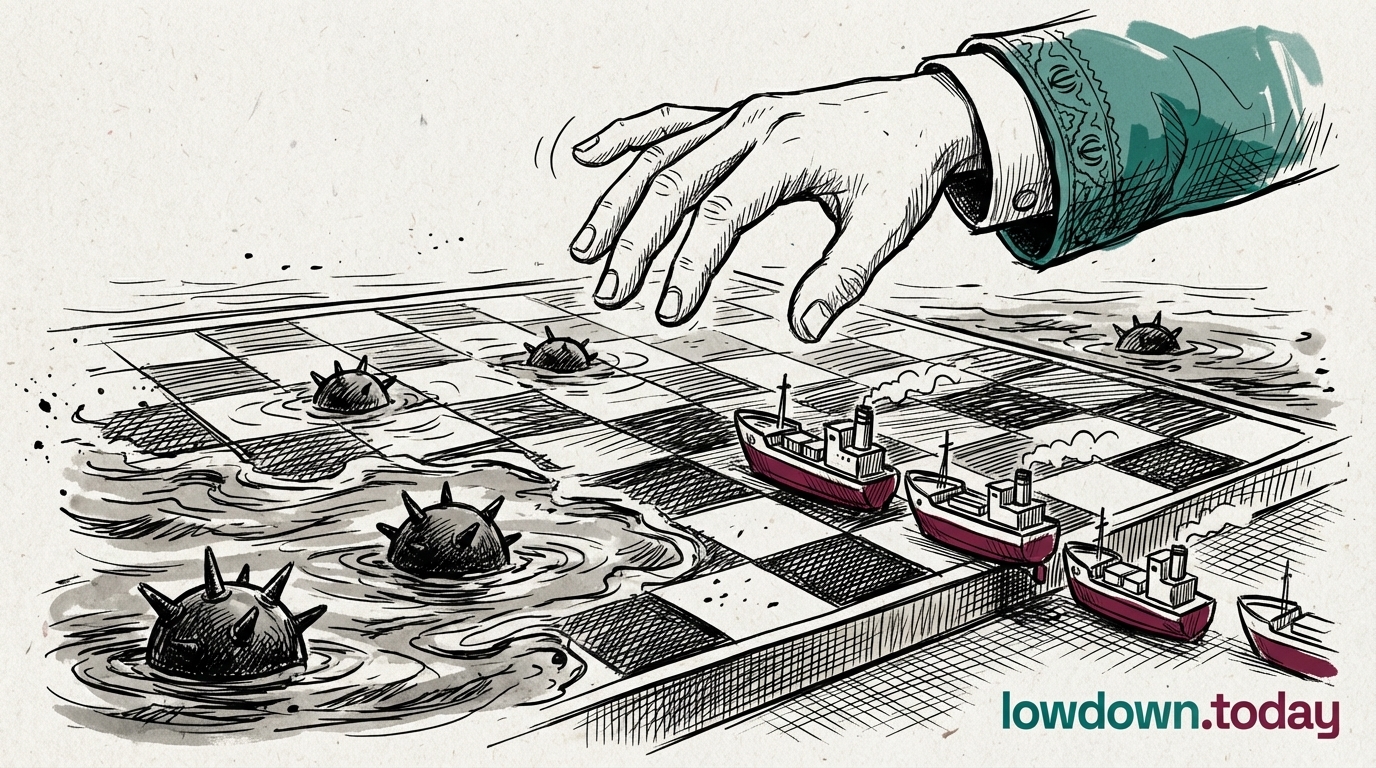
Oil tankers began voluntarily avoiding the Strait of Hormuz following the 28 February 2026 strikes on Iran, achieving a partial chokepoint effect through commercial risk calculation rather than Iranian military interdiction.

ConflictDeveloping
Key takeaway

Commercial tanker avoidance of Hormuz achieves partial supply disruption without requiring Iranian military action, and will reverse rapidly once a credible de-escalation signal appears.

Voluntary avoidance of Hormuz by tanker operators achieves, in functional terms, some of the same supply-disruption effects as an Iranian blockade — without requiring Iran to take the naval action that would have constituted a direct casus belli for further US military response.

Approximately 20 million barrels per day transited Hormuz in 2025 — around 20% of global oil supply and 30% of global liquefied natural gas. Voluntary tanker avoidance does not halt all transit, but it reduces throughput and drives insurance premiums on vessels that do proceed to prohibitive levels. Lloyd's of London and other marine war-risk insurers will reclassify the Gulf as a war-risk zone within hours of the strikes, adding several hundred percentage points to insurance costs and making many voyages commercially unviable even if the physical route remains open.

The difference between voluntary avoidance and a formal Iranian blockade is reversibility. Commercial tanker operators are risk-averse but economically rational: if the military situation stabilises or a credible de-escalation signal emerges, traffic will resume within days. A formal Iranian blockade would require negotiated lifting and military verification, potentially taking weeks or months. Voluntary avoidance is therefore a more moderate and more reversible disruption than the worst-case scenario — which is precisely why markets are pricing $80–100 rather than $150–200.

What could happen next?
  • Meaning

    Short term · Assessed
  • Meaning

    Short term · Assessed
  • Meaning

    Short term · Assessed
First Reported In

Update #2 · Five cities struck on opening night

whitehouse.gov· 28 Feb 2026
Read original
Causes and effects
This Event
Tankers self-impose Hormuz blockade
Tanker avoidance of Hormuz, through which approximately 20% of global oil transits, creates immediate supply disruption risks and freight cost spikes.
Different Perspectives
Iran human rights monitors (Amnesty International, Iran HRM, Hengaw)
Monitors documented 30 women held on capital moharebeh charges in a basement prison ward, Benyamin Naqdi's death sentence with a forced-confession broadcast, and 39 political executions since February. Iran's security courts have processed protest cases at uninterrupted wartime tempo regardless of the diplomatic track.
Lloyd's of London (war-risk underwriters)
Lloyd's held its Hormuz war-risk designation at $10-14 million per voyage while Brent fell 19%, maintaining a structural divergence from futures pricing. Underwriters require a UN Security Council resolution or government certification letter, not diplomatic optimism, before de-listing the strait.
Oman (Sultan Haitham's government)
Muscat issued a mine alert in its own territorial waters while denying any Hormuz toll plan after US Treasury threatened sanctions. A suspected mine in Omani waters on the same weekend as US financial pressure forces Muscat to demonstrate sovereignty without appearing to choose sides.
China (PRC)
China (PRC)
Beijing sent scholars rather than its defence minister to Shangri-La for the second year running and addressed Taiwan and multilateralism without mentioning Iran. China maintains its bilateral energy corridor protection with Tehran while refusing the diplomatic exposure of a public position at multilateral forums.
Iran Supreme National Security Council
The SNSC framed the unsigned MOU as a 10-point Iranian victory with enrichment already recognised, and the foreign ministry rejected Trump's nuclear conditions within hours. Tehran treats each unsigned day as validation that Iran has retained its stockpile without surrendering it.
Trump administration (CENTCOM/White House)
Trump posted three non-negotiable public conditions while CENTCOM disabled a commercial ship and Hegseth threatened resumed strikes from Singapore. The administration treats the unsigned MOU as leverage to extract maximum Iranian concessions before any ceasefire instrument is committed to paper.