Skip to content
Briefings are running a touch slower this week while we rebuild the foundations.See roadmap
Iran Conflict 2026
23MAR

Khamenei invisible for 17 days

2 min read
05:40UTC

No video. No audio. One written statement read by a TV anchor over a still photograph. The longest absence of any Supreme Leader since 1979.

ConflictDeveloping
Key takeaway

Iran's wartime decisions lack visible supreme-leader authority.

Supreme Leader Mojtaba Khamenei had not appeared in public for at least 17 days as of 30 March, the longest absence of any Supreme Leader since the 1979 revolution. 1 2 His only communication was a written statement read by a state TV anchor over a still photograph. No video or audio of Khamenei himself has been released.

The absence coincides with the most consequential period of the war: ground forces converging on the Gulf, a third Bushehr strike, the NPT withdrawal bill, and 1,700 wartime arrests. Jerusalem Post sources described the Iranian power arrangement: 'The Revolutionary Guards are controlling him, not the other way around.' A Middle East Institute senior fellow assessed that Mojtaba Khamenei 'owes his position to the Revolutionary Guards.'

Whether the absence reflects security precautions, incapacity, or IRGC-imposed isolation cannot be determined from open sources. The CIA, Mossad, and allied agencies were actively searching for evidence he is alive and functioning as of Day 23. His predecessor missed no Nowruz address in the revolution's entire history; Mojtaba's silence over the Persian New Year on 20 March remains the most striking public absence.

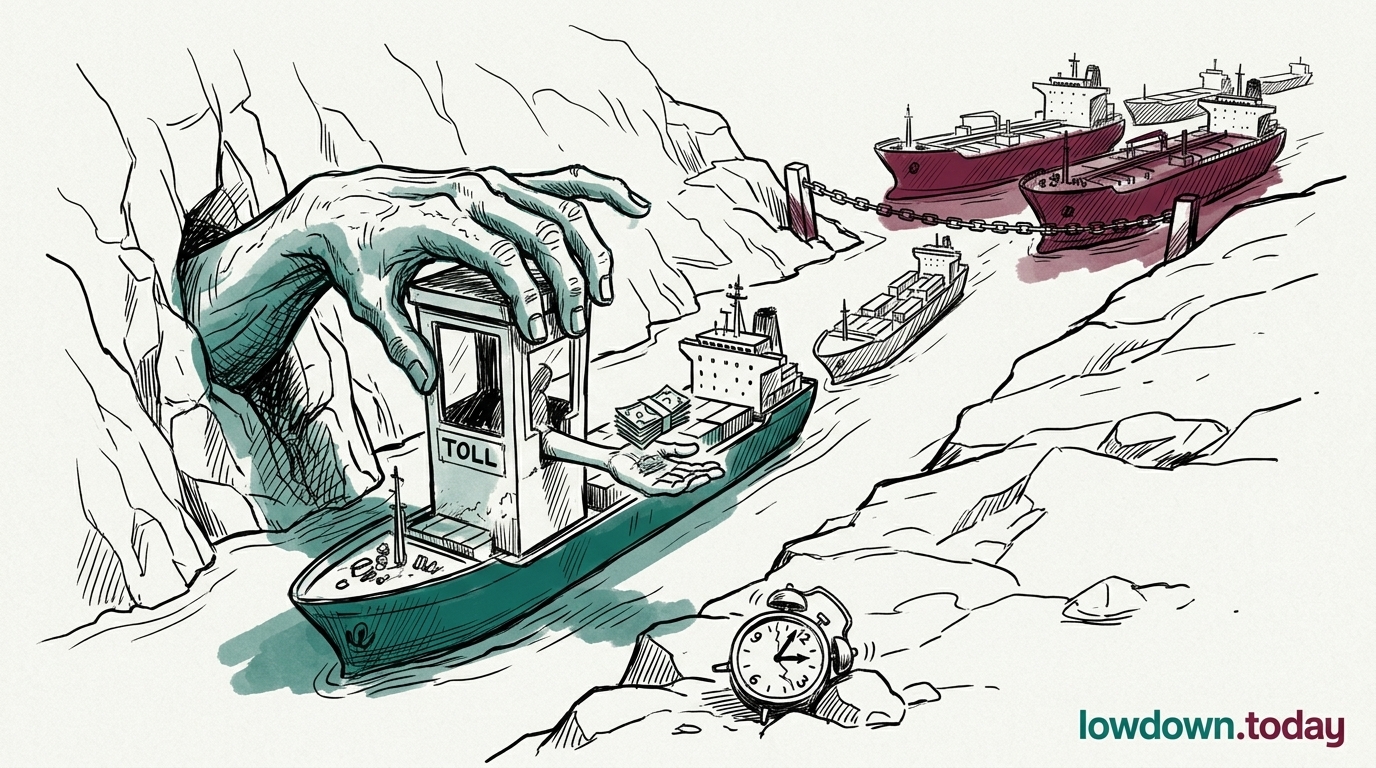
The practical consequence is institutional: the IRGC appears to be the decision-making authority in a wartime state that constitutionally vests supreme authority in a single individual. The 1,700 arrests across Kurdish provinces , the Hormuz toll system, and the university ultimatum all bear IRGC institutional fingerprints. Who authorised them is an open question.

Deep Analysis

In plain English

Iran's Supreme Leader is the highest authority in the country, above the president, above parliament. For seventeen days, no video and no audio of the current Supreme Leader, Mojtaba Khamenei, has been released. His only communication was a written statement that a news presenter read on television over a photograph. This is the longest any Supreme Leader has been absent from public view since the Islamic Republic was founded in 1979. During those seventeen days, major decisions have been taken: the NPT withdrawal bill was filed, the Bushehr reactor was struck three times, 1,700 people were arrested, and Iran has been managing a war against the United States and Israel. But the person who is constitutionally in charge has not been seen. The Revolutionary Guards appear to be making the decisions. Whether the Supreme Leader is directing them privately, is incapacitated, or is under their control is genuinely unknown.

What could happen next?
  • Risk

    A wartime state where executive authority is constitutionally vested in one person who has not been publicly visible for 17 days faces a succession ambiguity that could fracture decision-making at a critical moment.

  • Meaning

    If the IRGC is exercising de facto command without visible supreme-leader authority, the institution is operating as an autonomous wartime decision-maker, not an instrument of political oversight.

First Reported In

Update #52 · Trump wants Iran's oil; 3,500 Marines land

CNBC / Financial Times· 30 Mar 2026
Read original
Causes and effects
This Event
Khamenei invisible for 17 days
The 17-day absence raises questions about whether the IRGC is operating independently of visible political authority. Wartime decisions are being made, but the head of state is not visibly making them.
Different Perspectives
IAEA
IAEA
Director General Rafael Grossi appeared in person at the UNSC on 19 May and warned that a direct hit on an operating reactor 'could result in very high release of radioactivity'. The session produced a condemnation record but no resolution, and the Barakah perimeter was already struck on 17 May.
Hengaw (Kurdish rights monitor)
Hengaw documented three judicial executions and the detention of Kurdish writer Majid Karimi in Tehran on 19 May, establishing Khorasan Razavi province as the newest geography in Iran's wartime judicial record. The organisation's Norway-based operation continues to surface a domestic repression track running in parallel with every diplomatic and military development.
India
India
Six India-flagged vessels conducted a coordinated cluster transit under PGSA bilateral assurances during the 17 May window, paying no yuan tolls. New Delhi's inclusion in Iran's state-to-state passage track insulates Indian energy supply without requiring endorsement of the PGSA's yuan-toll architecture or alignment with the US coalition.
Pakistan
Pakistan
Pakistan is the only functioning diplomatic bridge between Tehran and Washington. Its role is relay, not mediation in the settlement sense: it conveyed Iran's 10-point counter-MOU in early May, relayed the US rejection, and is now passing 'corrective points' in the third documented exchange of this sub-cycle without either side working from a shared text.
UK and France (Northwood coalition)
Twenty-six coalition members have published no rules of engagement eight days after the Bahrain joint statement; Lloyd's underwriters have conditioned war-risk reopening on written ROE from either Iran or the coalition. Italian and French mine-countermeasures deployments are operating on the in-water clearance task CENTCOM Admiral Brad Cooper's 90% mine-stockpile claim does not address.
Saudi Arabia
Saudi Arabia
Riyadh has not publicly commented on the Barakah strike or the 50-47 discharge vote. Saudi output feeds the IEA's $106 base case; the $5 Brent premium above that model reflects institutional uncertainty no Gulf producer can compress through supply adjustment alone.