Skip to content
Briefings are running a touch slower this week while we rebuild the foundations.See roadmap
Iran Conflict 2026
7MAR

Evin's Ward 209 emptied, prisoners moved

3 min read
07:34UTC

The Intelligence Ministry evacuated Ward 209 — home to Iran's most sensitive political and intelligence detainees — to an undisclosed location, separate from the broader NOPO seizure of Evin Prison.

ConflictDeveloping
Key takeaway

Ward 209's evacuation is an intelligence asset protection move in a live factional custody dispute — the detainees' knowledge of operational secrets makes them a resource to be controlled, and their fate will be determined by which internal faction prevails.

Ward 209 of Evin Prison — the Intelligence Ministry's own detention facility within the larger complex — has been evacuated. Prisoners were moved to an undisclosed location. The evacuation is distinct from the broader seizure of Evin by NOPO riot police days earlier, in which regular guards abandoned their posts, food distribution stopped, and a missile struck the outer perimeter wall .

The distinction between the two events matters. The NOPO takeover was institutional chaos — riot police seizing a prison from its regular staff during wartime, forcing mass transfers of financial prisoners to Fashafuyeh and political detainees to Qom. The Ward 209 evacuation is the Intelligence Ministry extracting its own detainees from a facility it no longer fully controls. Since the 1980s, Ward 209 has operated as a facility within a facility: run by MOIS rather than the prison administration, with its own interrogation staff, its own intake process, and a specific category of detainee — dual nationals, journalists, accused spies, and political cases the ministry considers too sensitive for the general population.

Nobel laureate Narges Mohammadi and Kurdish activist Zeynab Jalalian are among those held in the broader Evin complex. Mohammadi, awarded the Nobel Peace Prize in 2023 for her campaign against the death penalty and for women's rights in Iran, has been imprisoned at Evin intermittently since 2015. Jalalian, sentenced to life in 2008, has been denied adequate medical treatment according to Amnesty International and the UN Working Group on Arbitrary Detention. Whether either was among the Ward 209 evacuees is unknown. Transfer to an unidentified facility would place them beyond the minimal monitoring that sustained international pressure has provided.

The destination and purpose of the evacuation are unverifiable. The security explanation — moving prisoners from a facility with a breached wall already under missile fire — is plausible. But Iran's intelligence services have moved sensitive prisoners to undisclosed locations before consequential moments. During the 2009 post-election crisis, detainees were transferred from Evin to the Kahrizak detention facility, where at least three were killed — deaths that became a political crisis when a military physician leaked his findings and was himself later found dead. Ward 209's evacuees are now held at a location that has not been named, under conditions no outside body can monitor.

Deep Analysis

In plain English

Ward 209 was not a normal prison wing — it was the Intelligence Ministry's own operational detention facility, holding people who know Iran's most sensitive secrets: informants, former intelligence officers, political figures who were interrogated about state operations. When a different faction (NOPO) seized the rest of Evin, the Intelligence Ministry moved its people first. This is less about prisoner welfare and more about which part of Iran's security apparatus retains control of human intelligence assets — people whose knowledge has operational and political value in a wartime factional struggle.

Deep Analysis
Synthesis

The Ward 209 evacuation, alongside the NOPO prison takeover, provides the first observable indicator of Iran's security apparatus competing with itself rather than co-ordinating against an external threat — a qualitatively different signal than civilian displacement or military attrition. Institutional fracture of this type, in Iranian political history, has preceded both regime consolidation (one faction defeats the others) and regime transformation (no faction achieves dominance). The direction is not yet determinable, but the fracture itself is significant.

Root Causes

The Intelligence Ministry and IRGC have maintained parallel, competing intelligence structures since Khamenei deliberately encouraged institutional rivalry as a regime control mechanism — preventing any single body from accumulating enough power to threaten supreme leadership. Wartime stress is now surfacing this structural competition as visible institutional rupture: the NOPO seizure and the Intelligence Ministry evacuation are the same fracture expressed through different factions.

What could happen next?
  • Risk

    Detainees with knowledge of intelligence sources and methods — including potentially foreign asset networks — are now in the custody of an unknown faction, creating an intelligence compromise risk that extends beyond Iran's borders.

    Immediate · Suggested
  • Risk

    High-profile internationally monitored detainees including Nobel laureate Narges Mohammadi are now caught inside a factional custody dispute with no transparent legal process — the enforced disappearance classification risk will intensify international legal pressure.

    Short term · Assessed
  • Meaning

    Visible inter-factional competition over control of the security apparatus's human intelligence assets is the first concrete indicator of Iranian institutional cohesion fracturing under wartime pressure.

    Immediate · Assessed
  • Consequence

    If the Intelligence Ministry's evacuation reflects a broader pattern of factional asset-securing, other institutions — financial reserves, weapons caches, communications infrastructure — may be subject to the same inter-factional competition.

    Short term · Suggested
First Reported In

Update #25 · Russia shares targeting data on US forces

Middle East Eye· 7 Mar 2026
Read original
Causes and effects
This Event
Evin's Ward 209 emptied, prisoners moved
The Intelligence Ministry's evacuation of Ward 209 moves Iran's most sensitive political and intelligence prisoners to an unknown and unmonitorable location during active military operations — a deliberate extraction distinct from the broader NOPO seizure of the prison. The detainees' whereabouts and conditions cannot be verified from outside.
Different Perspectives
Gulf shipping and insurance markets
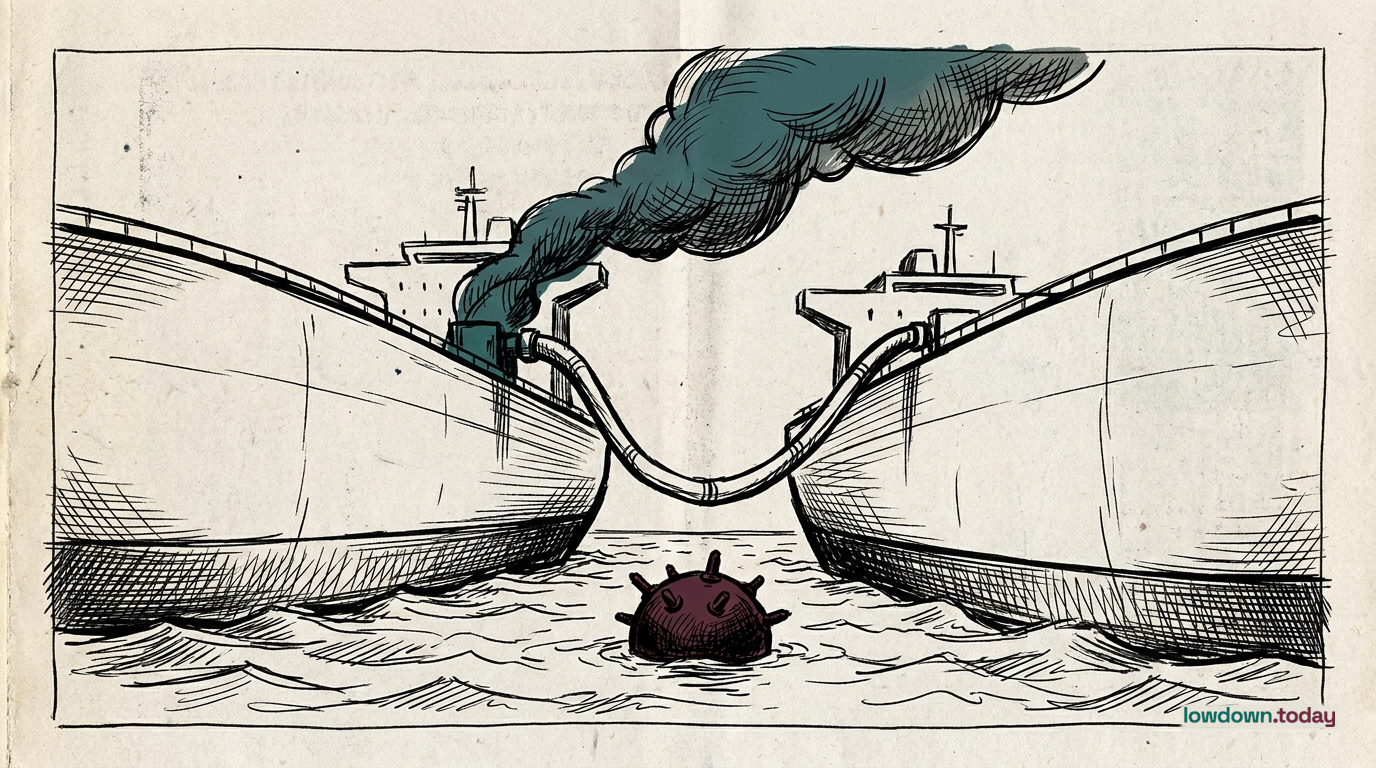
With Hormuz and Bab el-Mandeb both hostile at once, war-risk underwriters face their first dual-chokepoint pricing problem; the rerouting hedge that absorbed one closure is gone for Israeli-linked hulls. Any deal that reopens Hormuz without a Houthi stand-down clause delivers only partial shipping relief.
Russia and China
Russia and China
Russia and China met IAEA chief Grossi jointly in Geneva on 5 June to coordinate an advance blocking position against Washington's censure resolution, the first documented instance of proactive pre-session obstruction rather than reactive post-vote dissent. Beijing's move came four days after OFAC designated Shanghai Qianye Energy under Iran energy sanctions.
Saudi Arabia
Saudi Arabia
Saudi Arabia was left out of the emergency $4.01 billion Patriot waiver Qatar received on 2 May as its own PAC-3 stocks ran near-empty from intercepting Iranian salvoes over Aramco facilities. Riyadh is on a standard 18-month FMS queue behind a production line booked through 2030, with no equivalent priority to Qatar's Al Udeid basing role.
Houthis (Ansar Allah)
The Houthis declared a complete ban on Israeli Red Sea navigation on 8 June and struck Jaffa, their first attack on Israeli territory since April, seven days after the Tasnim authorisation to activate other fronts including Bab el-Mandeb. The declaration put both chokepoints under hostile authority simultaneously.
Iran
Iran
Iran agreed the 9 June mutual halt after the Mahshahr exchange and coordinated with Russia and China to block Washington's IAEA censure resolution, using the Board as a second front while the bilateral pause held on the military one. Tehran's acceptance of the Lebanon carve-out contradicts the linkage position it stated on 1 June.
Benjamin Netanyahu and the IDF
Israel struck the Karun Petrochemical plant at Mahshahr on 8 June over Trump's explicit objection, then agreed a halt with Iran the following day scoped on Israeli terms with Lebanon carved out. Netanyahu's posture is that the IDF will not accept Iranian missile factories as off-limits regardless of US diplomatic timelines.