Skip to content
Briefings are running a touch slower this week while we rebuild the foundations.See roadmap
Iran Conflict 2026
7MAR

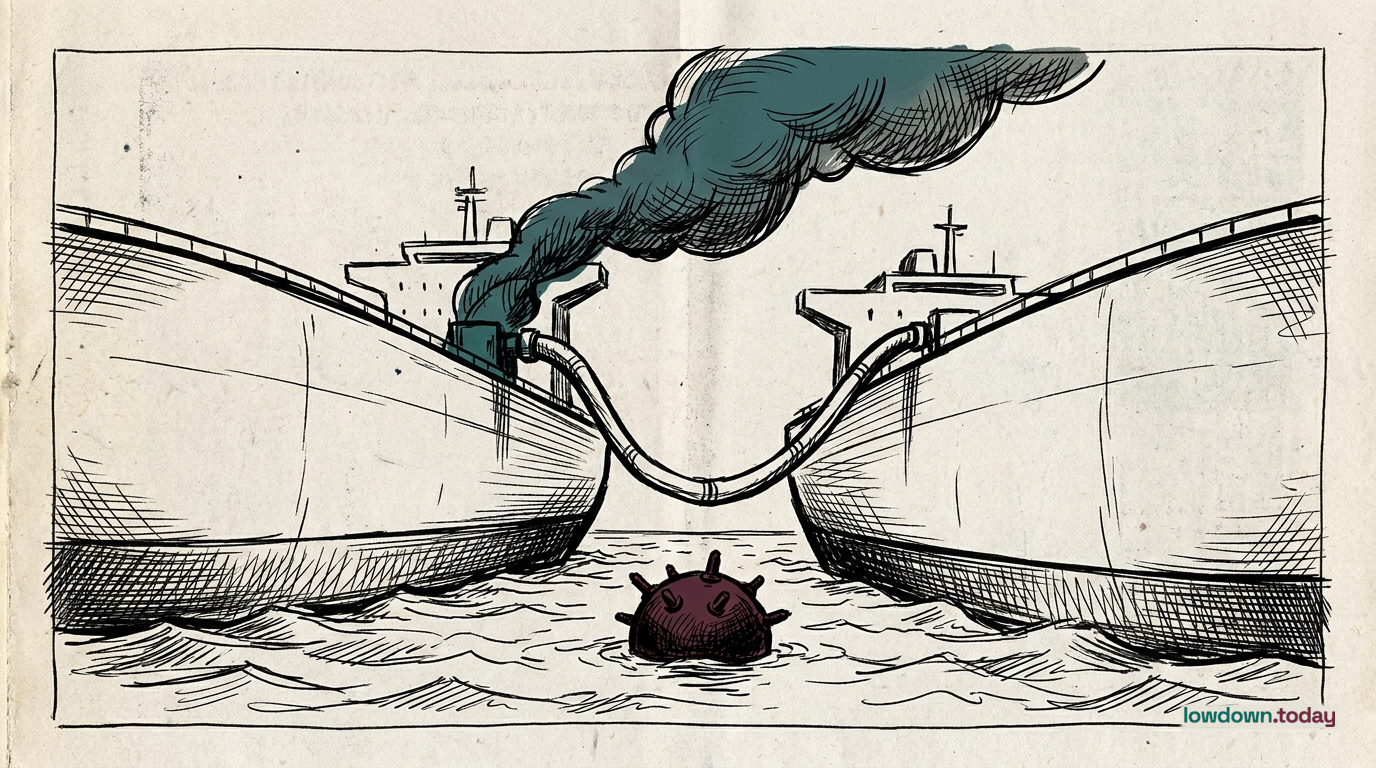
Tankers self-impose Hormuz blockade

1 min read
07:34UTC

Oil tankers began voluntarily avoiding the Strait of Hormuz following the 28 February 2026 strikes on Iran, achieving a partial chokepoint effect through commercial risk calculation rather than Iranian military interdiction.

ConflictDeveloping
Key takeaway

Commercial tanker avoidance of Hormuz achieves partial supply disruption without requiring Iranian military action, and will reverse rapidly once a credible de-escalation signal appears.

Voluntary avoidance of Hormuz by tanker operators achieves, in functional terms, some of the same supply-disruption effects as an Iranian blockade — without requiring Iran to take the naval action that would have constituted a direct casus belli for further US military response.

Approximately 20 million barrels per day transited Hormuz in 2025 — around 20% of global oil supply and 30% of global liquefied natural gas. Voluntary tanker avoidance does not halt all transit, but it reduces throughput and drives insurance premiums on vessels that do proceed to prohibitive levels. Lloyd's of London and other marine war-risk insurers will reclassify the Gulf as a war-risk zone within hours of the strikes, adding several hundred percentage points to insurance costs and making many voyages commercially unviable even if the physical route remains open.

The difference between voluntary avoidance and a formal Iranian blockade is reversibility. Commercial tanker operators are risk-averse but economically rational: if the military situation stabilises or a credible de-escalation signal emerges, traffic will resume within days. A formal Iranian blockade would require negotiated lifting and military verification, potentially taking weeks or months. Voluntary avoidance is therefore a more moderate and more reversible disruption than the worst-case scenario — which is precisely why markets are pricing $80–100 rather than $150–200.

What could happen next?
  • Meaning

    Short term · Assessed
  • Meaning

    Short term · Assessed
  • Meaning

    Short term · Assessed
First Reported In

Update #2 · Five cities struck on opening night

Washington Post· 28 Feb 2026
Read original
Causes and effects
This Event
Tankers self-impose Hormuz blockade
Tanker avoidance of Hormuz, through which approximately 20% of global oil transits, creates immediate supply disruption risks and freight cost spikes.
Different Perspectives
Gulf shipping and insurance markets
With Hormuz and Bab el-Mandeb both hostile at once, war-risk underwriters face their first dual-chokepoint pricing problem; the rerouting hedge that absorbed one closure is gone for Israeli-linked hulls. Any deal that reopens Hormuz without a Houthi stand-down clause delivers only partial shipping relief.
Russia and China
Russia and China
Russia and China met IAEA chief Grossi jointly in Geneva on 5 June to coordinate an advance blocking position against Washington's censure resolution, the first documented instance of proactive pre-session obstruction rather than reactive post-vote dissent. Beijing's move came four days after OFAC designated Shanghai Qianye Energy under Iran energy sanctions.
Saudi Arabia
Saudi Arabia
Saudi Arabia was left out of the emergency $4.01 billion Patriot waiver Qatar received on 2 May as its own PAC-3 stocks ran near-empty from intercepting Iranian salvoes over Aramco facilities. Riyadh is on a standard 18-month FMS queue behind a production line booked through 2030, with no equivalent priority to Qatar's Al Udeid basing role.
Houthis (Ansar Allah)
The Houthis declared a complete ban on Israeli Red Sea navigation on 8 June and struck Jaffa, their first attack on Israeli territory since April, seven days after the Tasnim authorisation to activate other fronts including Bab el-Mandeb. The declaration put both chokepoints under hostile authority simultaneously.
Iran
Iran
Iran agreed the 9 June mutual halt after the Mahshahr exchange and coordinated with Russia and China to block Washington's IAEA censure resolution, using the Board as a second front while the bilateral pause held on the military one. Tehran's acceptance of the Lebanon carve-out contradicts the linkage position it stated on 1 June.
Benjamin Netanyahu and the IDF
Israel struck the Karun Petrochemical plant at Mahshahr on 8 June over Trump's explicit objection, then agreed a halt with Iran the following day scoped on Israeli terms with Lebanon carved out. Netanyahu's posture is that the IDF will not accept Iranian missile factories as off-limits regardless of US diplomatic timelines.