Skip to content
Briefings are running a touch slower this week while we rebuild the foundations.See roadmap
Iran Conflict 2026
5MAR

Australia deploys C-17, rules out combat

2 min read
15:17UTC

Canberra deployed transport planes to extract nationals from the Gulf while explicitly foreclosing any combat role — a boundary even the UK declined to draw.

ConflictDeveloping
Key takeaway

The KC-30A tanker's inclusion signals Australia is quietly enabling allied air operations beyond its stated evacuation mandate, creating a gap between official non-combat policy and operational contribution.

Australia deployed a C-17A Globemaster heavy-lift transport and a KC-30A Multi-Role Tanker Transport to the region for evacuation operations. Defence Minister Richard Marles stated explicitly that Australia would not participate in combat.

The C-17A carries approximately 77 tonnes or 134 passengers; the KC-30A doubles as an air-to-air refuelling platform and a passenger transport. Both are standard Australian Defence Force assets for non-combatant evacuation — the kind of operation Canberra has run from Lebanon in 2006, Libya in 2011, and Kabul in 2021. The deployment itself is unremarkable. Marles's language is not.

Britain deployed four Typhoon jets to Qatar for what London called 'defensive operations' — a formulation that leaves operational room. France authorised US use of its bases and sent its carrier. Australia, a founding AUKUS partner, a Five Eyes intelligence-sharing member, and host to US military facilities including the Pine Gap joint intelligence base, chose the narrowest possible commitment: logistics aircraft, no weapons, no ambiguity. The US State Department's departure advisory covering 16 countries applies to a region where tens of thousands of Australian nationals live and work, concentrated in the UAE and Qatar. Marles's deployment addresses that evacuation requirement without accepting the political or operational risk of combat involvement in a war Canberra did not initiate.

The distinction matters because it answers a question the conflict is forcing on every US ally: what does solidarity require when the senior partner is at war? Australia's answer — humanitarian presence, combat absence — sits between New Zealand's silence and Britain's armed deployment. For a government that signed the AUKUS submarine agreement precisely to deepen its US security relationship, the combat exclusion is a deliberate calibration, not an oversight.

Deep Analysis

In plain English

Australia sent two aircraft: a large transport plane to move people out of the Gulf, and a refuelling tanker that tops up other aircraft mid-flight. Evacuation missions don't need tankers — tankers are for extending the range of fighter jets and other military planes. Including the KC-30A suggests Australia may be refuelling allied aircraft in the region, which is a military support role even if no Australian pilot pulls a trigger.

Deep Analysis
Synthesis

The tanker-transport pairing is not an improvised response but a practised Australian formula for contributing alliance value below the declared-combat threshold. Its repeated use — Afghanistan, Iraq, now the Gulf — suggests it has become institutionalised in Australian contingency planning, raising the question of whether Canberra's 'non-combat' declarations carry operational meaning or are primarily domestic political instruments.

Root Causes

Australia's ANZUS treaty obligations and Five Eyes intelligence integration create structural pressure to contribute tangible capability in any US-led military operation, regardless of stated combat stance. ASPI analysis of past operations shows Australia has consistently resolved this tension by contributing logistics, intelligence, and enabling assets — a formula that satisfies Washington without triggering the domestic anti-war response that a combat declaration would provoke.

Escalation

Domestically contained: the 'no combat' statement is designed to foreclose escalation pressure on the Albanese government. However, if the KC-30A is confirmed to be refuelling US or allied strike aircraft, the political and legal distinction collapses — creating a potential domestic political crisis that could force Australia to withdraw the tanker, weakening allied air sustainment at a critical moment.

What could happen next?
  • Meaning

    Australia's deployment confirms the 'non-combat contributor' role is a standing Australian contingency posture, not an ad hoc decision — indicating Canberra had options pre-planned for Gulf escalation.

    Immediate · Assessed
  • Risk

    If KC-30A tasking for allied combat aircraft becomes publicly confirmed, the government's 'no combat participation' position becomes legally and politically untenable, potentially forcing withdrawal of the tanker capability.

    Short term · Suggested
  • Precedent

    Establishes a replicable template for middle powers (Canada, Japan, South Korea) to contribute coalition value without crossing declared-combat thresholds — a model others will likely replicate.

    Medium term · Suggested
First Reported In

Update #22 · IRGC drones hit Azerbaijan; CIA link cut

Sky News· 5 Mar 2026
Read original
Different Perspectives
Gulf shipping and insurance markets
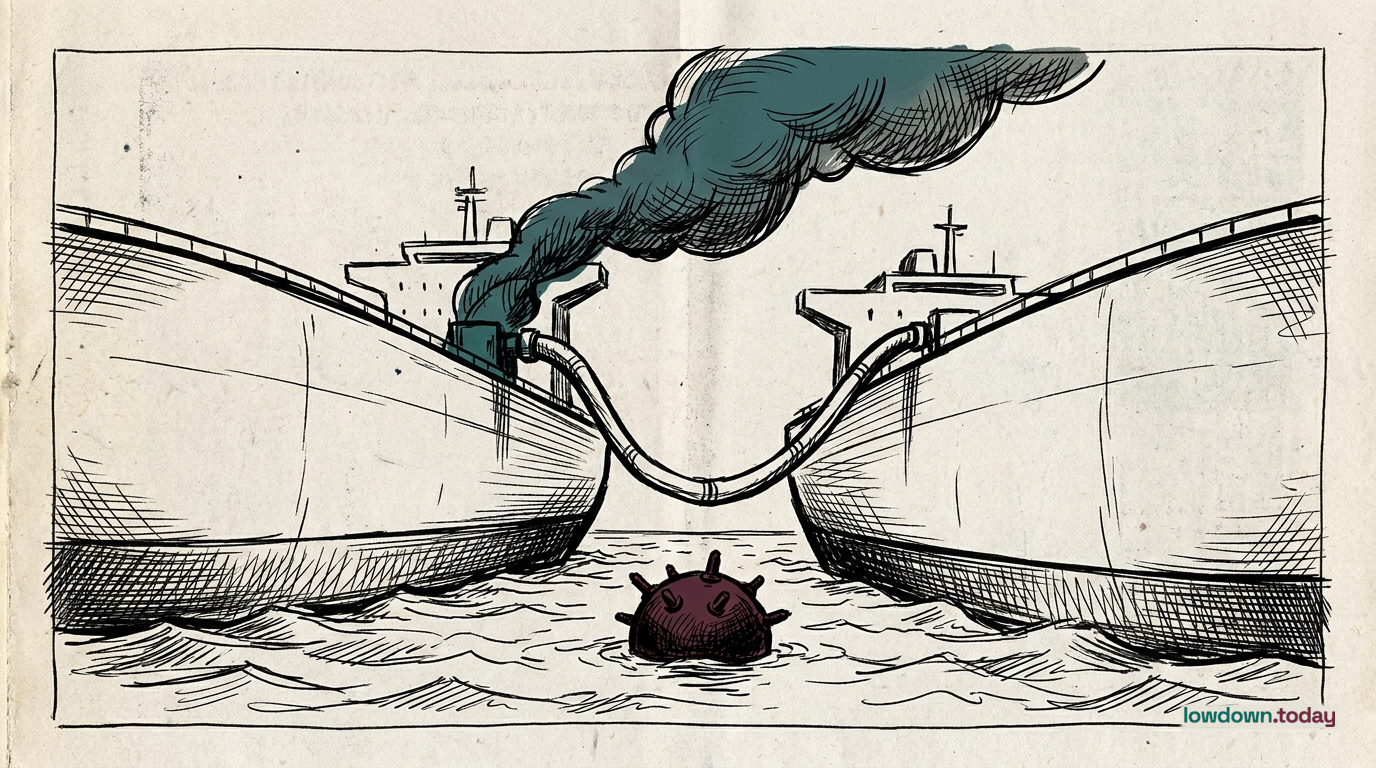
With Hormuz and Bab el-Mandeb both hostile at once, war-risk underwriters face their first dual-chokepoint pricing problem; the rerouting hedge that absorbed one closure is gone for Israeli-linked hulls. Any deal that reopens Hormuz without a Houthi stand-down clause delivers only partial shipping relief.
Russia and China
Russia and China
Russia and China met IAEA chief Grossi jointly in Geneva on 5 June to coordinate an advance blocking position against Washington's censure resolution, the first documented instance of proactive pre-session obstruction rather than reactive post-vote dissent. Beijing's move came four days after OFAC designated Shanghai Qianye Energy under Iran energy sanctions.
Saudi Arabia
Saudi Arabia
Saudi Arabia was left out of the emergency $4.01 billion Patriot waiver Qatar received on 2 May as its own PAC-3 stocks ran near-empty from intercepting Iranian salvoes over Aramco facilities. Riyadh is on a standard 18-month FMS queue behind a production line booked through 2030, with no equivalent priority to Qatar's Al Udeid basing role.
Houthis (Ansar Allah)
The Houthis declared a complete ban on Israeli Red Sea navigation on 8 June and struck Jaffa, their first attack on Israeli territory since April, seven days after the Tasnim authorisation to activate other fronts including Bab el-Mandeb. The declaration put both chokepoints under hostile authority simultaneously.
Iran
Iran
Iran agreed the 9 June mutual halt after the Mahshahr exchange and coordinated with Russia and China to block Washington's IAEA censure resolution, using the Board as a second front while the bilateral pause held on the military one. Tehran's acceptance of the Lebanon carve-out contradicts the linkage position it stated on 1 June.
Benjamin Netanyahu and the IDF
Israel struck the Karun Petrochemical plant at Mahshahr on 8 June over Trump's explicit objection, then agreed a halt with Iran the following day scoped on Israeli terms with Lebanon carved out. Netanyahu's posture is that the IDF will not accept Iranian missile factories as off-limits regardless of US diplomatic timelines.